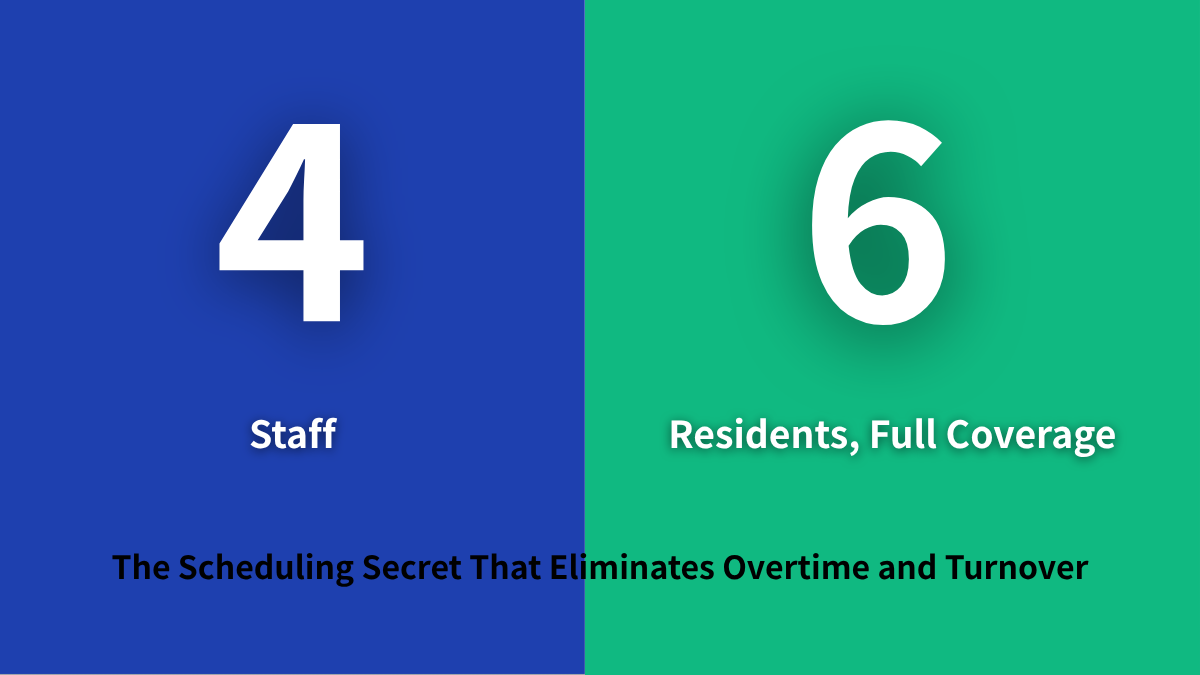
4 Staff, 6 Residents, Full Coverage: The Hour-by-Hour Schedule That Proves Small Facilities Don’t Need Big Teams
Resources | Read Time: 8 min | Author: Koujirou Nagata
“You can’t run a care facility with just four people.” I hear this from every aspiring owner. They’re wrong. My facility has operated on a 4-person team for 17 years. The secret isn’t more staff—it’s better scheduling.
## “We Need More Staff” Is Almost Always a Design Problem, Not a Staffing Problem
The most common complaint I hear from care facility operators is: “We don’t have enough people.” In most cases, they’re wrong. They don’t have a staffing shortage. They have a scheduling failure.
Staff are present during quiet periods when one person would suffice. Then during peak times—morning care, meals, evening routines—there aren’t enough hands. This imbalance creates a facility that feels permanently overwhelmed, no matter how many people you hire.
The solution is not adding headcount. It’s redesigning how time is allocated.
## The Complete Hour-by-Hour Schedule That Runs My Facility
This is the actual daily schedule operating at my facility. It has been refined over 17 years and works consistently.
6:00 – 8:00 AM | Morning Care | 2 Staff
Wake-up assistance, grooming, dressing, medication confirmation. This is the busiest window of the day. One staff member handles wake-up care while the second begins breakfast preparation. If these roles overlap or blur, the entire morning falls behind and never recovers.
8:00 – 9:00 AM | Breakfast | 2 Staff
Meal service, feeding assistance, medication administration, cleanup. Meals are the highest-risk period for choking and falls. Reducing staff during meals is not a cost optimization—it’s a liability.
9:00 – 11:30 AM | Morning Activities | 1–2 Staff
Bathing assistance, recreation, cleaning, laundry. This is where the first window of breathing room opens. Bathing can be handled by one person. The second handles facility maintenance tasks. Facilities that keep two people on active care during this window are overspending without improving safety.
11:30 AM – 1:00 PM | Lunch | 2 Staff
Preparation, service, cleanup, meal documentation. Same principle as breakfast: meals require full staffing. No exceptions.
1:00 – 3:00 PM | Rest Period & Documentation | 1 Staff + Rotating Breaks
This is the design pivot of the entire day. Residents rest after lunch. During this quiet window, staff rotate breaks and complete all documentation—care records, family communications, incident logs. Facilities that fail to use this window for paperwork create overtime. Facilities that use it well eliminate overtime entirely.
3:00 – 5:00 PM | Afternoon Activities | 1–2 Staff
Snacks, light recreation, walks. A relaxed period that can often run with a single staff member, depending on resident needs.
5:00 – 7:00 PM | Dinner & Bedtime Prep | 2 Staff
Dinner service, medication, toileting, changing. This is the second peak alongside morning care. Two staff are mandatory. Cutting corners here leads directly to incidents and complaints.
7:00 – 9:00 PM | Evening Transition | 1–2 Staff
Bedtime assistance and handover to the night shift. Thorough information transfer is critical—every detail about each resident’s day must reach the night worker.
9:00 PM – 6:00 AM | Night Shift | 1 Staff
Scheduled rounds every two hours, call bell response, rest between rounds. Emergency situations escalate to the owner’s direct phone line.
## Why This Works: The One Principle Behind Everything
The entire system runs on a single principle: concentrate staff during peak demand and minimize during low demand.
Peak times are morning care, every meal, and evening routines. These get two staff, always. Everything else operates with one or two, depending on the situation.
This rhythm—surge, recover, surge, recover—is what makes four people sufficient. Without it, six people wouldn’t be enough.
## The Three Mistakes That Make Any Team Size Feel Inadequate
• Maintaining two or more staff at all times: During quiet periods, this wastes payroll without improving care. That money comes directly from your profit margin.
• Failing to manage break times: If breaks aren’t scheduled during the natural lull after lunch, they eat into productive hours and create coverage gaps.
• Postponing documentation: Records pushed to end of day become overtime. Overtime becomes burnout. Burnout becomes turnover.
The result is always the same: increased labor costs, exhausted staff, and eventually, resignations. And the owner concludes, “We need more people.” They don’t. They need a better schedule.
## The Bottom Line
Whether four people can run a care facility is not a question of headcount. It’s a question of design.
Break the day into its demand peaks and valleys. Staff the peaks. Minimize the valleys. Use quiet time for recovery and paperwork. Do this, and four people is more than enough. Fail to do this, and no number of staff will ever feel sufficient.
Before you hire another person, redesign your schedule. That’s where the profit is.
—
## The Real Challenge: Staff Retention
A perfect schedule means nothing if your staff quit after 6 months.
The real challenge isn’t the schedule—it’s keeping your team stable enough to execute it consistently.
Over 17 years, I’ve reduced staff turnover from 40% to 3%. The difference wasn’t luck or culture talks. It was systematic salary design, clear advancement paths, and predictable hours.
The same principles that make a 4-person team sufficient—clear peak times, structured breaks, documented processes—are what create stability and keep your best people from leaving.
When staff know exactly when they’ll be busy, when they’ll rest, and when their work is done, they stay. When they’re exhausted by unclear schedules and constant overtime, they leave within months.
Design matters. Not just for efficiency, but for the people who execute it.
—
## Want the Complete Strategy?
This article covers scheduling. But sustainable staffing requires more: salary design for your market, interview methods that predict retention, rotation templates that prevent burnout, and the compliance frameworks that keep your facility stable.
I’ve condensed 17 years of staffing strategy into a practical guide. It includes:
• Salary Design Templates for Vietnam, Thailand, and Indonesia
• Staff Interview Scorecard with proven hiring patterns
• Shift Rotation Planner (automated Excel)
• Turnover Prevention Checklist (the 7 critical mistakes)
Available on Gumroad. Link in bio.
About the author
Koujirou Nagata
I’m a Japanese care facility operator based in Kobe, Japan. Over 17 years, I built three small-scale residential care homes in the U.S., sold two of them for $2.7M in a 2022 M&A exit, and currently operate a third. My staff turnover has held at roughly 3% — against a U.S. industry average of 34.53% — and the majority of my admissions have come through family referrals rather than paid marketing.
I now help U.S. and ASEAN operators of small-scale residential care homes — board and care homes, adult family homes, and similar facilities — apply the same operating methods to their own launches and expansions. The resources I’ve built reflect what I actually use, not what looks good on paper.
More at smallcarefacility.com
Two ways forward
Take what you need from here.
If you’re starting
The Care Facility Starter Kit
Six free guides I use myself in the operation of small-scale care facilities — financial planning, property evaluation, the first 90 seconds of family tours, and referral partner outreach. The materials I share with operators who reach out to me directly.
6 PDFs · Pay what you want · Instant download
If you’re past the basics
Complete USA + ASEAN Care Business Bundle
Six in-depth operator guides covering USA market entry, state selection across 9 states, the full financial model, staff hiring & retention, and ASEAN market entry — plus 16 working Excel templates I use myself: hiring scorecard, financial simulator, 1-on-1 tracker, retention analytics, and more.
View the Complete Bundle — $167
6 guides + 16 Excel templates · One-time purchase · Instant download
Koujirou Nagata · 17 years operating small-scale care facilities · 3 facilities built · $2.7M M&A exit · Currently operating
Koujirou Nagata
17 years operating small-scale care facilities · 3 facilities built · $2.7M M&A exit · Currently operating