Maria was four months into running her care facility when her bank account dropped below $1,200.
Two residents. Six beds. Rent at $3,200 a month. Staff payroll due the following week. That night, she called her family. “I might have to close,” she told them.
What had gone wrong?
Not the quality of care. Not her commitment to residents. The residents were satisfied. The social workers spoke well of her. The problem was exactly one thing:
She had never once simulated the moment the money would run out.
Maria’s story is a composite based on real events. But the wall she hit is one I’ve seen more AFC operators collide with than I can count.
If you’re considering opening a facility — or you’ve just opened one and you’re watching the cash position with growing unease — this article is written for you.
The funding problem can’t be solved by determination alone. But it can be solved, reliably, with the right knowledge and the right sequence. Let’s work through it.
The Number Nobody Warned You About: What Opening a Care Facility Actually Costs
Underestimating startup costs is the most common mistake first-time AFC operators make. The feeling that it will “work out somehow” does not survive contact with real numbers.
Opening a small residential care facility for 6 to 10 residents typically involves five categories of cost:
- Property costs: First month, last month, security deposit, and broker fees. Even for a rental, several months of rent leave the account before a single resident arrives.
- Renovation and compliance: Accessible bathrooms, emergency exits, smoke detectors, handrails — whatever your state requires. This range runs from $5,000 to $40,000 depending on the property’s starting condition.
- Licensing, training, and background checks: State-dependent, but typically $2,000 to $8,000 when you add up the application fees, required training hours, and background check costs for everyone in the building.
- Initial equipment and supplies: Beds, linens, medical supplies, kitchen equipment. Buying used compresses this, but budget $3,000 to $10,000.
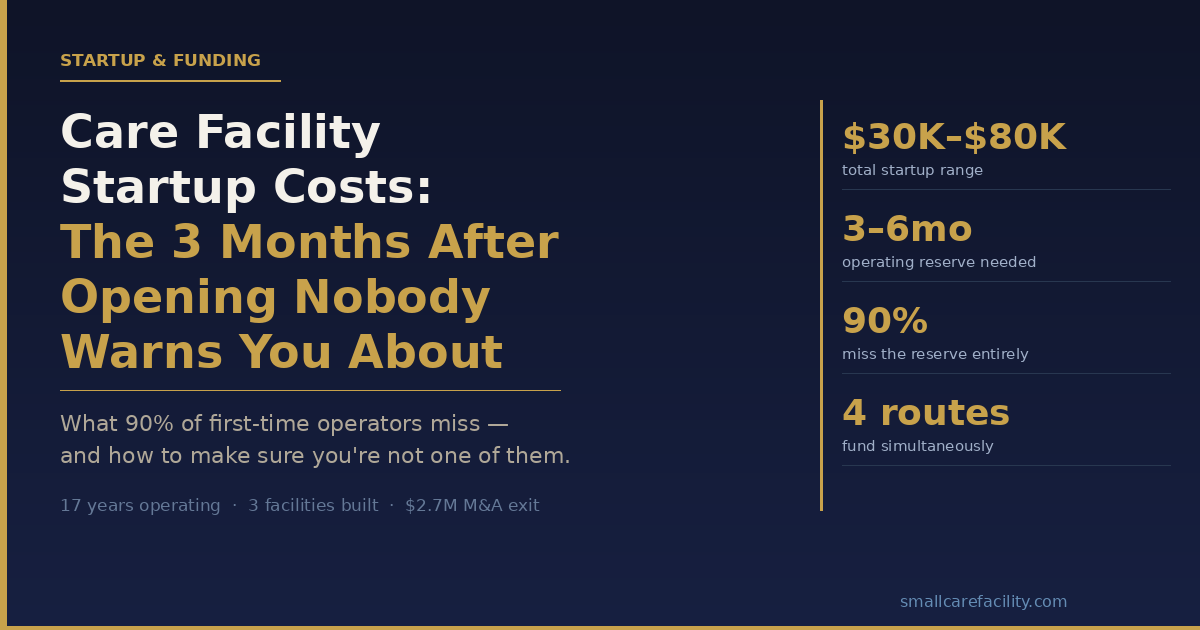
- Operating reserve — 3 to 6 months: This is the one that produces the Maria outcome when it’s missing. Rent, payroll, and utilities don’t pause while you fill your beds. If the reserve isn’t there, you run out of time before you run out of effort.
The realistic total: $30,000 to $80,000. This varies significantly by state, property, and scale — but the idea that a few thousand dollars is sufficient is one of the more expensive misconceptions in this industry.
If that number looks impossible, stay with me. You don’t have to arrive with all of it in your personal account.
Don’t Bet Everything on One Funding Route
The most common funding mistake isn’t choosing the wrong source. It’s choosing one source, waiting for the answer, and only moving to the next option after a rejection. That approach loses months.
The correct approach is parallel: multiple routes moving simultaneously.
- SBA loans (start here first): The federal Small Business Administration’s 7(a) loan program is designed for businesses like care facilities — healthcare services with tangible community value. Lower rates and longer repayment terms than conventional bank loans. The catch: approval takes 2 to 4 months. Start the process before you need the money. Find lenders at sba.gov/lendermatch.
- CDFIs — Community Development Financial Institutions: Nonprofit lenders focused on healthcare and underserved markets. More flexible underwriting than banks. Useful if your credit profile is complicated. Find your local CDFI at cdfi.org.
- Acquisition instead of startup: Buying an existing facility costs more upfront but delivers existing residents and revenue. If your priority is reaching profitability quickly, this path is worth serious consideration.
- Family and personal loans: Useful as bridge capital, but only with written terms — interest rate, repayment schedule, and what happens in a default scenario. Have an attorney draft it. The relationship depends on it.
- Grants: Search grants.gov for “elder care” and “adult family care.” Competitive and slow to arrive, but non-repayable. Start searching in parallel with everything else.
The sequence that works: Submit your SBA pre-qualification and contact two CDFIs in the same week. Begin the grant search in parallel. Fill any remaining gap with private capital. Run all four simultaneously.
Your Business Plan Is Not a Bank Document
When lenders ask for a business plan, most applicants spend their energy making it look credible to someone else. That’s the wrong use of the document.
A business plan’s real value is finding the problems in your model before the bank — or reality — finds them for you.
The act of writing a market analysis forces you to find out who else is operating in your area. The revenue projection forces you to model what happens if beds fill slowly. The risk section forces you to write down the things you’ve been avoiding thinking about. Where the comfortable assumptions crack under scrutiny — that’s where your plan needs more work before you open.
Resources for operators who haven’t written one before:
- SBA (sba.gov): Free business plan templates and step-by-step guides. Straightforward to follow even without a business background.
- SCORE (score.org): Retired executives providing free mentoring. If you can find someone with AFC or healthcare experience in the SCORE network, the feedback will be specific and useful.
- smallcarefacility.com Bundle: Business plan templates and financial projection worksheets built specifically for AFC operators. Cuts the build time significantly.
About the author
Koujirou Nagata
I’m a Japanese care facility operator based in Kobe, Japan. Over 17 years, I built three small-scale residential care homes in the U.S., sold two of them for $2.7M in a 2022 M&A exit, and currently operate a third. My staff turnover has held at roughly 3% — against a U.S. industry average of 34.53% — and the majority of my admissions have come through family referrals rather than paid marketing.
I now help U.S. and ASEAN operators of small-scale residential care homes — board and care homes, adult family homes, and similar facilities — apply the same operating methods to their own launches and expansions. The resources I’ve built reflect what I actually use, not what looks good on paper.
More at smallcarefacility.com
Two ways forward
Take what you need from here.
If you’re starting
The Care Facility Starter Kit
Six free guides I use myself in the operation of small-scale care facilities — financial planning, property evaluation, the first 90 seconds of family tours, and referral partner outreach. The materials I share with operators who reach out to me directly.
6 PDFs · Pay what you want · Instant download
If you’re past the basics
Complete USA + ASEAN Care Business Bundle
Six in-depth operator guides covering USA market entry, state selection across 9 states, the full financial model, staff hiring & retention, and ASEAN market entry — plus 16 working Excel templates I use myself: hiring scorecard, financial simulator, 1-on-1 tracker, retention analytics, and more.
View the Complete Bundle — $167
6 guides + 16 Excel templates · One-time purchase · Instant download
Koujirou Nagata · 17 years operating small-scale care facilities · 3 facilities built · $2.7M M&A exit · Currently operating
The Risk No Spreadsheet Can Capture
The money is in place. The plan is written. The license is approved. And then, within the first six months, something happens that none of the paperwork prepared you for.
A key staff member quits without notice. A family complaint arrives with no clear resolution process. An incident occurs at 2 AM and you’re the only one who can handle it. Decisions you never anticipated get made on the fly, every week.
Operational instinct can’t be purchased. But it can be built before you open.
- Volunteer or work short-term at an existing facility: Nothing replaces proximity to the actual work. Ask an owner directly for an informational interview — most will say yes.
- Attend industry events: McKnight’s Senior Living and NCAL host conferences where regulatory updates and peer connections happen in the same room. The relationships you build there become the network you call when things get hard.
- Join online operator communities: LinkedIn groups and Facebook communities for AFC and adult family home operators are active. Ask questions. Read the hard conversations. The operators a few years ahead of you are more accessible than you’d expect.
The gap between what you expect care facility operation to feel like and what it actually feels like is real. The smaller that gap when you open, the less it costs you.
What Happened to Maria
Maria borrowed $8,000 from her family and made that payroll. The following month, three new residents arrived through a social worker referral. By month five, she was profitable for the first time.
What she said afterward has stayed with me.
“If I had truly understood what three months of operating reserve meant before I opened — not just the number, but the reason for it — I would never have made that phone call.”
The depth of your preparation determines the stability of your operation. Capital, knowledge, operational instinct, referral relationships — these compound. The operators who take the time to build each one before opening find that the first year is hard in the expected ways, not in the ways that end businesses.
Steady progress. No shortcuts. That’s the approach that lasts.