The 17-Year System That Makes Caregivers Stay (When Everyone Else Walks Out the Door)
The Real Problem in Senior Care Isn’t What You Think
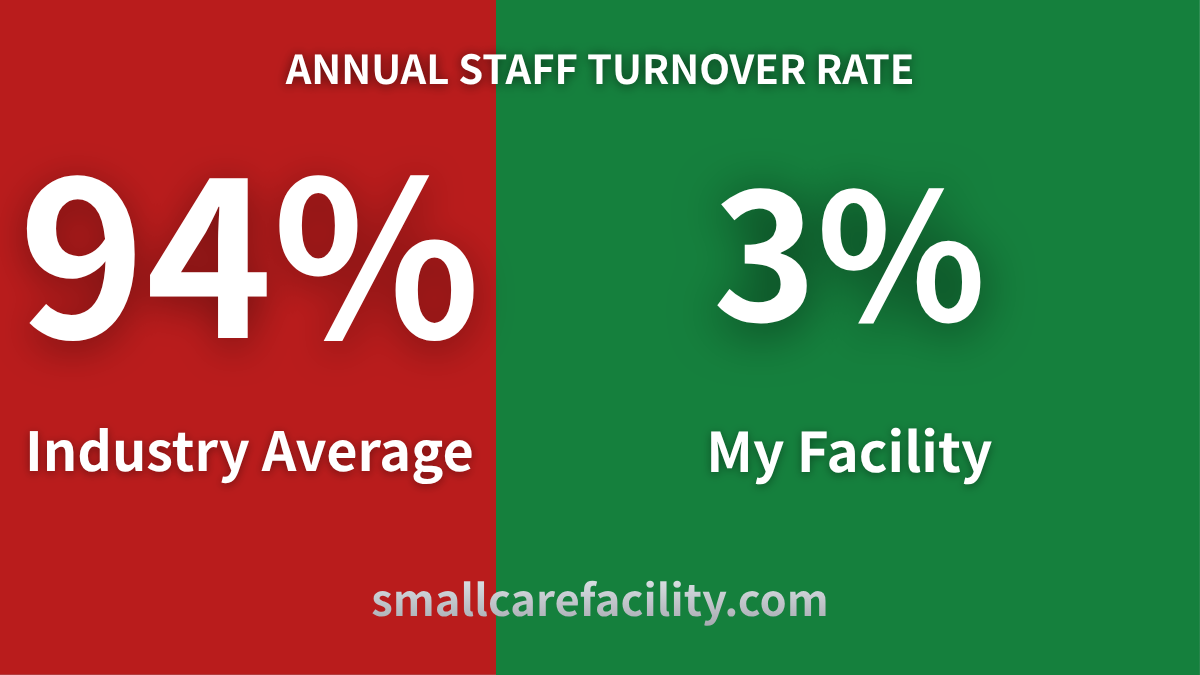
The average annual staff turnover rate in U.S. assisted living facilities is 90–94%.
That means nearly every caregiver working at a facility today will be gone within a year.
This isn’t exaggeration. It’s the documented industry reality.
My facility’s turnover rate? 3%. I’ve maintained this for 17 straight years.
People assume I’m hiring some special breed of caregiver. I’m not.
I’m building an environment people refuse to leave.
Why Caregivers Actually Quit (It’s Not What Owners Believe)
Before you can fix turnover, you have to understand it.
Most owners blame the work. “It’s hard. The hours are long. That’s why people leave.”
They’re wrong.
In 17 years of operating care facilities, I’ve identified three real reasons caregivers walk away:
- Their pay is at or below market rate
- Their voice doesn’t reach leadership
- They can’t see a future for themselves at your facility
Caregivers who feel fairly compensated, genuinely heard, and able to grow—they don’t quit. Even when the work is exhausting.
Turnover isn’t a job-difficulty problem. It’s an environment problem.
Strategy 1: Pay 10–20% Above Market Rate (And Save Money Doing It)
The single most powerful retention tool is paying above the going rate.
Most owners hear this and immediately think: “That destroys my margins.”
Let me show you the math.
The true cost of losing one caregiver:
- Recruitment advertising
- Interview time (yours and your team’s)
- Reduced productivity during training period
- Handover and onboarding costs
Total cost per departure: $4,000–$8,000 in the U.S. market.
Now compare that to a raise:
Increasing a caregiver’s monthly pay by $200 costs you $2,400 per year.
Preventing one departure saves $4,000–$8,000.
Higher wages aren’t an expense. They’re the cheapest insurance policy you can buy.
This isn’t sentiment. It’s pure arithmetic.
Strategy 2: Hold a One-on-One Meeting With Every Caregiver Every Month
Once a month, I sit down with every single caregiver—individually.
Not for performance reviews. Not for task assignments.
I ask three questions:
- How are you doing lately?
- Is anything frustrating you right now?
- What would you change about how we operate?
That’s it.
What this builds isn’t a feedback system. It’s a feeling:
“This company actually sees me.”
That single feeling determines whether someone stays for five years or quits in five months.
It costs no money. It requires 30 minutes per caregiver per month. And it’s the most powerful retention tool I’ve ever found.
Strategy 3: Hire for Character, Not Credentials
When I interview caregiver candidates, I don’t prioritize experience or certifications.
I prioritize character.
Care skills can be taught. The instinct to treat another human being with dignity cannot.
There’s one question I ask every candidate without fail:
“Tell me about a time in your career when someone deeply thanked you for what you did.”
If their eyes light up and they have a story ready—that person stays.
If they say “I can’t really think of one” or “I don’t remember”—I don’t hire them. They almost always leave within six months.
Every problem in your facility traces back to a hiring decision. That’s why I spend more time on hiring than almost anything else.
What Happens When Caregivers Actually Stay
When turnover drops to single digits, a chain reaction starts inside your facility:
- Service quality stabilizes (residents see the same trusted faces every day)
- Families develop deep trust and peace of mind
- Word-of-mouth referrals multiply
- Occupancy rates rise—and stay there
- Profit margins expand
Once this cycle starts turning, your facility enters a state I call “automatic occupancy.”
My facility is in that state right now. I spend zero dollars on advertising. The beds stay full anyway.
Investing in your caregivers is the highest-ROI marketing strategy in this entire industry.
The Bottom Line
The operators who win in senior care aren’t the ones with the best buildings, the best location, or the best marketing budgets.
They’re the ones who built a place caregivers refuse to leave.
Solve staffing, and you solve the business.
Ready to Build a Facility That Keeps Its Caregivers?
I’ve packaged the complete 17-year system I built into resources for USA and ASEAN care facility entrepreneurs:
About the author
Koujirou Nagata
I’m a Japanese care facility operator based in Kobe, Japan. Over 17 years, I built three small-scale residential care homes in the U.S., sold two of them for $2.7M in a 2022 M&A exit, and currently operate a third. My staff turnover has held at roughly 3% — against a U.S. industry average of 34.53% — and the majority of my admissions have come through family referrals rather than paid marketing.
I now help U.S. and ASEAN operators of small-scale residential care homes — board and care homes, adult family homes, and similar facilities — apply the same operating methods to their own launches and expansions. The resources I’ve built reflect what I actually use, not what looks good on paper.
More at smallcarefacility.com
Two ways forward
Take what you need from here.
If you’re starting
The Care Facility Starter Kit
Six free guides I use myself in the operation of small-scale care facilities — financial planning, property evaluation, the first 90 seconds of family tours, and referral partner outreach. The materials I share with operators who reach out to me directly.
Get the Starter Kit — Free6 PDFs · Pay what you want · Instant download
If you’re past the basics
Complete USA + ASEAN Care Business Bundle
Six in-depth operator guides covering USA market entry, state selection across 9 states, the full financial model, staff hiring & retention, and ASEAN market entry — plus 16 working Excel templates I use myself: hiring scorecard, financial simulator, 1-on-1 tracker, retention analytics, and more.
View the Complete Bundle — $1676 guides + 16 Excel templates · One-time purchase · Instant download
Koujirou Nagata · 17 years operating small-scale care facilities · 3 facilities built · $2.7M M&A exit · Currently operating
Koujirou Nagata
17 Years Operating Care Facilities in Japan | $2.7M M&A Success | Currently Operating Active Facilities | smallcarefacility.com