Are you still “considering” entering the care business?
That’s not a neutral position. Every day you stay on the sideline, you’re not standing still. You’re falling behind.
Loss aversion is keeping you stuck.
The human brain is more than twice as sensitive to loss as it is to gain. The fear of “what if it fails” drowns out the far more important question: what am I already losing by not moving?
Here’s what the numbers actually say:
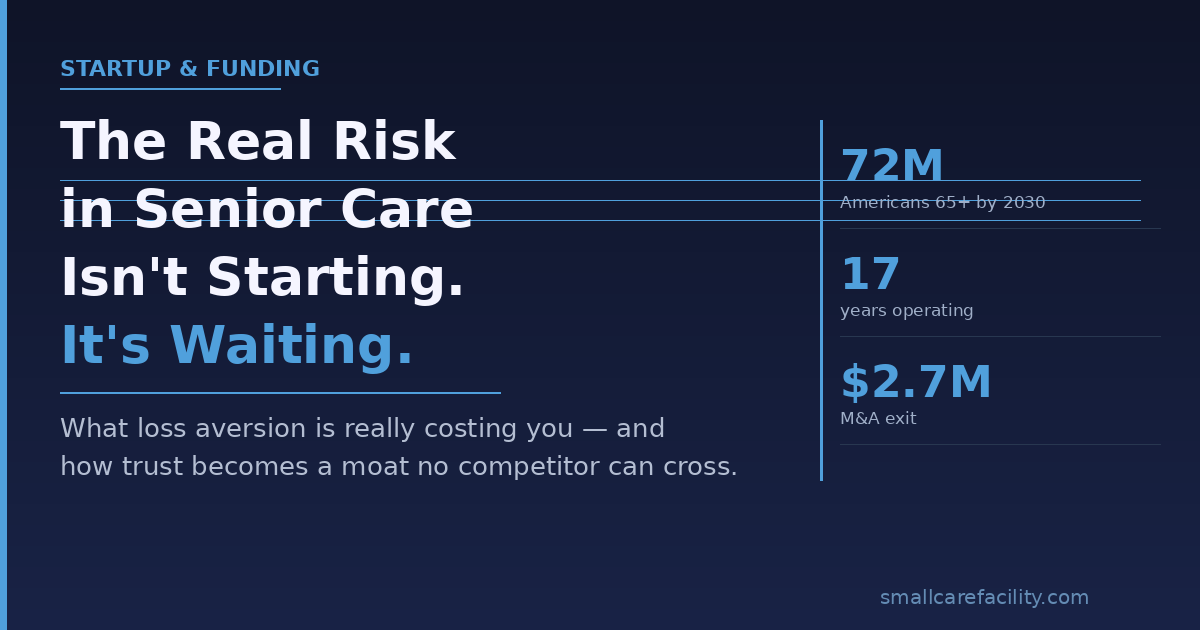
The U.S. population aged 65 and older will reach 72 million by 2030 — up from roughly 58 million today.
In many regions, small residential care facilities already have waitlists. Demand is outpacing supply.
Every month you delay is a month your future competitors are building referral networks, operational credibility, and regulatory track records you won’t be able to buy.
The risk of entering is real. But so is the risk of staying out. Most people only calculate one of them.
The Opportunity Cost of Waiting — In Real Numbers
I’m not speaking in abstractions. I operated small-scale residential care facilities in the United States for 17 years before exiting through an M&A transaction. What I built had real value — not because I had industry connections or a healthcare degree when I started, but because I started.
Delaying entry by even one year doesn’t simply mean “starting one year later.” It means losing:
One year of operational history — the credibility that makes referral sources trust you
One year of referral network development — the relationships that fill beds
One year of regulatory experience — the institutional knowledge that survives inspections
One year of competitive distance — the gap between you and the operators who are already building
In the care business, trust is not something you can purchase. It accumulates over time. The operators who are moving now are compounding that advantage every single day.
How I Actually Built Something Worth Exiting
I had no care industry credentials. No U.S. network. No insider knowledge. What I had was the willingness to start and the discipline to keep every small promise I made.
The facility stabilized not because of a breakthrough strategy, but because of repetition. Families got called back on time. Staff concerns got addressed. Inspection findings got resolved the same day. Small things, done consistently.
Eventually, the hospital social workers in our area started saying: “If it’s that facility, we can make the referral without hesitation.” Placement agencies began routing residents our way preferentially. That reputation — built one kept promise at a time — became a competitive moat that no new entrant could replicate quickly.
Compliance wasn’t the foundation of that trust. It was the proof of it.
1. A License Is Not a One-Time Event
Operating licenses in most states require regular renewal and are subject to scheduled and unannounced inspections. Inspectors evaluate a wide range of criteria:
Cleanliness and physical safety of the facility
Staff qualifications and training records
Resident documentation and care plan currency
Emergency preparedness protocols
Repeated serious violations can result in license suspension or revocation. The operators who treat every inspection as an unannounced visit — because it might be — are the ones who never have a bad one. That posture, sustained over years, becomes part of the facility’s identity.
2. Staff Credentials and Training Records: Aim for Flawless
Most states mandate specific certifications and training completion for care staff. CPR and first aid, dementia care training, and infection control are among the most common requirements. Documentation gaps are among the first things inspectors flag.
Build a system — even a simple spreadsheet — that tracks each staff member’s certifications, expiration dates, and training history. Renewals should never be a surprise. When your records are complete and current, inspections become routine rather than stressful.
3. Resident Rights Are a Culture, Not a Policy
U.S. law clearly defines the rights of residents in care facilities: the right to privacy, self-determination, grievance, and protection from abuse and neglect. These are not checkboxes. They are the values that should be visible in how your staff talks to residents, how care plans are written, and how families are treated when they raise concerns.
Facilities that embed resident rights into daily practice — rather than referencing them only during inspections — tend to have fewer complaints, stronger family relationships, and lower staff turnover. The compliance and the quality reinforce each other.
4. Regulations Change. Stay Ahead of Them.
Care regulations in the U.S. shift with administrations, budget cycles, and public health events. Medicaid reimbursement rates and minimum wage rules have direct operational impact and can change with relatively little notice.
Subscribe to your state agency’s newsletters. Join owner networks and industry associations in your state. Build relationships with operators who are a few years ahead of you. The operators who hear about regulatory changes early have time to adapt. The ones who learn about them during inspections don’t.
Compliance Is Not Defense. It’s Your Market Signal.
Every operator who stays licensed, passes inspections, and maintains complete records is sending a continuous signal to the market: this facility is trustworthy. Referral sources read that signal. Families read it. And over time, it becomes the reason your beds fill faster than a competitor’s.
The trust I built over 17 years — through renewals, inspections, staff advocacy, and consistency — is what created the exit. That trust was the asset. The building was just where it lived.
The operators moving now are building that asset today. Every day of delay is a day that asset doesn’t grow.
Today’s action is next year’s advantage. Next year’s advantage is a five-year moat.
About the author
Koujirou Nagata
I’m a Japanese care facility operator based in Kobe, Japan. Over 17 years, I built three small-scale residential care homes in the U.S., sold two of them for $2.7M in a 2022 M&A exit, and currently operate a third. My staff turnover has held at roughly 3% — against a U.S. industry average of 34.53% — and the majority of my admissions have come through family referrals rather than paid marketing.
I now help U.S. and ASEAN operators of small-scale residential care homes — board and care homes, adult family homes, and similar facilities — apply the same operating methods to their own launches and expansions. The resources I’ve built reflect what I actually use, not what looks good on paper.
More at smallcarefacility.com
Two ways forward
Take what you need from here.
If you’re starting
The Care Facility Starter Kit
Six free guides I use myself in the operation of small-scale care facilities — financial planning, property evaluation, the first 90 seconds of family tours, and referral partner outreach. The materials I share with operators who reach out to me directly.
Get the Starter Kit — Free6 PDFs · Pay what you want · Instant download
If you’re past the basics
Complete USA + ASEAN Care Business Bundle
Six in-depth operator guides covering USA market entry, state selection across 9 states, the full financial model, staff hiring & retention, and ASEAN market entry — plus 16 working Excel templates I use myself: hiring scorecard, financial simulator, 1-on-1 tracker, retention analytics, and more.
View the Complete Bundle — $1676 guides + 16 Excel templates · One-time purchase · Instant download
Koujirou Nagata · 17 years operating small-scale care facilities · 3 facilities built · $2.7M M&A exit · Currently operating