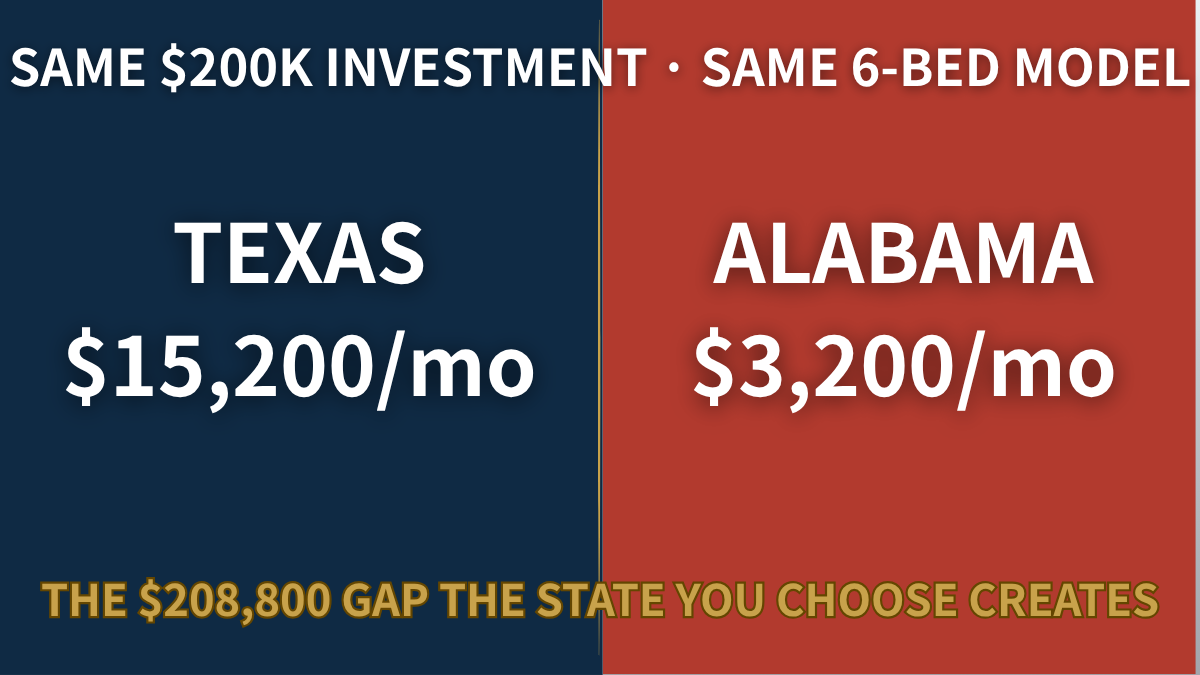
Why state selection is the single decision that creates a $208,800 profit gap — and how to choose right.
Why state selection is the most important decision you’ll make
Most entrepreneurs spend months preparing to open an assisted living facility. Staffing ratios. Floor plans. Licensing procedures. Then, almost as an afterthought, they decide which state to open in — usually based on where they already live or where the rent looks cheapest.
This is the most expensive mistake in the industry.
The state you choose determines whether the same 6-bed facility generates $15,200 a month in profit or only $3,200. Everything else — the property, the staff, the financial plan — is built on top of that single decision.
The $208,800 gap between two identical operators
Consider two entrepreneurs with the same business model, the same 6-bed capacity, and the same $200,000 initial investment. The only variable is the state they chose.
| Metric | Operator A (Texas) | Operator B (Alabama) |
|---|---|---|
| Monthly profit at full occupancy (6 residents) | $15,200 | $3,200 |
| Time to break-even | 2 months | 6 months |
| Cumulative 18-month profit | $230,400 | $21,600 |
| THE GAP | $208,800 | — |
Same model. Different state. $208,800 difference. This is not a rounding error — it’s the line between a profitable business and a failed one.
The 5 factors that determine state-level profitability
1. Medicaid reimbursement rates
Most U.S. assisted living revenue flows through state Medicaid waiver programs, and reimbursement rates vary dramatically by state. Some states pay $180 per resident per day. Others pay $60. Across a 6-bed facility, that gap translates to roughly $260,000 in annual revenue.
High-reimbursement states include Texas, Arizona, and Florida. Low-reimbursement states include Alabama, Mississippi, and many rural Midwestern markets.
2. Certificate of Need (CON) requirements
Some states require a Certificate of Need — a state-issued approval that must be obtained before opening. The CON process typically takes 12 to 18 months and costs $30,000 to $80,000 in legal fees.
CON-free states (Texas, Arizona, Colorado, Indiana) allow you to open within 90 days. CON states can delay your launch by a year or more before you serve your first resident.
3. Staffing cost differentials
Direct care wages range from $13 per hour in rural Mississippi to over $22 per hour in California and Washington. For a 6-bed facility staffed at two caregivers per shift, that wage gap produces an annual labor cost difference of more than $70,000.
4. Care manager network density
Most resident placements come from hospital discharge planners and care manager offices. States with dense healthcare infrastructure — Texas, Arizona, Florida — offer abundant referral channels, which means faster ramp-up to full occupancy.
5. Private-pay market strength
Medicaid sets the revenue floor. Private-pay residents drive the highest margins. In retirement-heavy markets with high household incomes (Texas, Arizona, Florida, and parts of the Carolinas), monthly private-pay rates of $4,500 to $6,500 are realistic.
A 4-step framework to evaluate any state
Research the target state’s Medicaid waiver program. Identify the current per-diem reimbursement rate and the waiver waitlist timeline.
Confirm Certificate of Need (CON) requirements. If a CON is required, budget 12 to 18 months and $30,000 to $80,000 into your plan.
Pull median direct care wages from the U.S. Bureau of Labor Statistics (BLS) for your target city. Model your labor cost at 2.2 caregivers per resident.
Call three major hospital discharge planning departments within 15 miles of your target facility location. Ask whether they place residents in small-scale residential care.
Five states worth evaluating first
Texas
No CON requirement, strong Medicaid waiver program, large senior population, and competitive labor costs in non-urban markets.
Arizona
One of the fastest-growing retirement destinations in the country, no CON requirement, strong private-pay demand in Scottsdale and Mesa.
Florida
The largest senior population in the U.S., powerful coastal private-pay market, and no state income tax.
North Carolina
Reasonable labor costs, no CON requirement for small-scale facilities, and increasing senior migration from the Northeast.
Indiana
Light regulatory burden, low real estate costs, and Medicaid reimbursement rates that are favorable relative to local cost of living.
What state selection actually means
State selection is not a background condition — it is the foundation on which property selection, staffing, and financial planning all rest.
Operators who get this decision right build profitable facilities. Operators who get it wrong spend years wondering why the numbers never add up — without ever realizing the root cause was the state they chose before they opened the door.
Get the full state-by-state analysis
This article covers the framework. The complete state-by-state analysis — Medicaid rates, CON requirements, wage data, and recommended markets for all 50 U.S. states — is included in the resources below.
About the author
Koujirou Nagata
I’m a Japanese care facility operator based in Kobe, Japan. Over 17 years, I built three small-scale residential care homes in the U.S., sold two of them for $2.7M in a 2022 M&A exit, and currently operate a third. My staff turnover has held at roughly 3% — against a U.S. industry average of 34.53% — and the majority of my admissions have come through family referrals rather than paid marketing.
I now help U.S. and ASEAN operators of small-scale residential care homes — board and care homes, adult family homes, and similar facilities — apply the same operating methods to their own launches and expansions. The resources I’ve built reflect what I actually use, not what looks good on paper.
More at smallcarefacility.com
Two ways forward
Take what you need from here.
If you’re starting
The Care Facility Starter Kit
Six free guides I use myself in the operation of small-scale care facilities — financial planning, property evaluation, the first 90 seconds of family tours, and referral partner outreach. The materials I share with operators who reach out to me directly.
Get the Starter Kit — Free6 PDFs · Pay what you want · Instant download
If you’re past the basics
Complete USA + ASEAN Care Business Bundle
Six in-depth operator guides covering USA market entry, state selection across 9 states, the full financial model, staff hiring & retention, and ASEAN market entry — plus 16 working Excel templates I use myself: hiring scorecard, financial simulator, 1-on-1 tracker, retention analytics, and more.
View the Complete Bundle — $1676 guides + 16 Excel templates · One-time purchase · Instant download
Koujirou Nagata · 17 years operating small-scale care facilities · 3 facilities built · $2.7M M&A exit · Currently operating
Koujirou Nagata
17 years operating small-scale care facilities · 3 facilities built · $2.7M M&A exit · Currently operating