1 AM. You can’t sleep.
Tomorrow morning, a notice from your state inspector might be waiting. You’ve been reading through new regulatory documents for two hours, switching between Google and YouTube, and you still can’t figure out what actually changed. The answer isn’t there.
Does that sound familiar?
Running a small residential care facility in the United States means fighting a constant battle against information isolation. Regulations vary by state. Industry standards shift. And if English isn’t your first language, the wall is even thicker.
Here’s the honest truth.
The information exists. The resources are there — more than most operators realize. The only question is whether you know where to find them.
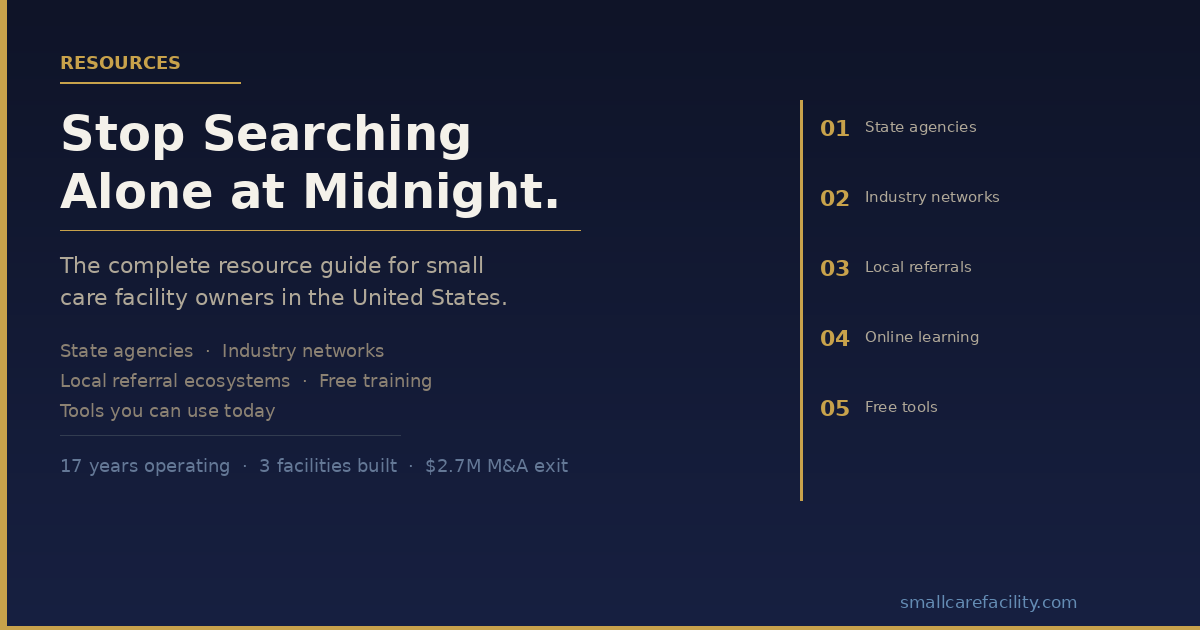
What follows is a curated list of the resources I’ve used myself and recommended to operators I work with. By the time you finish reading, that 1 AM panic should feel a little less familiar.
Your State Agency: Make This Your Home Base
Everything that governs your facility — license applications and renewals, inspection standards, Medicaid billing rules — flows from your state’s care oversight agency. Operating with a vague understanding of these requirements is how operators end up with costly surprises. Going directly to the primary source is the foundation of sustainable operations.
- California: CDSS (California Department of Social Services). The official source for RCFE and AFH licensing, inspection standards, and regulatory updates.
- Texas: HHSC (Health and Human Services Commission). AFH licensing and Medicaid provider registration.
- All other states: Search “[State name] adult family care license” in Google. You will land on the right page.
Sign up for your state agency’s newsletter. Regulatory changes arrive by email before they become enforcement problems. In a world where “I didn’t know” is never an acceptable answer, knowing first is a genuine operational advantage.
Build a real relationship with your state contact. Not as a formality — as a strategy. Response times change when they know your name.
Industry Associations and Professional Networks: Find the People in the Same Boat
If you feel like you’re fighting alone, it’s likely because you haven’t found your people yet.
State-level care facility associations offer member training, regulatory updates, and direct access to policy conversations that affect your operations. Joining one changes the speed at which information reaches you.
- CASA (California Assisted Living Association): The first call for California RCFE operators. Regulatory alerts, training events, and peer networks.
- McKnight’s Senior Living: The industry’s primary trade publication. Following their coverage alone keeps you current on policy, workforce, and operational trends across the country.
- Senior Living SMART: Practical content aimed at small and mid-size operators. Their podcast is worth adding to a commute.
LinkedIn is more useful than most operators treat it. There are active groups of care professionals — placement advisors, case managers, hospice operators, discharge planners — where the relationships that fill beds actually start.
A network isn’t something you use. It’s something you build over time. The case manager you connect with today may send you a resident three months from now.
Local Healthcare Networks: Where Referrals Actually Come From
Most operators who struggle with occupancy believe the problem is marketing. It usually isn’t.
The residents who fill small care homes come overwhelmingly through referrals — from hospital social workers, discharge planners, case managers, and hospice providers. Building your presence inside that referral ecosystem is the most direct path to stable occupancy, and it costs nothing but time.
- Area Agency on Aging (AAA): Federally funded elder care coordination hubs in every region. They aggregate local care service information and are one of the first stops for families navigating care decisions. Search eldercare.acl.gov to find your nearest office.
- Hospital social workers and discharge planners: These professionals are looking for immediate placement options for patients leaving acute care. Being the operator who answers the phone and has a bed available changes your relationship with them permanently.
- Hospice and home health agencies: Not competitors — partners. Operators who serve overlapping populations in the same geography become natural referral sources for each other.
Becoming known in this network — not famous, just known — is the most reliable way to improve occupancy without spending money on advertising.
Online Learning and Training: The Operators Who Keep Growing Are the Ones Who Last
The moment you stop learning as an operator, your facility begins a slow decline. This is true in every industry, but it’s especially true in one where regulations, medical standards, and family expectations all shift continuously.
- Dementia Care Specialist (DCS) program: A recognized credential in dementia care. Holding it signals something meaningful to referral partners and families — and earns trust that marketing money can’t buy.
- Alzheimer’s Association (alz.org): Free training programs for operators and staff. Practical, clinically grounded, and directly applicable to daily care decisions.
- YouTube and podcasts: Search “adult family care” or “senior care business” and you’ll find operators sharing real operational experience. Useful for commutes and downtime.
- smallcarefacility.com: A resource platform built specifically for small-scale residential care operators. Licensing guidance, financial models, and operational frameworks — updated regularly and written from 17 years of hands-on experience.
One more thing worth saying directly.
The language barrier is no longer an excuse. AI tools like Claude and DeepL translate complex regulatory documents in seconds. The barrier isn’t the language anymore. It’s the willingness to read.
Resources You Can Use Today at smallcarefacility.com
Knowing about a resource and actually using it are two different things. Here is where to start.
- The Care Facility Starter Kit (free): Six operator tools I use myself — financial planning, property evaluation, the first 90 seconds of a family tour, and referral partner outreach. The same materials I share directly with operators who reach out. No email required.
- Complete USA + ASEAN Care Business Bundle ($167): Six in-depth guides and 16 working Excel templates covering USA market entry, state selection across 9 states, the full financial model, staff hiring and retention, and ASEAN market entry.
About the author
Koujirou Nagata
I’m a Japanese care facility operator based in Kobe, Japan. Over 17 years, I built three small-scale residential care homes in the U.S., sold two of them for $2.7M in a 2022 M&A exit, and currently operate a third. My staff turnover has held at roughly 3% — against a U.S. industry average of 34.53% — and the majority of my admissions have come through family referrals rather than paid marketing.
I now help U.S. and ASEAN operators of small-scale residential care homes — board and care homes, adult family homes, and similar facilities — apply the same operating methods to their own launches and expansions. The resources I’ve built reflect what I actually use, not what looks good on paper.
More at smallcarefacility.com
Two ways forward
Take what you need from here.
If you’re starting
The Care Facility Starter Kit
Six free guides I use myself in the operation of small-scale care facilities — financial planning, property evaluation, the first 90 seconds of family tours, and referral partner outreach. The materials I share with operators who reach out to me directly.
Get the Starter Kit — Free6 PDFs · Pay what you want · Instant download
If you’re past the basics
Complete USA + ASEAN Care Business Bundle
Six in-depth operator guides covering USA market entry, state selection across 9 states, the full financial model, staff hiring & retention, and ASEAN market entry — plus 16 working Excel templates I use myself: hiring scorecard, financial simulator, 1-on-1 tracker, retention analytics, and more.
View the Complete Bundle — $1676 guides + 16 Excel templates · One-time purchase · Instant download
Koujirou Nagata · 17 years operating small-scale care facilities · 3 facilities built · $2.7M M&A exit · Currently operating
The Decision to Stop Fighting Alone
There will be nights when running a small care facility in the United States feels like a solitary fight. You’re not wrong to feel that way — the information is scattered, the regulations are complex, and the support systems are hard to find.
But every AFC operator across the country is hitting the same walls and spending the same nights. The difference between the ones who burn out and the ones who build something durable isn’t talent or luck.
It’s whether they found the right resources before the wrong decisions caught up with them.
Pick one thing from this list. Open the AAA website. Follow McKnight’s Senior Living. Download the Starter Kit. Any of them.
You don’t have to carry all of this alone. The tools exist. Now you know where they are.