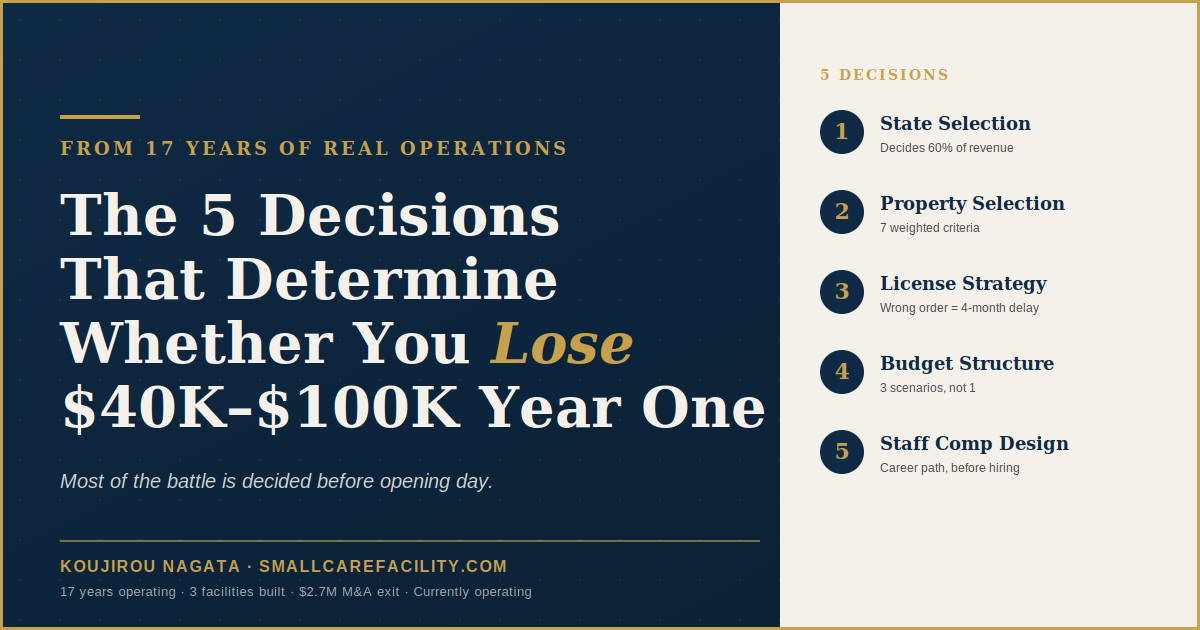
FROM 17 YEARS OF REAL OPERATIONS
Most of the battle is decided before opening day — and almost no one realizes it until the losses are already showing up on the P&L.
Most first-time small-scale care facility operators lose between $40,000 and $100,000 in their first eighteen months.
It is not because luck was against them. It is not because the market was wrong. It is because, before opening day, they made five specific decisions — and got each one wrong.
After 17 years operating small-scale care facilities, building three facilities, and completing a $2.7M M&A exit, I can tell you that the facilities that fail in year one share a common pattern. I have organized that pattern as five decisions. Each one is made before the doors ever open. Each one is, by then, almost impossible to reverse without significant cost.
Decision 1 — State selection
Sixty percent of your revenue is determined by which state you open in.
A six-bed Residential Care Facility for the Elderly (RCFE) in California and a six-bed licensed Adult Day Health facility in Texas are not the same business. The initial capital, working capital, margin profile, and regulatory burden are completely different.
Each of the nine major states — Florida, Arizona, North Carolina, Georgia, Oregon, Washington, New York, Texas, California — has its own economic structure. Choosing a state because you happen to live there, or because you have local familiarity, creates problems that may not be recoverable three years later.
Before selecting a state, you need to score five criteria: licensing cost, minimum wage, Medicaid reimbursement rate, 65+ population share, and regulatory density. Without that scoring, the state choice is essentially a guess — and it is the most expensive guess in the entire startup process.
Decision 2 — Property selection
Operators who choose a property because they “liked it” almost always run into cash flow trouble in years one and two.
Small-scale care facility property selection requires at least seven weighted evaluation criteria:
Location and demographics
Realistic renovation cost
Likelihood of license approval
Reasonable per-bed unit economics
Distance from adjacent competition
Exit strategy at the end of the lease or hold period
Psychological accessibility for families
When I was opening my second facility, I almost signed on the first property I toured — on intuition. When I went back and scored that property against three candidates using these seven criteria, it ranked last.
The property you would choose by feel and the property you would choose by score are often different properties. That gap is the difference between professional and amateur judgment.
Decision 3 — License strategy
Getting the order of licensing wrong will delay your opening by four months.
Most first-time operators move in this order: sign property lease, start renovations, then submit the license application.
This order is wrong.
The correct sequence is: pre-application meeting with the state regulator, secure the administrator certification, and then advance property selection and license application in parallel.
Across the major five states — Texas, North Carolina, Georgia, Florida, Arizona — each has a real-world average time from application to license issuance. The state’s published “processing time” and the actual months it takes are almost always different numbers. If you build your financial plan on the published number, your first-year cash flow will not survive contact with reality.
Decision 4 — Budget structure
A “$300,000 total budget” is essentially the same as no budget at all.
A meaningful budget structure separates five categories: pre-opening costs, renovation, initial equipment, initial staffing, and — most importantly — three to six months of working capital reserve.
It is the working capital reserve that operators underestimate. Without it, the facility runs out of cash about six months in, before occupancy has had time to ramp up.
Occupancy never ramps up on schedule. In my experience, base-case occupancy projections come in at 70–80% of plan in reality. That means if you finance the business off the base case, you are walking in with a 20–30% probability of cash shortage built into your model.
The defense against this is three-scenario modeling: pessimistic, base, optimistic. Build the cash plan against the pessimistic case. If the pessimistic case still survives, the business is fundable.
Decision 5 — Staff compensation design
Industry-average CNA turnover is above 40%. That is not “the reality of the industry.” That is the failure of compensation design.
Achieving turnover under 20% in year one requires designing a career-path hierarchy and a transparent raise logic before opening day.
“Hire first, figure it out later” is too late. Candidates can tell, often in the first interview, whether your facility is a place where someone can build a career or a place where they will be churned through.
In my third facility, before opening day, I documented a seven-tier career path and the specific triggers for each raise. Eighteen months after opening, turnover was approximately 3%. That single number was one of the primary reasons our M&A valuation multiple came in at 1.8x the industry average.
By opening day, it is already too late
All five of these decisions are made before opening day.
Once you have opened: you cannot change states. You can change properties, but at a loss. You can re-apply for licenses, but you will lose six months. You can redesign your budget, but you will need new capital. You can redesign compensation, but the staff you originally hired will leave first.
In other words, whether you lose $40,000 to $100,000 in year one is essentially decided in the three to six months of preparation before opening.
The less industry experience you have, the harder it is to see the weight of these five decisions. They become visible only after the losses start showing.
The reverse is also true: operators who get all five right before opening day have a strong chance of profitability from year one. In 17 years of watching this industry, the successful small-scale facilities have, almost without exception, followed this pattern.
If you delay your opening date by three months to redo these decisions properly, the cost of that delay is a fraction of the first-year loss you are walking into.
YOUR NEXT STEP
Honest self-assessment
If you are in the middle of preparing to open a facility right now, ask yourself one question:
Of these five decisions, how many have you made based on data — and how many on intuition, local familiarity, or one advisor’s recommendation?
If three or more of yours fall in the second category, delaying your opening by three months to redo them properly is worth it. The cost of that delay is a fraction of the first-year loss you are otherwise walking into.
KEEP GOING
Two resources to take you further
About the author
Koujirou Nagata
I’m a Japanese care facility operator based in Kobe, Japan. Over 17 years, I built three small-scale residential care homes in the U.S., sold two of them for $2.7M in a 2022 M&A exit, and currently operate a third. My staff turnover has held at roughly 3% — against a U.S. industry average of 34.53% — and the majority of my admissions have come through family referrals rather than paid marketing.
I now help U.S. and ASEAN operators of small-scale residential care homes — board and care homes, adult family homes, and similar facilities — apply the same operating methods to their own launches and expansions. The resources I’ve built reflect what I actually use, not what looks good on paper.
More at smallcarefacility.com
Two ways forward
Take what you need from here.
If you’re starting
The Care Facility Starter Kit
Six free guides I use myself in the operation of small-scale care facilities — financial planning, property evaluation, the first 90 seconds of family tours, and referral partner outreach. The materials I share with operators who reach out to me directly.
Get the Starter Kit — Free6 PDFs · Pay what you want · Instant download
If you’re past the basics
Complete USA + ASEAN Care Business Bundle
Six in-depth operator guides covering USA market entry, state selection across 9 states, the full financial model, staff hiring & retention, and ASEAN market entry — plus 16 working Excel templates I use myself: hiring scorecard, financial simulator, 1-on-1 tracker, retention analytics, and more.
View the Complete Bundle — $1676 guides + 16 Excel templates · One-time purchase · Instant download
Koujirou Nagata · 17 years operating small-scale care facilities · 3 facilities built · $2.7M M&A exit · Currently operating
ABOUT THE AUTHOR
Koujirou Nagata
17 years operating small-scale care facilities · 3 facilities built · $2.7M M&A exit · Currently operating
Founder of smallcarefacility.com, writing operator-to-operator for care entrepreneurs in the United States and ASEAN markets.