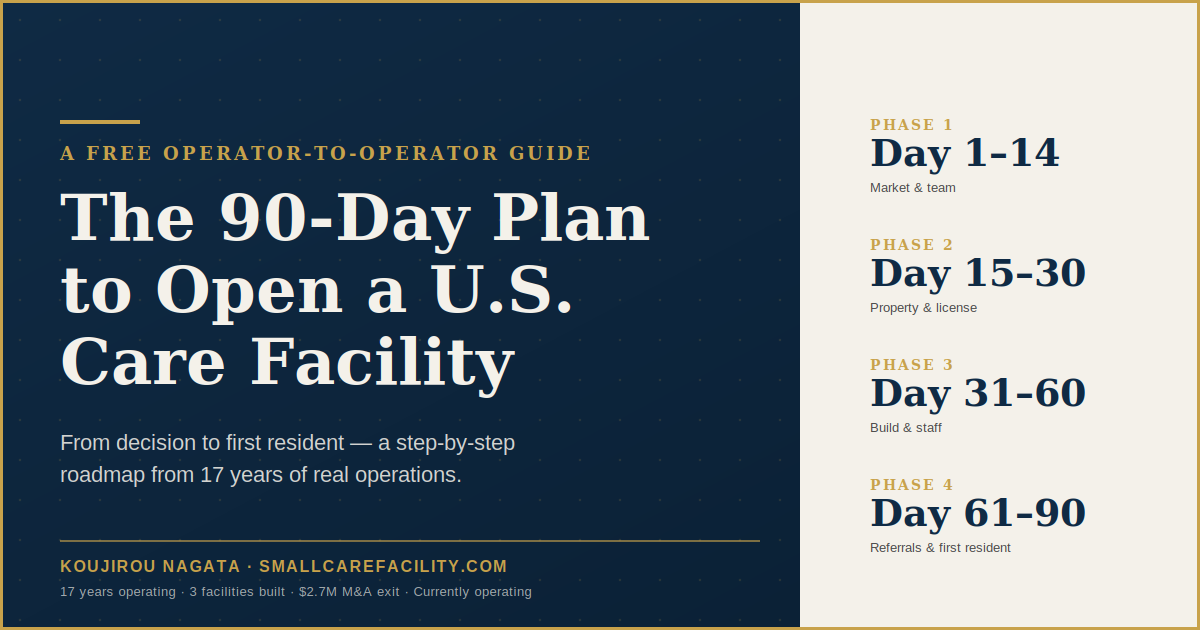
AN OPERATOR-TO-OPERATOR ROADMAP
From the moment you decide to your first resident — a step-by-step roadmap built from real operating experience, not from a textbook.
Why most people never start
The care facility business is not difficult. It does not require advanced technology or rare skills. What it requires is the willingness to execute concrete steps in the right order.
Most people who consider opening a facility never do. The reason is not that the barriers are insurmountable. The reason is that without a clear sequence of actions, the process feels overwhelming. Every step appears to depend on every other step. Research piles on research, and the opening never moves forward.
This 90-day plan removes that paralysis. It tells you exactly what to do, in what order, in what week.
Seventy percent preparation is enough. The remaining thirty percent you learn while doing. Operators who wait for one hundred percent never open.
Before Day 1: two preconditions
Before you start the 90-day clock, two things must be in place. If either is missing, do not start the clock.
$80,000–$125,000 in committed capital. Not promised. Not pending withdrawal from a retirement account. Liquid and immediately usable.
One target state identified. Not three states under consideration. One — based on Medicaid reimbursement rates, certificate-of-need requirements, and local market research.
If either condition is unmet, your first task is to meet it. Everything in the 90-day plan depends on these two foundations.
Days 1–14: market research and professional team
Market research
Identify three cities or counties in your target state with the best combination of senior population growth, Medicaid reimbursement rates, and lack of small-facility competition.
Identify the five largest hospitals in each candidate market and their discharge planning departments. These are your future referral sources. Record the names and contact details of the relevant staff.
Run competitor research. Visit or phone three existing small-scale facilities in your target market and learn their pricing, occupancy, and resident profile.
Contact the planning department of each target city directly to confirm zoning requirements for residential care facilities. Do not rely on internet research alone.
Professional team
Engage a healthcare attorney licensed in your target state. Share the 90-day timeline and request a regulatory roadmap specific to your target market.
Form your business entity (typically an LLC) under the attorney’s guidance.
Open a dedicated business bank account. Keep all startup and working capital completely separate from personal accounts.
Days 15–30: property and licensing
Property selection
Build a shortlist of 10–15 candidate properties in your target market. Prioritize four-to-six bedroom layouts, accessibility-friendly floor plans, and proximity to your target hospitals.
Walk each property with a contractor experienced in care-facility renovations. Get rough renovation estimates for your top three properties.
Before submitting any offer, get written confirmation of use compatibility from the local planning department.
Negotiate a minimum 36-month lease with renewal options. Always include a clause that makes the lease contingent on receiving your operating license.
License application
Submit the state residential-care-facility license application with your attorney’s support. Required documents: articles of organization, property lease, floor plan, initial staffing plan.
Start your Medicaid provider enrollment in parallel. Registration takes 60–120 days, so it must run alongside the license process, not after it.
Days 31–60: facility preparation and hiring
Facility preparation
Begin renovations immediately after lease execution. Prioritize accessibility requirements, safety equipment, and resident-room configurations that meet state standards.
Order furniture, equipment, and supplies. Use care-facility-specific suppliers so that compliance requirements and delivery timelines are understood from the start.
Install required safety systems: smoke detectors, sprinklers, emergency call systems, and a locked medication storage cabinet.
Schedule the state pre-licensure inspection for the end of Day 60. Your attorney coordinates the scheduling.
Hiring
Post openings at community college CNA programs, local churches, and selected job boards. Prioritize candidates within 12 months of CNA certification.
Conduct first-round interviews. Invite your top three finalists to spend two hours on-site before any formal offer.
Extend conditional offers to two full-time staff and one part-time staff. Start onboarding paperwork.
Build a 90-day post-opening shift schedule and publish it to your staff before Day 60.
Days 61–90: referral network and first resident
Building the referral network
Visit the discharge planning departments of your three target hospitals in person. Bring a one-page facility summary with bed count, rates, resident profile, and contact information. Do not email it — walk it in.
Contact the case managers at your regional Area Agency on Aging. These agencies make placements into residential care and are an underused referral source.
Visit three geriatric or internal medicine physicians in the area. Leave a facility summary with each.
Follow up with every referral source weekly. Relationships take time. The operator who visits once and waits fills beds slower than the operator who keeps showing up.
First resident
Receive your operating license. If there are any deficiencies, address them within 48 hours.
Confirm Medicaid enrollment is complete or in active processing.
Take your first resident inquiry. Conduct a detailed admissions assessment to confirm your facility can meet the resident’s care needs.
Sign the admission contract and accept the resident. At that moment, the business becomes real.
Who you are on Day 91
At the end of this 90-day plan, you have a licensed facility, a trained staff team, an active referral network, and your first resident. Revenue is coming in. You are on the trajectory toward full occupancy.
More importantly, you have crossed the wall most people never cross. You are no longer “someone thinking about opening a care facility.” You are someone who opened one.
Everything from here is operations: filling beds, managing staff, deepening referral relationships, maintaining compliance. All of these are learnable and executable tasks. The hard part was getting here.
Operators who succeed are not smarter or better-funded than operators who fail. They are the ones who started.
KEEP GOING
Two resources to take you further
If this 90-day plan is useful, two resources go deeper:
About the author
Koujirou Nagata
I’m a Japanese care facility operator based in Kobe, Japan. Over 17 years, I built three small-scale residential care homes in the U.S., sold two of them for $2.7M in a 2022 M&A exit, and currently operate a third. My staff turnover has held at roughly 3% — against a U.S. industry average of 34.53% — and the majority of my admissions have come through family referrals rather than paid marketing.
I now help U.S. and ASEAN operators of small-scale residential care homes — board and care homes, adult family homes, and similar facilities — apply the same operating methods to their own launches and expansions. The resources I’ve built reflect what I actually use, not what looks good on paper.
More at smallcarefacility.com
Two ways forward
Take what you need from here.
If you’re starting
The Care Facility Starter Kit
Six free guides I use myself in the operation of small-scale care facilities — financial planning, property evaluation, the first 90 seconds of family tours, and referral partner outreach. The materials I share with operators who reach out to me directly.
Get the Starter Kit — Free6 PDFs · Pay what you want · Instant download
If you’re past the basics
Complete USA + ASEAN Care Business Bundle
Six in-depth operator guides covering USA market entry, state selection across 9 states, the full financial model, staff hiring & retention, and ASEAN market entry — plus 16 working Excel templates I use myself: hiring scorecard, financial simulator, 1-on-1 tracker, retention analytics, and more.
View the Complete Bundle — $1676 guides + 16 Excel templates · One-time purchase · Instant download
Koujirou Nagata · 17 years operating small-scale care facilities · 3 facilities built · $2.7M M&A exit · Currently operating
ABOUT THE AUTHOR
Koujirou Nagata
17 years operating small-scale care facilities · 3 facilities built · $2.7M M&A exit · Currently operating
Founder of smallcarefacility.com, writing operator-to-operator for care entrepreneurs in the United States and ASEAN markets.