An operator-to-operator walkthrough of the regulatory process — from someone who has built three facilities and lived every line of it.
Why First-Time Operators Get Buried by Licensing
The U.S. care facility regulatory process is not the obstacle most operators think it is.
It is manageable — if you understand it before you face it.
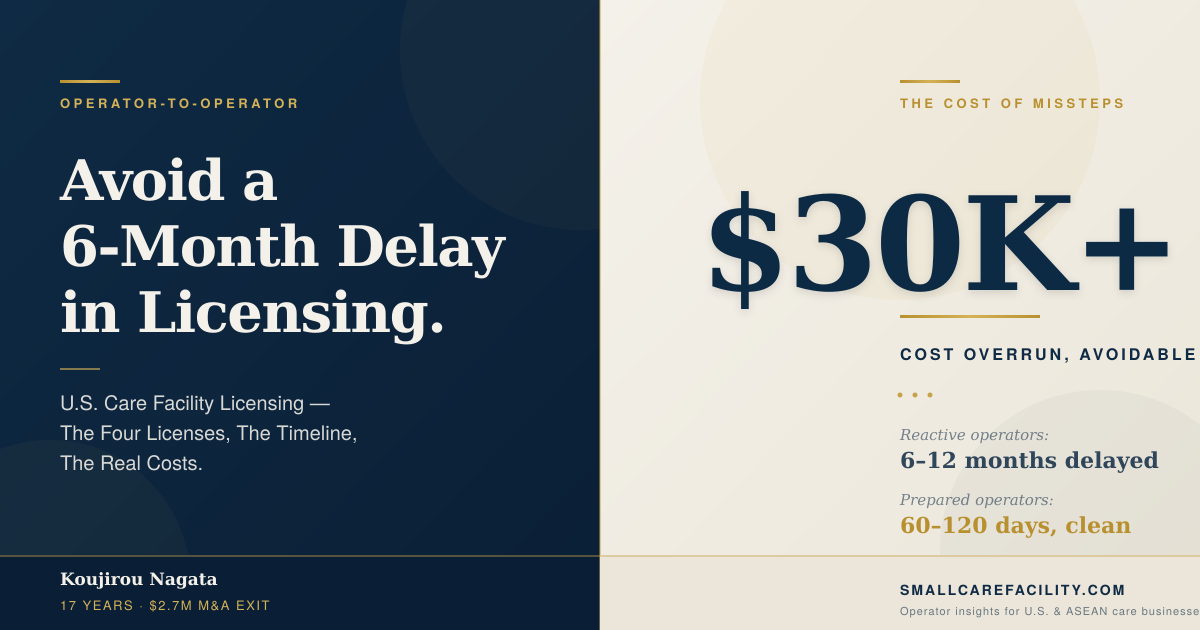
Operators who deal with licensing reactively routinely lose 6–12 months of opening time and over $30,000 in cost overruns.
Operators who understand the process in advance clear it in 60–120 days without major surprises.
The difference is not connections or luck. It is preparation.
The Four Licenses You Actually Need
1. State Residential Care Facility License
Every state that permits small-scale residential care requires a state-issued operating license.
The name varies by jurisdiction — Residential Care Facility License, Adult Foster Care License, Board and Care License — but the function is identical: it gives you the legal authority to accept residents, and it defines your maximum bed count, staffing ratios, facility requirements, and inspection schedule.
Without it, you cannot legally accept a single resident.
Processing time: 30 days in light-regulation states, up to 12 months in stringent ones.
Cost: $1,000–$5,000.
2. Certificate of Need (CON) — In States That Require It
Roughly 35 states require a Certificate of Need before you can open a care facility.
The requirement was originally created to prevent oversupply in healthcare markets. In practice, it functions as a significant entry barrier — and, once cleared, as a competitive moat.
The CON process demands proof of market demand, community impact analysis, and financial sustainability, and frequently involves public hearings. Budget 12–18 months and $30,000–$80,000.
CON-exempt states include Texas, Arizona, Colorado, and Indiana. If avoiding this process matters to your timeline, your state selection matters even more.
3. Local Business License and Zoning Approval
Beyond the state license, you need a local business license and — most importantly — zoning approval.
Residential care facilities are not permitted in every residential zone. Before signing any property contract, verify use compatibility directly with the local planning department in writing.
Zoning approval takes 30–90 days and may require a conditional use permit. Some jurisdictions mandate neighbor notification — which can occasionally trigger community opposition.
4. Medicaid Provider Registration
If you plan to accept Medicaid Waiver residents — and in most U.S. markets, this is essential for financial stability — you must register as a provider with your state’s Medicaid agency.
This is a separate process from operational licensing, and approval takes 60–120 days.
Do not wait until your facility opens to begin Medicaid registration. Start the moment your operating license is approved.
Physical Facility Requirements
Every state defines minimum physical requirements for licensed facilities. The major ones:
Minimum bedroom square footage per resident (80–100 sq ft shared, 120 sq ft private)
ADA-accessible bathrooms with grab bars and roll-in shower compatibility
Smoke detectors, sprinklers, and fire suppression meeting current code
Medication storage meeting state pharmacy board requirements
Shared spaces for dining and social activity
Adequate egress paths from every resident room
Before you contract any property, have it inspected by a contractor who specializes in care facility build-outs in your target state. Retrofitting a property that fails physical requirements is the single most expensive surprise first-time operators encounter.
The Inspection Process
Licensed facilities are subject to state inspection. Typically, an initial licensing inspection precedes opening, followed by annual surveys. Some states conduct unannounced visits.
Inspectors evaluate physical condition, staff records, medication management, resident care plans, and documentation. Deficiencies are recorded as citations with correction deadlines. Failure to correct can result in fines, conditional licensure, or — in the worst case — license revocation.
The most reliable way to pass inspections is to operate as if you are always being inspected. Facilities that maintain records, staff files, and medication logs consistently rarely receive significant citations.
A Realistic Timeline
|
Phase |
Activity |
Timing |
|
Pre-application |
State research, property selection, entity formation |
Months 1–2 |
|
Application |
License filing and fee payment |
Months 2–3 |
|
Inspection |
State inspector facility review |
Months 3–4 |
|
License Issued |
Operating license received |
Months 4–5 |
|
Medicaid Registration |
Provider application and approval |
Months 5–7 |
|
Hiring & Training |
Initial staff recruitment and training |
Months 5–6 |
|
First Resident |
Initial resident admission |
Months 6–7 |
This timeline assumes a CON-exempt state with reasonably efficient application processing. For CON-required states, add 12–18 months to the pre-application phase.
The Highest-ROI Investment You’ll Make
Every operator who has been through licensing gives the same advice: hire a healthcare attorney licensed in your target state before you start. Not after problems arise — before.
A competent healthcare attorney knows your state’s regulatory environment, has relationships with the licensing agencies, and can anticipate problems before they become expensive.
Cost: $3,000–$8,000 for the initial licensing process. The value of avoiding a 6-month delay or a failed inspection is many times that.
Do not attempt state licensing without legal counsel. Regulations vary state by state, change frequently, and the cost of mistakes is measured in months of delay and tens of thousands of dollars.
About the author
Koujirou Nagata
I’m a Japanese care facility operator based in Kobe, Japan. Over 17 years, I built three small-scale residential care homes in the U.S., sold two of them for $2.7M in a 2022 M&A exit, and currently operate a third. My staff turnover has held at roughly 3% — against a U.S. industry average of 34.53% — and the majority of my admissions have come through family referrals rather than paid marketing.
I now help U.S. and ASEAN operators of small-scale residential care homes — board and care homes, adult family homes, and similar facilities — apply the same operating methods to their own launches and expansions. The resources I’ve built reflect what I actually use, not what looks good on paper.
More at smallcarefacility.com
Two ways forward
Take what you need from here.
If you’re starting
The Care Facility Starter Kit
Six free guides I use myself in the operation of small-scale care facilities — financial planning, property evaluation, the first 90 seconds of family tours, and referral partner outreach. The materials I share with operators who reach out to me directly.
Get the Starter Kit — Free6 PDFs · Pay what you want · Instant download
If you’re past the basics
Complete USA + ASEAN Care Business Bundle
Six in-depth operator guides covering USA market entry, state selection across 9 states, the full financial model, staff hiring & retention, and ASEAN market entry — plus 16 working Excel templates I use myself: hiring scorecard, financial simulator, 1-on-1 tracker, retention analytics, and more.
View the Complete Bundle — $1676 guides + 16 Excel templates · One-time purchase · Instant download
Koujirou Nagata · 17 years operating small-scale care facilities · 3 facilities built · $2.7M M&A exit · Currently operating
—— Koujirou Nagata
17 years operating small-scale care facilities · 3 facilities built · $2.7M M&A exit · Currently operating