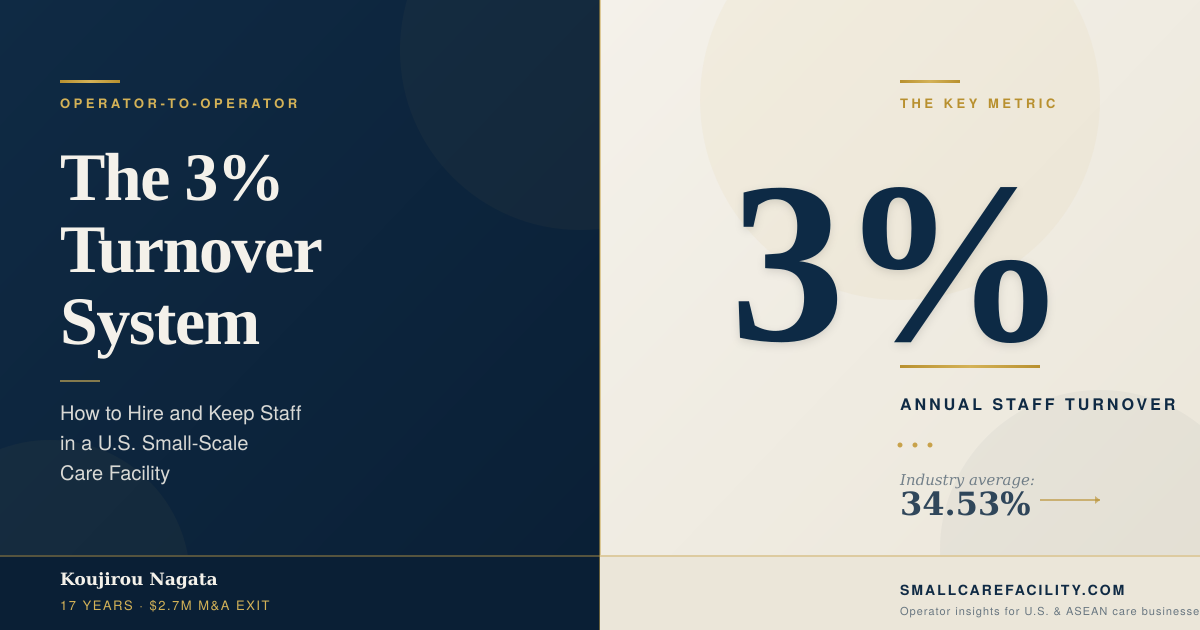
The recruitment and retention system that delivered ~3% turnover — built over 17 years of running small-scale care facilities
The staffing problem no one talks about honestly
The U.S. care industry is in the middle of a workforce crisis. The national assisted living turnover rate is 34.53%. For CNAs and PCAs specifically, it runs above 40%. In some markets, it exceeds 100% — meaning the entire staff turns over within a single year.
The financial cost is real. Recruiting and training one direct care worker runs $3,000 to $5,000. A six-bed facility losing four staff per year quietly burns $12,000 to $20,000 in pure operating cost — before you count the residents who notice, the families who tell their friends, and the case managers who stop sending referrals.
But the financial cost is not the worst part.
In a high-turnover facility, residents face new faces every month. Care routines never stabilize. A facility culture never has time to form. Residents notice. Families notice. And reputation moves through case manager networks faster than most operators realize.
Operators who solve the staffing problem solve the business. Operators who don’t, don’t.
The structural advantage small facilities don’t use
Large 80-to-200-bed facilities are at a structural disadvantage in the hiring market. Dozens of staff work rotating shifts. Individual caregivers are treated as interchangeable. Distance between staff and management is built into the org chart.
A four-to-six-resident small-scale home is a different environment entirely. Staff know every resident’s name. They know their history, their preferences, the names of their grandchildren. The work has personal meaning attached to it.
This is a competitive advantage in the hiring market — and most small operators fail to use it.
You cannot match the wages of a 150-bed corporate facility. You don’t have to. You can offer something the corporate facility structurally cannot: the feeling that this work matters.
Where to actually find good staff
1. Community college CNA programs
The single most reliable hiring source is the CNA program at your local community college. Graduates are formally trained, looking for their first position, and not yet burned out from a large facility’s floor.
Contact the clinical placement coordinator at every community college within 30 miles of your facility. Offer to host clinical rotations. Students who form a positive impression during placement will apply formally after graduation. This is the highest-yield recruiting channel I have ever used.
2. Community networks
In most U.S. markets, the most committed caregivers don’t come from job boards. They come from community institutions. Post openings in local churches, community centers, and immigrant community organizations.
Internal referrals from existing staff are consistently the highest-quality hiring channel. When a staff member refers a friend, she feels personally accountable for that person’s performance. Pay a meaningful referral bonus — $500 to $1,000 — and pay it after the new hire completes 90 days, not before.
3. Indeed and Care.com (selectively)
Job boards generate volume but not quality. Use them to build a candidate pool — then filter aggressively in the interview process described below. Treat the job board as a top-of-funnel tool, not a hiring decision.
An interview process that evaluates character, not just skills
Skills can be taught. Character cannot. Design your interview process to evaluate character first, skills second.
Four questions and one observation will tell you almost everything:
Question 1: Tell me about a time you helped someone who couldn’t help themselves. Listen for specificity and genuine emotion — not memorized interview answers.
Question 2: What do you find hardest about working with older adults? Inexperienced candidates give vague answers. Experienced candidates give specific, honest ones.
Question 3: Why did you leave your last position? Listen for ownership versus blame. Ownership predicts long tenure. Blame predicts the next exit will be just as short.
Question 4: What do you want to be doing five years from now? You’re listening for whether caregiving fits into their answer — or whether this is a stopgap.
The observation: Invite finalists to spend two hours in the facility before you make a formal offer. Watch how they interact with residents. The residents’ reactions are the most accurate evaluation you will ever get.
And call every reference. Not to verify employment dates — your HR vendor can do that. Call to ask two questions: “Would you trust this person to care for your own parent?” and “Would you hire them back?” Hesitation in the answer tells you more than the answer itself.
The retention system that actually works
Stable, predictable scheduling
Staff turnover spikes when shifts change suddenly. Publish the schedule four weeks in advance. Don’t change it without staff consent. This single discipline will lower turnover more than any raise you can afford.
Schedule stability tells your staff that their lives outside of work matter to you. Most facilities communicate the opposite — and lose people because of it.
Specific recognition
Every week, identify one specific thing one staff member did well — and tell them directly. In person. Not by text, not by email.
Skip the vague praise (“great job this week”). Use specific observation: the moment she handled a difficult family conversation with grace; the extra time he spent on the night shift; the way she noticed a resident’s changing condition before anyone else did.
People don’t quit jobs. They quit managers. Recognition is the most cost-effective retention tool you have — and it costs nothing but attention.
A visible career path
In a large facility, a direct care worker sees no future. In your facility, you can build one.
Cover the cost of additional certifications — medication aide, dementia care specialist. Create a Lead Caregiver position with modest pay increase and expanded responsibility. People who can see their future stay. People who cannot see their future apply to every job ad they receive.
Honest exit interviews
When someone resigns, conduct an honest exit interview within 48 hours. Ask two questions: “What would have kept you here?” and “What should we fix as a facility?”
This is the most direct, unfiltered feedback you will ever receive about your operation. Most operators waste it by treating exit interviews as a formality. The information is gold — if you have the discipline to listen without defending.
The 3% turnover target
With disciplined recruiting, stable scheduling, specific recognition, and systematic career development, a small-scale facility can consistently achieve annual turnover below 10%. The best operators run under 3%.
For a four-person staff, 3% turnover means 0.12 departures per year — less than one staff change annually. Recruiting cost: negligible. Training cost: minimal. And the team accumulates deep knowledge of every resident, compounding care quality month after month.
In 2022, when I sold two of my facilities for $2.7M, the buyer’s due diligence team spent more time on staff tenure data than on any other operational metric. Three percent turnover, sustained for three years, was the single largest contributor to the premium valuation multiple I received. It wasn’t the cost savings — it was the proof that the operation was durable.
Staff management is not HR — it is your business model
If you treat staffing as a back-office function — something to delegate, automate, or postpone — you will pay for that decision in turnover cost, declining care quality, and reputational damage. There is no version of this business in which staff management is optional.
The good news: small-scale facilities have a structural advantage in this fight. You just have to be disciplined enough to use it.
About the author
Koujirou Nagata
I’m a Japanese care facility operator based in Kobe, Japan. Over 17 years, I built three small-scale residential care homes in the U.S., sold two of them for $2.7M in a 2022 M&A exit, and currently operate a third. My staff turnover has held at roughly 3% — against a U.S. industry average of 34.53% — and the majority of my admissions have come through family referrals rather than paid marketing.
I now help U.S. and ASEAN operators of small-scale residential care homes — board and care homes, adult family homes, and similar facilities — apply the same operating methods to their own launches and expansions. The resources I’ve built reflect what I actually use, not what looks good on paper.
More at smallcarefacility.com
Two ways forward
Take what you need from here.
If you’re starting
The Care Facility Starter Kit
Six free guides I use myself in the operation of small-scale care facilities — financial planning, property evaluation, the first 90 seconds of family tours, and referral partner outreach. The materials I share with operators who reach out to me directly.
Get the Starter Kit — Free6 PDFs · Pay what you want · Instant download
If you’re past the basics
Complete USA + ASEAN Care Business Bundle
Six in-depth operator guides covering USA market entry, state selection across 9 states, the full financial model, staff hiring & retention, and ASEAN market entry — plus 16 working Excel templates I use myself: hiring scorecard, financial simulator, 1-on-1 tracker, retention analytics, and more.
View the Complete Bundle — $1676 guides + 16 Excel templates · One-time purchase · Instant download
Koujirou Nagata · 17 years operating small-scale care facilities · 3 facilities built · $2.7M M&A exit · Currently operating
—— Koujirou Nagata
17 years operating small-scale care facilities · 3 facilities built · $2.7M M&A exit · Currently operating