“CNA turnover is just the nature of this industry.” I’ve heard this line repeated across the U.S. assisted living sector more times than I can count.
It’s wrong. Turnover isn’t fate—it’s a failure of compensation design and one-on-one management.
And the cost of that failure is far larger than most operators realize.
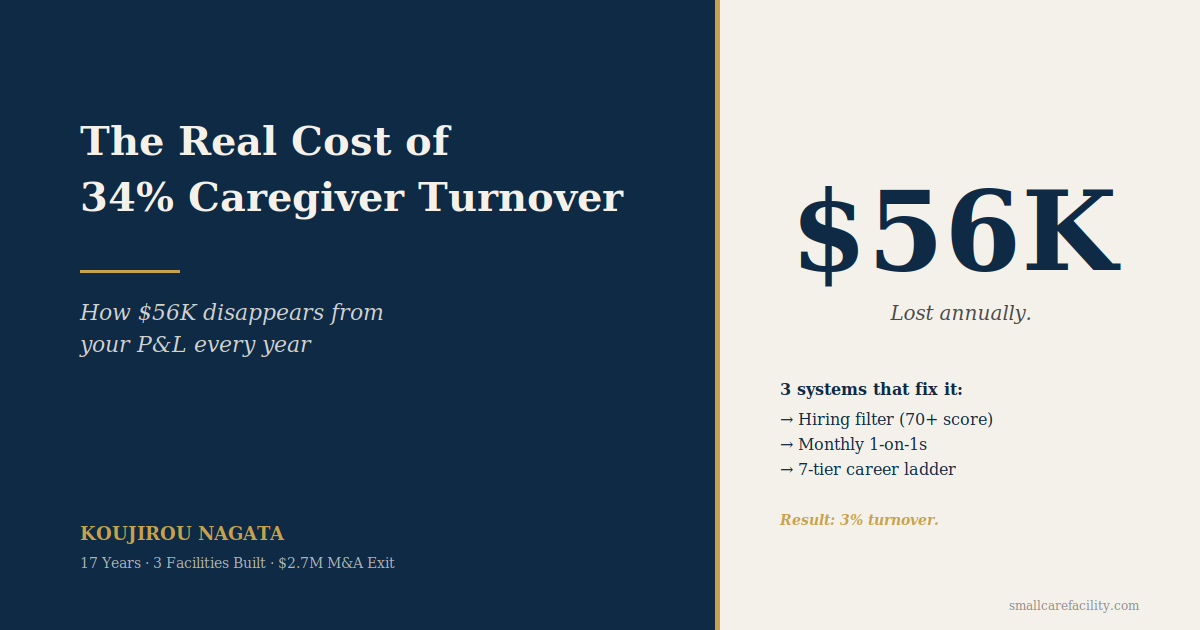
Industry-average assisted living turnover sits at 34.53%. Narrow it to CNAs and PCAs, and the figure climbs above 40%. For a 40-resident facility, roughly $56,000 disappears from your P&L every year—before you even calculate the downstream impact on family trust, occupancy, and your eventual M&A exit multiple.
The Blind Spot: “Direct Cost” Thinking
Ask most operators to calculate the cost of one CNA leaving, and you’ll get something like this:
“Job ad costs around $500, interview time maybe $200, training another $1,000. Call it $1,700.”
That’s direct cost. It’s not real cost.
The Seven Components of Real Turnover Cost
Real cost includes at least seven line items most operators never put on paper:
1. Recruiting and screening costs ($500–$1,500)
2. Management time spent on interviews ($300–$600 at loaded hourly rates)
3. Onboarding and training costs ($1,500–$3,000)
4. New-hire productivity drag (2–3 months at $2,000–$4,000 equivalent)
5. Coverage overtime and burnout among remaining staff ($1,500–$3,000 per departure)
6. Loss of family trust and elevated move-out risk (difficult to quantify, but very real)
7. Chain-reaction turnover (one departure typically triggers one to two more within 3–6 months)
Add it up, and the real cost of losing one CNA lands between $7,000 and $15,000.
At a 40-resident facility with 40% turnover, that’s roughly 16 departures a year. Sixteen times an average of $10,000 equals $160,000 vanishing from your P&L annually.
Why Raising Wages Alone Doesn’t Fix It
“Just raise hourly pay by a dollar and turnover will drop.” Partially true. Structurally inadequate.
When you rank the reasons CNAs actually leave, the order is consistent across facilities:
1. Relationship with their supervisor
2. Absence of a career path
3. Workload pressure
4. Compensation
Pay isn’t in the top three. Raise wages while ignoring the top three, and you simply increase labor cost without slowing departures. Your P&L gets worse, not better.
Three Systems That Drive Turnover Below 20%
At my third facility, eighteen months after opening, turnover sat at roughly 3%. That’s less than one-tenth of the industry average.
It wasn’t talent or luck. It was three systems running together.
System 1: A Hiring Filter That Actually Filters
A twelve-question structured interview paired with a seven-dimension scoring rubric (100-point scale). Candidates below 70 don’t get hired—no exceptions, even when we’re short-staffed.
Turnover risk is identifiable at the interview stage. Hire candidates scoring below 70 because you’re “desperate,” and their six-month departure rate runs three times higher than the rest of your team.
System 2: Monthly One-on-Ones, Documented
Every staff member gets a fifteen-to-twenty-minute one-on-one each month, recorded in a standard template.
Turnover doesn’t happen suddenly. Signals appear 60 to 90 days before someone actually resigns. The one-on-one record is your early-warning system for catching those signals before they harden into a resignation letter.
System 3: A Documented Career Ladder
Seven defined tiers reachable within three years of hire, with the pay-increase trigger at each tier written down and visible to every employee.
Staff who can see where they’ll be in three years don’t leave. Staff who can’t see it respond to the first competitor job ad that crosses their phone.
The Direct Impact on Your M&A Exit Multiple
Lowering turnover doesn’t just improve your monthly P&L. It moves your eventual sale price.
In 2022, when I sold two facilities to a mid-sized care group, the line item the buyer’s due-diligence team spent the most time on was “36-month rolling staff turnover.”
They understood the calculus: if staff exit en masse after acquisition, resident retention drops, family trust collapses, and acquisition value evaporates.
Maintaining 3% turnover for three consecutive years pushed my valuation multiple to roughly 1.8x the small-scale facility benchmark. Without that multiplier effect, the exit would likely have landed somewhere around $1.5M instead of $2.7M.
The economic value of a 3% turnover rate isn’t measured in monthly cost savings alone. It’s measured at exit.
One Thing to Start This Month
If your facility’s turnover is above 30%, start one thing this month:
Begin monthly one-on-ones with every staff member. Fifteen minutes is enough. Use a template.
Run it for three months, and you’ll start seeing who’s likely to leave before they tell you. Run it for six months, and turnover begins to bend downward—visibly, measurably.
Keep telling yourself “that’s just the industry,” and $56,000 keeps disappearing from your P&L every year. Turnover isn’t fate. It’s a design outcome.
About the author
Koujirou Nagata
I’m a Japanese care facility operator based in Kobe, Japan. Over 17 years, I built three small-scale residential care homes in the U.S., sold two of them for $2.7M in a 2022 M&A exit, and currently operate a third. My staff turnover has held at roughly 3% — against a U.S. industry average of 34.53% — and the majority of my admissions have come through family referrals rather than paid marketing.
I now help U.S. and ASEAN operators of small-scale residential care homes — board and care homes, adult family homes, and similar facilities — apply the same operating methods to their own launches and expansions. The resources I’ve built reflect what I actually use, not what looks good on paper.
More at smallcarefacility.com
Two ways forward
Take what you need from here.
If you’re starting
The Care Facility Starter Kit
Six free guides I use myself in the operation of small-scale care facilities — financial planning, property evaluation, the first 90 seconds of family tours, and referral partner outreach. The materials I share with operators who reach out to me directly.
Get the Starter Kit — Free6 PDFs · Pay what you want · Instant download
If you’re past the basics
Complete USA + ASEAN Care Business Bundle
Six in-depth operator guides covering USA market entry, state selection across 9 states, the full financial model, staff hiring & retention, and ASEAN market entry — plus 16 working Excel templates I use myself: hiring scorecard, financial simulator, 1-on-1 tracker, retention analytics, and more.
View the Complete Bundle — $1676 guides + 16 Excel templates · One-time purchase · Instant download
Koujirou Nagata · 17 years operating small-scale care facilities · 3 facilities built · $2.7M M&A exit · Currently operating
— Koujirou Nagata
17 years operating small-scale care facilities · 3 facilities built · $2.7M M&A exit · Currently operating