The 5 Screening Criteria Most Care Home Operators Skip
“Where I already live” is the most expensive reason to open a care home.
When launching a small-scale care facility in the United States, what single decision carries the most financial weight?
Not the property you choose. Not the staff you hire. Not your marketing strategy.
The answer is: which state you open in.
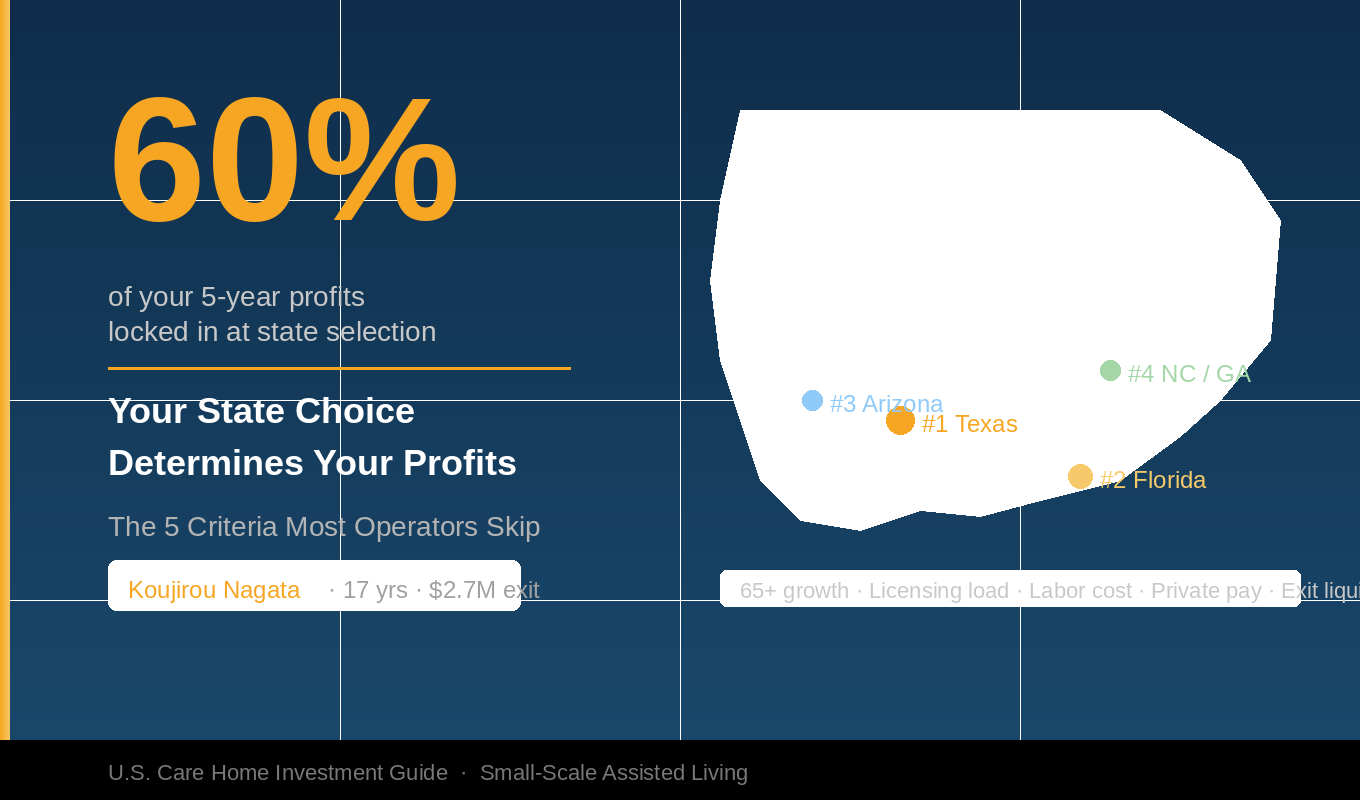
In my experience, roughly 60% of cumulative profits from Year 1 through Year 5 are determined at the moment you select your state. Apply the same operational effort in two different states, and the financial outcomes can diverge by multiples.
Why Your State Choice Is the Highest-Leverage Decision You Will Ever Make
Care homes are a regulated industry. That is the entire explanation.
Each state operates its own licensing framework, minimum wage floor, Medicaid reimbursement rate, staffing mandates, insurance requirements, and tax structure. A 6-bed assisted living facility in Texas and an identical one in California can differ by 2x in upfront capital, 1.5x in monthly operating costs, and 3x in regulatory compliance burden.
Despite this, the vast majority of first-time operators choose their state based on:
Where they currently live
Where their family is located
Where they feel most familiar
None of these are economically rational criteria. The moment you choose a state on instinct, you may be forfeiting up to 40% of your five-year profit potential.
The 5-Variable Filter: How to Score Any State Before You Commit
Here is the five-variable framework I use when evaluating the nine key states for small-scale care facility investment.
Criterion 1: 65+ Population Share and Growth Trajectory
Look beyond absolute headcount. Analyze the projected growth rate over the next decade. Florida and Arizona rank high on both dimensions. Texas sits mid-tier today but is trending upward fast, making it a compelling long-term demand play.
Key risk: Opening in a state with weak demand fundamentals creates a structural marketing cost problem. You will spend more to fill beds—forever.
Criterion 2: Licensing Density and Ongoing Compliance Load
California and New York require documentation volume and inspection frequency that exceeds other states by 3x or more. This is not simply a matter of stricter rules. It means dozens of hours per month absorbed by regulatory compliance—hours that, in a small facility, come directly out of the owner-operator’s schedule and hit the P&L.
Criterion 3: Minimum Wage Floor and Total Labor Cost Structure
California’s minimum wage exceeds $16/hour. Texas holds at the federal floor of $7.25. In practice, CNA market wages run approximately $22/hour in California versus $15/hour in Texas.
At a 40-person staffing level, the annual labor cost gap exceeds $1 million. You cannot set identical rates in both markets. The difference flows directly to your margin.
Criterion 4: Private-Pay Mix and Average Monthly Rate Ceiling
States with heavy Medicaid dependence—New York and Oregon, for example—cap your pricing flexibility and therefore your margin ceiling. Markets where private-pay residents exceed 80% of the mix (southern Florida, parts of Arizona, suburban Texas) allow you to charge a quality premium.
With equivalent operations, a private-pay-dominant market can generate 1.5–2x higher net margins than a Medicaid-weighted one.
Criterion 5: Exit Liquidity and M&A Market Depth
If you intend to sell within 10–20 years, your state must have active buyers. Florida, Texas, Arizona, North Carolina, and Georgia all show strong mid-market acquirer activity and healthy valuation multiples.
Building in a market with no buyers is a fatal long-term mistake. Exit liquidity is not a bonus feature—it is a core investment criterion.
A Rapid Snapshot: 9 States Evaluated Against the 5 Criteria
For anyone evaluating U.S. market entry in small-scale senior care, I recommend scoring these nine states first: Florida, Texas, Arizona, North Carolina, Georgia, Oregon, Washington, California, and New York.
If I were entering the U.S. market today, my priority ranking would be:
- Texas — Best balance of regulatory burden and demand trajectory
- Florida — Largest absolute demand pool and deepest private-pay market
- Arizona — Strong growth rate with manageable operating costs
- North Carolina and Georgia — Active M&A exit markets with improving fundamentals
California and New York can generate significant returns for experienced operators. For first-time entrants, the regulatory learning curve alone is enough to consume your entire early-stage margin.
The 30-Day State Selection Sprint: A Repeatable Decision Framework
You do not need a year to make this decision. Thirty days is sufficient, structured as follows:
Week 1: Score all nine states against the five criteria. Narrow to three finalists.
Week 2: Contact the licensing authority in each of your three states. Confirm real-world approval timelines and active operator counts.
Week 3: Reach out to local real estate brokers and staffing agencies in each state. Obtain current market rates on property and labor.
Week 4: Synthesize all data and select your final state.
The intelligence you gather in 30 days of direct outreach is 10x more reliable than anything you can assemble from online searches and secondary sources.
Stop Paying the “I Live Here” Tax for the Next Twenty Years
“Where I live.” “Where my family is.” “Where I know the area.”
These are personally valid reasons. Economically, they are the most expensive reasons to open a care home.
This is a 20–30 year business. Choose the wrong state at launch, and you carry a structural handicap for two decades. Spending 30 days to re-evaluate your state selection costs nearly nothing compared to that scale of opportunity loss.
If you are still in the early stages of launch planning: treat your state as undecided. Start the 30-day sprint from zero. The cumulative profit difference from Year 1 to Year 5 could reach six figures.
About the author
Koujirou Nagata
I’m a Japanese care facility operator based in Kobe, Japan. Over 17 years, I built three small-scale residential care homes in the U.S., sold two of them for $2.7M in a 2022 M&A exit, and currently operate a third. My staff turnover has held at roughly 3% — against a U.S. industry average of 34.53% — and the majority of my admissions have come through family referrals rather than paid marketing.
I now help U.S. and ASEAN operators of small-scale residential care homes — board and care homes, adult family homes, and similar facilities — apply the same operating methods to their own launches and expansions. The resources I’ve built reflect what I actually use, not what looks good on paper.
More at smallcarefacility.com
Two ways forward
Take what you need from here.
If you’re starting
The Care Facility Starter Kit
Six free guides I use myself in the operation of small-scale care facilities — financial planning, property evaluation, the first 90 seconds of family tours, and referral partner outreach. The materials I share with operators who reach out to me directly.
Get the Starter Kit — Free6 PDFs · Pay what you want · Instant download
If you’re past the basics
Complete USA + ASEAN Care Business Bundle
Six in-depth operator guides covering USA market entry, state selection across 9 states, the full financial model, staff hiring & retention, and ASEAN market entry — plus 16 working Excel templates I use myself: hiring scorecard, financial simulator, 1-on-1 tracker, retention analytics, and more.
View the Complete Bundle — $1676 guides + 16 Excel templates · One-time purchase · Instant download
Koujirou Nagata · 17 years operating small-scale care facilities · 3 facilities built · $2.7M M&A exit · Currently operating
— Koujirou Nagata
17 years operating small-scale care facilities · 3 facilities built · $2.7M M&A exit · Still operating today