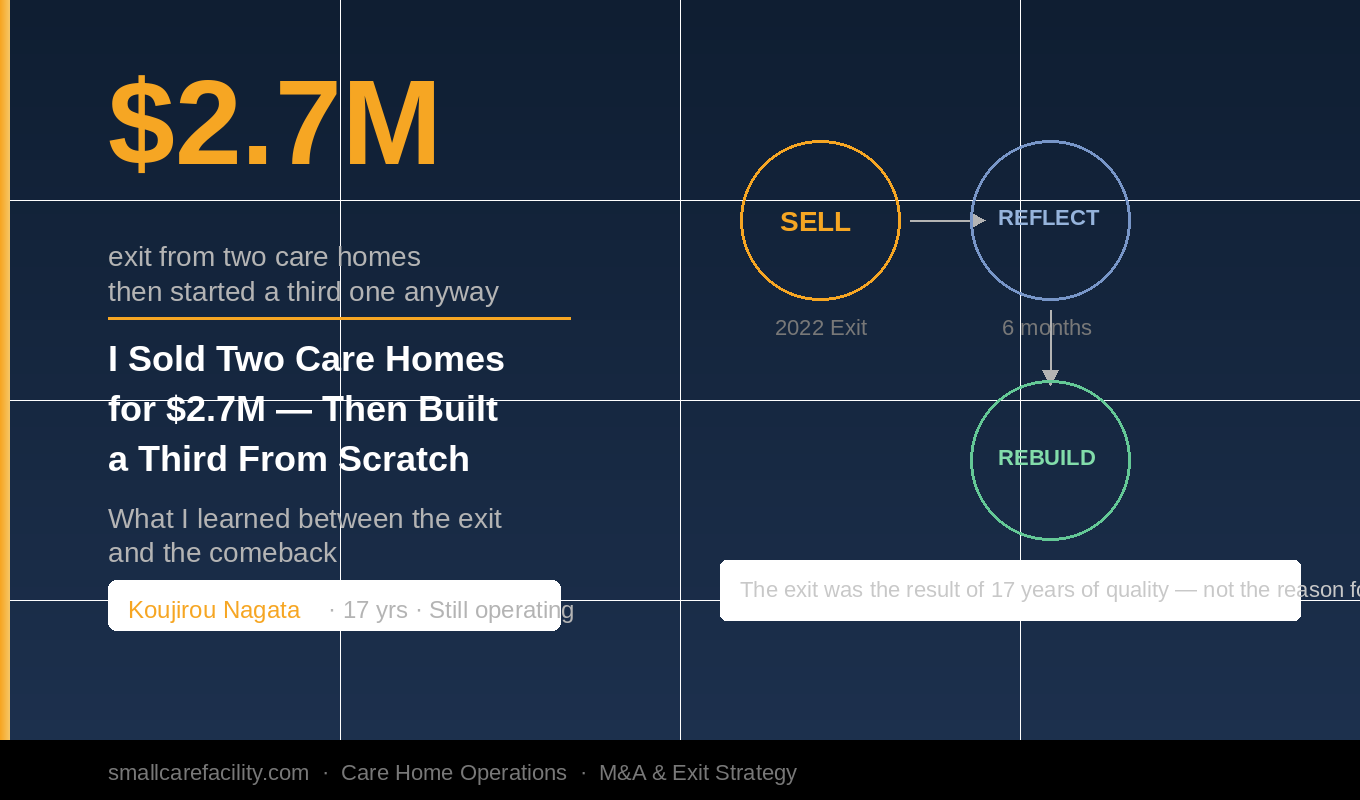
In 2022, I sold the two small-scale care facilities I had built and operated over 17 years to a mid-sized care group for $2.7 million.
The day I signed the acquisition paperwork, I felt it was over. I had graduated from care home operations. I was ready for something else.
Three years later, I am running a third facility and back on the floor every day.
Here is what happened between the exit and the comeback — and what I would tell anyone who is building, operating, or thinking about selling a care home.
What Happened in the Six Months After the Sale
Three months after the handover, the acquiring team contacted me.
Staff turnover was climbing. Family complaints were increasing. They wanted to know what was happening.
I was not surprised. I had flagged this risk before the deal closed. During due diligence, I told the buyer directly: the way these facilities run depends on me being present. Remove me, and the culture shifts within six to twelve months.
Their answer was that manuals and a structured handover would be sufficient.
The problems surfaced at three months. By six months, they were undeniable.
What manuals cannot transfer:
The trust built individually with every staff member over years
A decade of relationship history with residents’ families
The floor-level instinct to read a resident’s expression and know something is wrong
These were not documented assets. They were the actual operating infrastructure of the business — and they walked out the door with me.
What I Did With the Time and Money
The sale price was enough. My family’s financial security was set. My mother’s care in later life was covered. There was no economic reason to return to operations.
For about six months I tried other things. Digital marketing projects in Japan. A small AI-adjacent consulting engagement. A couple of other ventures.
None of them lasted.
When I analyzed why, the answer was simple: I genuinely liked running care homes. Not as a means to an exit. Not as an asset class. The work itself.
The M&A outcome was a byproduct of 17 years of operational focus. It was never the point. The point was noticing when a resident’s appetite dropped before the family did. Watching a nervous new hire become someone the residents trusted. Hearing a family member say they wished they had moved their parent in sooner.
That was the work. Everything else — including $2.7 million — was a result of doing it well.
How the Third Facility Is Different — and Why I Built It That Way
When I decided to start again, I made three deliberate changes from how I had approached the first two.
I kept it intentionally small
The first two facilities grew toward mid-scale over time. The third is capped at a size where I can personally hold a monthly one-on-one with every staff member and speak directly with every resident’s family.
That boundary is not a constraint. It is the design. I am not building for another exit. I am building for the work.
I designed for profitability from month one
In the earlier facilities, I accepted first-year losses in exchange for faster scale. The third facility was structured differently: beds filled incrementally from opening day, with stable profitability as a hard constraint by month six.
Slower ramp, cleaner economics, less pressure on the team during the critical early months.
I documented everything this time
In the first two facilities, the operational knowledge lived in my head. The acquiring team found that out the hard way.
In the third, every decision framework, interview scoring rubric, one-on-one template, and family communication script is written down. This serves two purposes: it addresses the weakness the buyer identified, and it forms the basis of the educational content I am building for English-speaking operators through smallcarefacility.com.
Three Things I Would Tell Anyone Building or Running a Care Home
Do not over-engineer the exit from the start
Operators who treat M&A as the primary objective end up degrading the very thing that creates exit value. Residents, families, and staff can tell — not through any single moment, but through the cumulative texture of how decisions get made — when the person running the facility is mentally already somewhere else.
An exit should happen as a consequence of quality. Not as the reason for it.
Do not let the sale price define what success means
$2.7 million is a legible number. It is easy to point to. But my own definition of success in 17 years of operations was whether the final years of hundreds of residents were genuinely peaceful, and whether dozens of staff members found work they could stay in long-term.
The sale price was a downstream output of those priorities. Reverse the sequence and neither the quality nor the exit holds up.
Keep a path back to the work — even if you never use it
Many operators sell and then lose the thread entirely. The facility name changes. The staff relationships end. The daily rhythm disappears. That is a legitimate trade-off — but it is worth designing for consciously.
If you are planning an exit, spend as much time designing what comes after as you spend on the deal itself. The money solves one set of problems. It does not automatically replace a professional identity built over decades.
A Note for Operators Who Are Tired Right Now
If you are running a facility today and the daily weight of it is wearing you down, be careful not to confuse that exhaustion with a signal to sell.
The reason I sold was not fatigue. It was that I wanted to build something new. Those are different decisions, and they lead to very different outcomes.
If you are genuinely tired: take a month off. Fully off. Then see how you feel about the work.
If you miss it, you are not done yet. If you do not, then you have your answer — and it will be a cleaner decision, made from rest rather than depletion.
What I Know After 17 Years and a Third Start
Care home operations is not a get-rich-quick business. It is not a passive income vehicle. It is a long-duration profession that rewards people who treat it as such.
The $2.7 million exit was real. But it happened because of 17 years of genuine commitment to the work — not because I optimized for the number.
If you are coming into this industry, design for 20 to 30 years. The financial outcomes and the professional fulfillment both arrive on a long timeline, and they compound together. Rushing either one tends to undermine both.
Two ways forward
Take what you need from here.
If you’re starting
The Care Facility Starter Kit
Six free guides I use myself in the operation of small-scale care facilities — financial planning, property evaluation, the first 90 seconds of family tours, and referral partner outreach. The materials I share with operators who reach out to me directly.
Get the Starter Kit — Free6 PDFs · Pay what you want · Instant download
If you’re past the basics
Complete USA + ASEAN Care Business Bundle
Six in-depth operator guides covering USA market entry, state selection across 9 states, the full financial model, staff hiring & retention, and ASEAN market entry — plus 16 working Excel templates I use myself: hiring scorecard, financial simulator, 1-on-1 tracker, retention analytics, and more.
View the Complete Bundle — $1676 guides + 16 Excel templates · One-time purchase · Instant download
Koujirou Nagata · 17 years operating small-scale care facilities · 3 facilities built · $2.7M M&A exit · Currently operating
I plan to be doing this for another 20 years. That is not a concession. It is the point.
— Koujirou Nagata
17 years operating small-scale care facilities · 3 facilities built · $2.7M M&A exit · Still operating today