By Koujirou Nagata | 17 years operating small care facilities in the United States | Sold 2 facilities for $2.7M in 2022
The U.S. home care and residential care industry is in the middle of a seismic shift.
Demographics are changing. Policies are evolving. Technology is rewriting the rules of daily operations. For small facility owners, understanding these forces isn’t optional — it’s the difference between growing and getting left behind.
I’ve spent 17 years building and operating small care facilities in the U.S. — launched three of them from Japan, sold two for $2.7 million in 2022, and still operate the third today. What I’m sharing here isn’t borrowed from a textbook. It’s what I’m watching unfold in real time.
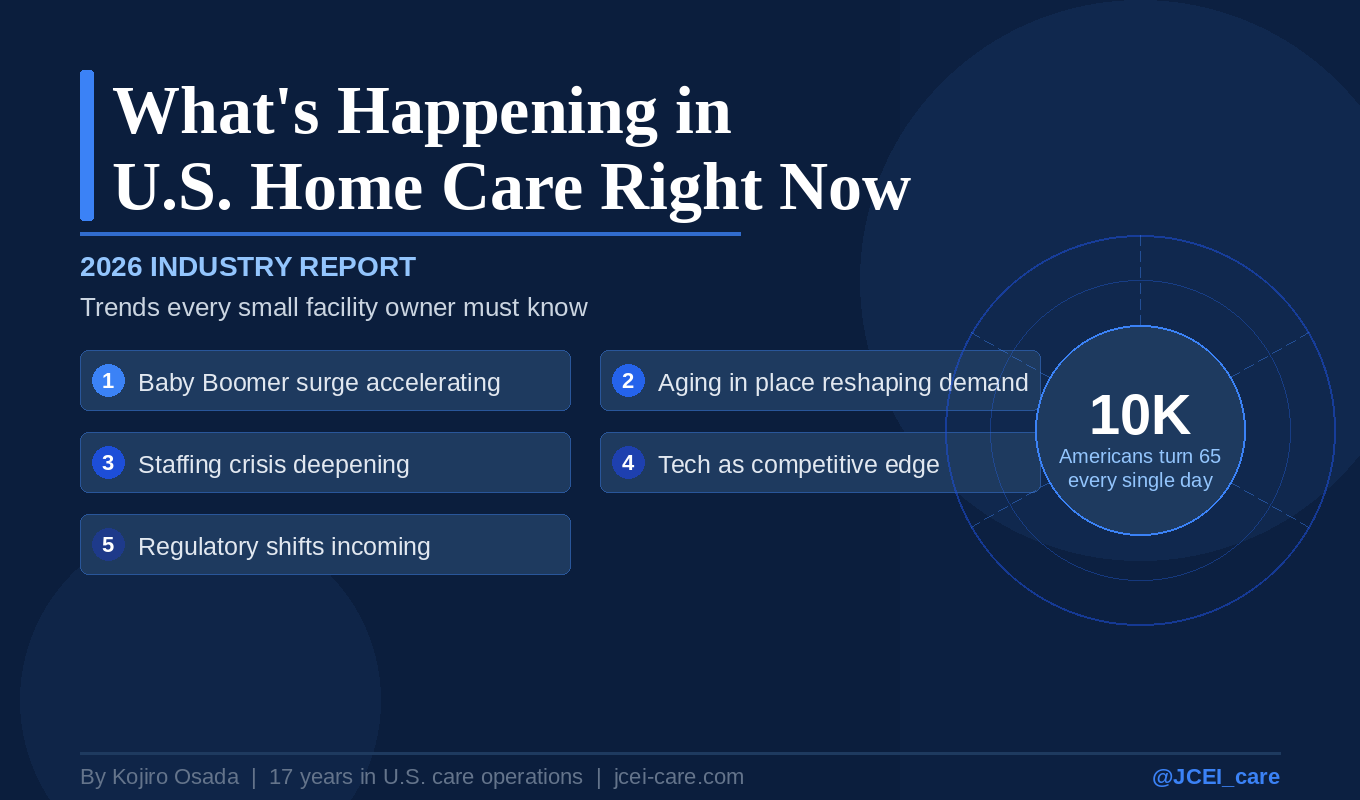
Here are the five trends that matter most right now.
1. The Baby Boomer Wave Has Arrived — And It’s Bigger Than You Think
The generation born between 1946 and 1964 is now firmly entering the age of care dependency. According to the U.S. Census Bureau, adults 65 and older will represent roughly 20% of the total U.S. population by 2030. Between 2026 and 2030, approximately 10,000 Americans will turn 65 every single day.
That’s not a slow tide. That’s a surge.
But here’s what the numbers don’t tell you: this generation is different from any before it. Baby Boomers are selective, vocal, and self-directed consumers. In my own facility, I’ve watched the deciding factor for move-ins shift dramatically over the past decade. It used to be the amenities — the building, the meals, the list of services. Today? Families and prospective residents increasingly tell me the deciding factor is the quality of conversation with the staff.
Baby Boomers expect to be treated as individuals, not as patients. They care about privacy, dignity, the quality of personal connection — and they will walk away from a facility that doesn’t deliver on those levels, no matter how clean the floors are.
For small facility owners, this is actually good news. We can offer what large chains struggle to replicate: genuine, relationship-based care. But only if we design our services intentionally around quality of life, not just quality of care.
2. Aging in Place Is Accelerating — and That Changes Who Walks Through Your Door
“Aging in place” — the preference to remain in one’s own home or community for as long as possible — has moved from a niche concept to a mainstream expectation. Home health aides, visiting nurses, and community-based care services are growing rapidly to meet this demand.
At first glance, this might look like a threat to residential facilities. I’d argue the opposite.
When people can manage at home longer, the ones who eventually do need residential care arrive with more complex needs. I’ve seen this clearly in my own facility over the past five years. The average acuity level of incoming residents has risen significantly. Where we once welcomed residents who were largely independent, we now regularly admit individuals with advanced dementia, multiple chronic conditions, or significant mobility limitations.
What this means for small operators: the bar for clinical and care capability is rising. Staff training, care protocols, and relationships with local medical providers aren’t just operational concerns — they’re now core to whether your facility can serve the people who need you most.
Position your facility not as an alternative to home care, but as the next step when home care is no longer enough.
3. The Staffing Crisis Is Not Going Away
I’ll be direct: the staffing shortage in U.S. care is the most pressing operational challenge facing small facilities right now, and there is no quick fix on the horizon.
The pandemic accelerated burnout and attrition across the care workforce. Wages have risen in response, but pay increases alone have not solved the retention problem — and for small operators, competing on compensation alone with large institutional employers is a losing battle.
After 17 years in this industry, here’s what I’ve learned: the three most powerful drivers of long-term staff retention are not pay. They are a workplace culture where people feel respected, a visible path for professional growth, and a genuine relationship with ownership.
The single change that made the biggest difference in my retention numbers? I started scheduling one-on-one conversations with every staff member, every month. Not performance reviews. Just conversations. It costs nothing, and the impact has been profound.
Other strategies worth exploring: building relationships with local care training programs and community colleges for a steady pipeline of new hires, and cultivating connections within immigrant communities where many skilled care workers reside.
4. Technology Is a Differentiator — Even at Small Scale
Large facility chains are investing heavily in electronic health records (EHR), sensor-based fall detection, AI-assisted scheduling, and predictive care analytics. The gap between enterprise-level technology and what small operators use is real — but it doesn’t have to be permanent.
My advice: don’t try to close that gap overnight. Start with the highest-leverage, lowest-cost tools.
The first technology investment I made at my facility wasn’t an expensive care management platform. It was a family communication app that cost less than $50 per month. It centralized all family updates, reduced the time staff spent fielding individual calls, and measurably improved family satisfaction scores.
From there, you build. Each small win in efficiency or safety creates the case — and the budget — for the next upgrade.
There’s also a digital presence dimension that small operators often overlook. LinkedIn, a well-written blog, and active social media aren’t just marketing tools — they’re trust signals. Families researching care options are increasingly checking an operator’s online presence before making contact. If you’re not visible, you’re not in consideration.
5. The Regulatory Environment Is Shifting — Stay Ahead of It
Care regulations in the U.S. vary by state and change frequently. Licensing requirements, staffing ratios, resident rights protections — these aren’t static, and falling out of compliance, even unknowingly, carries serious consequences.
In 2026, several states are actively revisiting their Medicaid budgets and reimbursement structures. For operators whose business models include Medicaid residents, these discussions will directly affect revenue. This is not a background issue to monitor casually.
Build a habit of checking in regularly with your state’s Department of Health or equivalent agency. Subscribe to newsletters from your state’s care industry association. And perhaps most practically: build relationships with other operators in your area. Peer networks are often the fastest way to learn about regulatory changes before they catch you off guard.
The Mindset That Keeps Operators Standing
The U.S. care industry in 2026 is demanding. The staffing pressures are real. The regulatory complexity is real. The rising acuity of residents is real.
But so is the opportunity.
Demand for quality residential care is not going down. It is going up — steeply and sustainably, driven by demographics that have been visible for decades. The operators who will thrive are not the ones with the largest buildings or the biggest budgets.
They’re the ones who stay informed, stay adaptable, and keep improving — one resident, one staff member, one decision at a time.
Slow and steady. Don’t stop moving.
About the author
Koujirou Nagata
I’m a Japanese care facility operator based in Kobe, Japan. Over 17 years, I built three small-scale residential care homes in the U.S., sold two of them for $2.7M in a 2022 M&A exit, and currently operate a third. My staff turnover has held at roughly 3% — against a U.S. industry average of 34.53% — and the majority of my admissions have come through family referrals rather than paid marketing.
I now help U.S. and ASEAN operators of small-scale residential care homes — board and care homes, adult family homes, and similar facilities — apply the same operating methods to their own launches and expansions. The resources I’ve built reflect what I actually use, not what looks good on paper.
More at smallcarefacility.com
Two ways forward
Take what you need from here.
If you’re starting
The Care Facility Starter Kit
Six free guides I use myself in the operation of small-scale care facilities — financial planning, property evaluation, the first 90 seconds of family tours, and referral partner outreach. The materials I share with operators who reach out to me directly.
6 PDFs · Pay what you want · Instant download
If you’re past the basics
Complete USA + ASEAN Care Business Bundle
Six in-depth operator guides covering USA market entry, state selection across 9 states, the full financial model, staff hiring & retention, and ASEAN market entry — plus 16 working Excel templates I use myself: hiring scorecard, financial simulator, 1-on-1 tracker, retention analytics, and more.
View the Complete Bundle — $167
6 guides + 16 Excel templates · One-time purchase · Instant download
Koujirou Nagata · 17 years operating small-scale care facilities · 3 facilities built · $2.7M M&A exit · Currently operating