By Koujirou Nagata | 17 years operating small care facilities in the United States | Sold 2 facilities for $2.7M in 2022
If you’re running a small care facility, you already know what a difficult day looks like.
A staff member calls in sick with no notice. A resident’s condition changes overnight. A family member calls with a complaint you weren’t expecting.
For the first few years of my career operating care facilities in the U.S., this was my daily reality. I was supposed to be the owner — the one with the perspective and the plan. Instead, I was the one putting out fires. I had no time to run the business because I was too busy keeping it from falling apart.
What changed everything wasn’t more staff or more money. It was systems.
Over 17 years of building and running three small residential care facilities in the U.S. — and selling two of them for $2.7 million — I’ve built, tested, and refined four operational systems that I credit for most of the stability my facilities have achieved. My staff turnover rate has held at roughly 3% against a U.S. industry average of 34.53%. The majority of my admissions have come through family referrals. Neither of those outcomes happened by accident.
Here’s what I actually use.
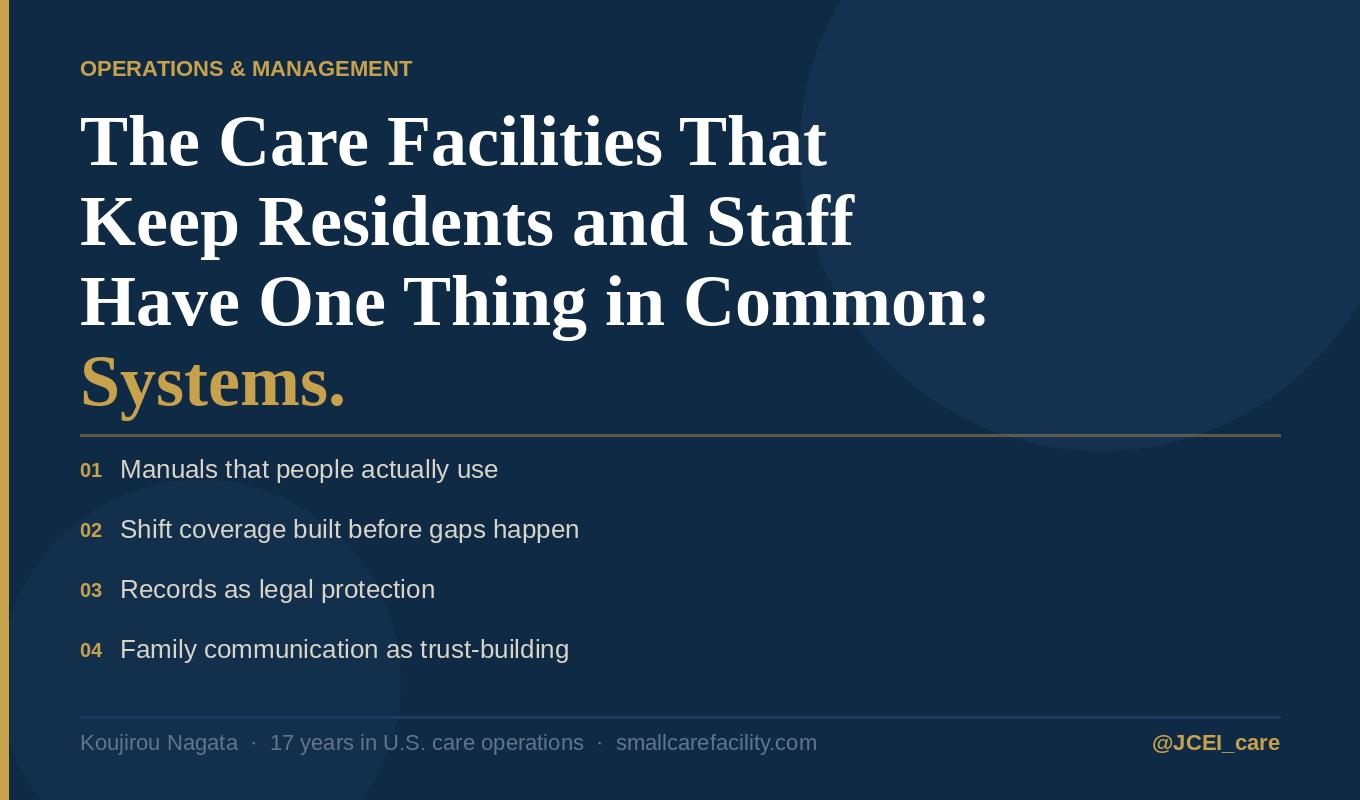
1. A Manual Nobody Reads Is Worth Nothing
Most small care facilities have some version of a policy manual. Most of them are sitting on a shelf, untouched.
My first facility was no different. I spent weeks writing a thorough manual before we opened. Nobody read it. Every time a new staff member joined, I ended up walking them through everything from scratch — verbally, on the spot, while trying to manage everything else.
By the time I opened my third facility, I had changed my approach entirely.
Instead of comprehensive documents, I created single-page checklist sheets for each critical process: resident intake, emergency response, and medication management. Each one fit on an A4 sheet. Each one was posted on the wall where the work actually happened.
The result: new staff were completing basic tasks independently on day one in half the time it used to take. The manual that gets used is not the thickest one. It’s the one that’s in the right format, in the right place, at the right moment.
If your current documentation requires someone to hunt for it, open a binder, and read through pages before they can act — it is not a system. It’s a document with good intentions.
2. Shift Coverage Gaps Will Break You — Personally and Operationally
Scheduling is the structural foundation of a care facility. When that foundation has cracks, everything above it becomes unstable.
In my first facility’s first year, I covered nearly every staffing gap myself. There were stretches where I worked more than 60 hours a week on the floor. I was physically present, but I wasn’t running a business — I was filling a role that didn’t allow me to do anything else.
The shift that changed everything was simple: I stopped treating coverage gaps as emergencies to be solved in the moment and started treating them as a scenario to be designed for in advance.
I built a written, prioritized contact list — a substitute roster — of staff who were available to step in on short notice. I maintained a standing pool of three to four part-time workers who could absorb unexpected gaps a few times per month. And I documented the exact escalation sequence for who gets called first, second, and third when a shift opens.
After implementing this, the number of times I personally covered an emergency shift dropped to fewer than once per month on average. Staff still got sick. Gaps still happened. But the system absorbed them instead of me.
You cannot build a business if you are the backup plan for every operational problem. The system has to be.
3. Resident Records Are Legal Documents — Treat Them Accordingly
In U.S. residential care, documentation is not administrative paperwork. It is a legal record. In the event of a family dispute, a licensing inspection, or a regulatory audit, your records are the evidence of what happened — or didn’t.
I learned this firsthand. During a state inspection at one of my facilities, an inspector identified a 30-minute gap in a medication administration record. The medication had been given. The staff member simply hadn’t logged it at the time. The result was a formal citation.
That experience was a turning point. From that point forward, I standardized the timing and format of all critical records across my facilities: meal intake, medication administration, and incident reports. I implemented a system that flagged any documentation gaps in real time and notified the responsible staff member to complete the record before their shift ended.
The principle is this: if it isn’t documented, it didn’t happen. That standard protects your residents, your staff, and your license.
Documentation gaps are almost never the result of people not caring. They’re the result of not having a clear system that makes timely documentation the path of least resistance.
4. Family Communication Is Relationship-Building — Not Just Reporting
Families are not just people who pay the bills. They are your most powerful source of referrals, your early warning system when something is wrong, and — when things go well — your most credible advocates.
The standard approach in many facilities is reactive: contact families when there’s a problem, send required notices when regulations demand it, and otherwise keep communication minimal. This approach treats family relationships as a compliance obligation rather than a strategic asset.
At my third facility, I took a different approach from the start. I sent a monthly newsletter — brief, consistent, personal. I shared photographs from seasonal activities and small daily moments. I made it easy for families to feel connected to their loved one’s daily life, even when they couldn’t visit.
The outcomes were measurable. In the first year of that facility’s operation, more than half of new admissions came through referrals from existing residents’ families. Those families referred people they knew because they trusted us — and they trusted us because we had communicated consistently, even when there was nothing urgent to report.
Families who feel informed and connected rarely escalate small concerns into formal complaints. Families who feel ignored find out what they missed only when something goes wrong.
The Operator With Systems Gets to Lead — Not Just Survive
Systematizing your daily operations is not about reducing the humanity of your facility. It is about ensuring that quality care is delivered consistently, regardless of who is on shift, what emergencies arise, or how complex the day becomes.
The facilities that retain residents and staff over the long term are not always the largest or the best-funded. They are the ones where the work is structured well enough that the operator can spend time thinking about the future instead of managing the present.
You don’t need to build all four systems at once. Pick one from this list — whichever creates the most friction in your facility right now. Build it, test it, refine it. Then move to the next.
About the author
Koujirou Nagata
I’m a Japanese care facility operator based in Kobe, Japan. Over 17 years, I built three small-scale residential care homes in the U.S., sold two of them for $2.7M in a 2022 M&A exit, and currently operate a third. My staff turnover has held at roughly 3% — against a U.S. industry average of 34.53% — and the majority of my admissions have come through family referrals rather than paid marketing.
I now help U.S. and ASEAN operators of small-scale residential care homes — board and care homes, adult family homes, and similar facilities — apply the same operating methods to their own launches and expansions. The resources I’ve built reflect what I actually use, not what looks good on paper.
More at smallcarefacility.com
Two ways forward
Take what you need from here.
If you’re starting
The Care Facility Starter Kit
Six free guides I use myself in the operation of small-scale care facilities — financial planning, property evaluation, the first 90 seconds of family tours, and referral partner outreach. The materials I share with operators who reach out to me directly.
Get the Starter Kit — Free6 PDFs · Pay what you want · Instant download
If you’re past the basics
Complete USA + ASEAN Care Business Bundle
Six in-depth operator guides covering USA market entry, state selection across 9 states, the full financial model, staff hiring & retention, and ASEAN market entry — plus 16 working Excel templates I use myself: hiring scorecard, financial simulator, 1-on-1 tracker, retention analytics, and more.
View the Complete Bundle — $1676 guides + 16 Excel templates · One-time purchase · Instant download
Koujirou Nagata · 17 years operating small-scale care facilities · 3 facilities built · $2.7M M&A exit · Currently operating
By next month, you’ll feel the difference. By next year, you’ll have built something that runs without you at the center of every problem.
That’s when the real work of ownership begins.