Residents Are There. Revenue Isn’t. Here’s Why.
If you’ve ever thought, “We have residents. Why isn’t the profit higher?”—the answer is almost certainly not in your operations. It’s in your billing.
When I first opened my facility, I didn’t understand this. I assumed that as long as beds were filled, revenue would take care of itself. I was wrong.
For months, I was leaving tens of thousands of yen on the table every single month without realizing it. Revenue was there to collect. I just wasn’t claiming it.
Then I decided to tear apart my entire billing structure and rebuild it from scratch. The result:
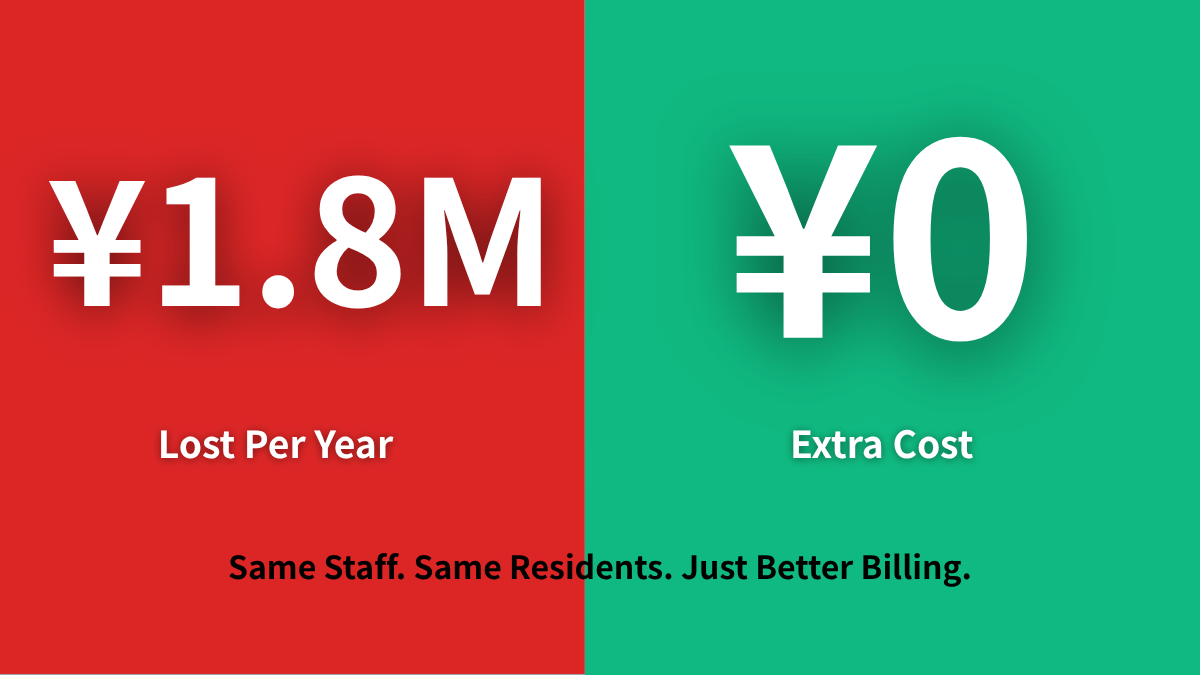
¥150,000 more per month. ¥1,800,000 more per year.
Without changing a single thing about my services, staffing, or resident count.
Care reimbursement billing is not administrative work. It is revenue strategy.
The Billing Structure That Silently Drains Your Profit
Care facility reimbursement systems—whether in Japan, across ASEAN, or in other regulated markets—share a common characteristic: extreme complexity.
Base rates vary by care level
Dozens of supplementary add-ons exist
Staff improvement subsidies have their own rules
Regional adjustments apply differently
Qualification requirements change regularly
If you don’t understand every detail, you don’t claim every dollar you’re entitled to.
And here’s the truly dangerous part:
Nobody tells you when you’re under-billing.
The government won’t flag it. Residents don’t notice. Your staff isn’t involved in billing. If the owner doesn’t catch it, the money simply vanishes—month after month, silently and permanently.
The Three Most Common Revenue Leaks in Care Facilities
Leak 1: Unclaimed Supplementary Add-Ons
This is the single biggest source of lost revenue in care facilities.
Your facility may already meet the requirements for supplementary billing categories:
Specialized service provisions
Enhanced staffing ratios
Night-shift staffing bonuses
Individualized care planning add-ons
Wheelchair accessibility improvements
Dementia care specialization programs
But if you haven’t filed the paperwork, you receive nothing.
Once approved, these add-ons generate recurring revenue every single month. Which means every month you delay is a month of permanent revenue loss.
Leak 2: Outdated Care Level Assessments
Residents’ conditions change over time:
Mobility decreases
Cognitive function declines
Need for assistance increases
But many facilities continue billing at the care level assigned at admission—sometimes for years.
The difference in reimbursement between a lower and higher care level can be substantial.
If a resident’s actual needs have increased but their official classification hasn’t been updated, you’re leaving that entire difference uncollected. This is invisible revenue loss, but over time it accumulates into a staggering amount.
Leak 3: Under-Optimized Staff Improvement Subsidies
Most regulated care markets offer subsidies or add-ons for facilities that invest in staff development:
Career path programs
Training systems
Wage improvement plans
Many facilities claim the basic tier but never upgrade to the higher tiers they’re actually eligible for.
The reasons are always the same: incomplete documentation, missing career development frameworks, or simply not knowing that a higher tier exists.
Staff improvement subsidies are not just labor cost offsets. They are a critical pillar of your profit structure.
Three Strategies to Maximize Revenue Without Changing Your Operations
Strategy 1: Conduct a Complete Billing Audit Every Three Months
Reimbursement regulations change regularly. New billing categories are added. Qualification requirements are relaxed. But most facilities set their billing structure once and never revisit it.
Every three months, I review three things:
Which add-ons we currently claim
Which add-ons we qualify for but haven’t claimed
What changes we need to make to qualify for additional categories
This single habit eliminates the majority of revenue leakage.
A quarterly review takes 2–3 hours and typically identifies ¥50K–¥150K in unclaimed revenue per review. That’s ¥200K–¥600K annually just from a three-hour quarterly check.
Strategy 2: Train Staff to Document Changes Through a Revenue Lens
Your care staff documents daily activities. But their records are focused on care delivery, not billing implications.
The critical shift is training them to flag changes that affect reimbursement:
Decreased food intake
Reduced mobility or increased fall risk
Increased need for toileting assistance
Cognitive decline or increased confusion
Behavioral changes requiring additional supervision
When these changes are documented systematically, you never miss the window to update a resident’s care level assessment.
This directly impacts revenue. A care level increase might mean ¥50K–¥100K more per month for that single resident.
Strategy 3: Build a System for Staying Ahead of Regulatory Changes
If you don’t know about a billing opportunity, you can’t claim it.
I make it a priority to:
Attend regional care provider meetings
Monitor government briefings on policy updates
Review regulatory revision documents immediately upon release
Subscribe to industry newsletters about reimbursement changes
Most facilities neglect this entirely. But in this business, information asymmetry equals profit asymmetry. The facility that learns about a new billing category first is the facility that claims it first.
What Happened When I Rebuilt My Billing from Scratch
In my early years, I didn’t fully understand the billing system. I was claiming the basics but missing multiple supplementary categories I was already qualified for.
When I finally conducted a complete audit, I:
Identified every unclaimed add-on we were eligible for
Prepared the necessary documentation for each category
Filed every application systematically
Restructured my operational tracking to ensure nothing would be missed again
The result: ¥150,000 more per month. ¥1,800,000 more per year.
I changed nothing about the care we provided. Nothing about the staff. Nothing about the number of residents.
I simply billed correctly for what we were already doing.
The Easiest Profit Improvement Most Owners Overlook
Most care facility owners focus their energy on:
Increasing occupancy
Reducing costs
Improving staff training
All of these are important. But there’s a faster path to higher profit that requires almost zero risk and zero additional cost:
Recover the revenue you’re already entitled to but aren’t collecting.
The Bottom Line: Billing Is Management
Billing is not paperwork. Billing is management.
If you don’t understand it, you lose money. If you master it, you gain profit. And the gap compounds every single month.
Your facility almost certainly has uncollected revenue waiting to be claimed right now.
Whether you find it depends on one thing: whether you look.
The difference between a struggling facility and a profitable one is often not better care or more residents. It’s better billing.
Ready to Audit Your Billing and Recover Hidden Revenue?
Get the complete billing optimization framework—showing exactly how to identify unclaimed add-ons, optimize care level assessments, stay ahead of regulatory changes, and recover the revenue you’re already entitled to but aren’t collecting.
About the author
Koujirou Nagata
I’m a Japanese care facility operator based in Kobe, Japan. Over 17 years, I built three small-scale residential care homes in the U.S., sold two of them for $2.7M in a 2022 M&A exit, and currently operate a third. My staff turnover has held at roughly 3% — against a U.S. industry average of 34.53% — and the majority of my admissions have come through family referrals rather than paid marketing.
I now help U.S. and ASEAN operators of small-scale residential care homes — board and care homes, adult family homes, and similar facilities — apply the same operating methods to their own launches and expansions. The resources I’ve built reflect what I actually use, not what looks good on paper.
More at smallcarefacility.com
Two ways forward
Take what you need from here.
If you’re starting
The Care Facility Starter Kit
Six free guides I use myself in the operation of small-scale care facilities — financial planning, property evaluation, the first 90 seconds of family tours, and referral partner outreach. The materials I share with operators who reach out to me directly.
6 PDFs · Pay what you want · Instant download
If you’re past the basics
Complete USA + ASEAN Care Business Bundle
Six in-depth operator guides covering USA market entry, state selection across 9 states, the full financial model, staff hiring & retention, and ASEAN market entry — plus 16 working Excel templates I use myself: hiring scorecard, financial simulator, 1-on-1 tracker, retention analytics, and more.
View the Complete Bundle — $167
6 guides + 16 Excel templates · One-time purchase · Instant download
Koujirou Nagata · 17 years operating small-scale care facilities · 3 facilities built · $2.7M M&A exit · Currently operating
Join Care Operators Maximizing Revenue Through Billing Mastery
Koujirou Nagata
17 years operating small-scale care facilities · 3 facilities built · $2.7M M&A exit · Currently operating