When a government inspector arrives at your facility, the instinct is immediate and visceral: “What did we do wrong? Are we getting shut down?”
The reality is far less dramatic.
A regulatory inspection at this stage is guidance—not punishment. No penalties are imposed. No licenses are revoked. The inspector is simply saying: “This needs to be fixed.”
However, how you respond determines everything that follows. The escalation path is clear and irreversible:
Guidance → Formal Warning → Order → License Revocation
The inspector isn’t just checking your facility. They’re evaluating you. How quickly you act. How accurately you understand the issue. How seriously you take it. The inspection itself is an assessment of your management capability.
The Four Behaviors That Turn Guidance into License Revocation
After 17 years of watching facilities succeed and fail through regulatory interactions, the pattern of failure is always the same:
Behavior 1: Dismissing Verbal Guidance
“It was just a verbal warning, nothing serious.”
This attitude guarantees the next visit will be formal—and far less forgiving. Regulators interpret dismissal as arrogance. The message they receive is: “This facility doesn’t take us seriously.”
Behavior 2: Assuming Operations Are Fine Without Verification
“Our team is doing great, there’s no real problem.”
Belief without evidence is exactly what regulators consider negligence. You haven’t verified the issue. You haven’t checked whether the correction is actually implemented. You’re operating on hope.
Behavior 3: Postponing Documentation Updates
“We’ll get to the paperwork later.”
Later never comes. And when the follow-up inspection arrives, undocumented corrections don’t exist in the regulator’s eyes. You claimed to fix something, but you didn’t prove it.
Behavior 4: Keeping Findings from Staff
If your team doesn’t know what was flagged, they can’t fix it. The same issue recurs, and the regulator concludes you have no intention of improving.
The result is always the same: repeated citations for the same issue, followed by the regulator’s conclusion that your facility lacks the willingness to improve. From there, the escalation is swift.
The 5-Step Response System That Builds Regulator Trust
Step 1: Document Everything on the Spot
Regulatory guidance is often delivered verbally. If you leave it to memory, critical details will be lost or distorted.
Write down every finding on the spot: what was cited, which specific area or process, and the direction of expected improvement.
After the visit, confirm your notes in writing with the inspector: “I want to make sure I understood correctly. Here’s what I documented from your visit. Please let me know if I’ve captured it accurately.”
“I think they meant…” is a recipe for correcting the wrong thing.
Step 2: Never Argue. Ever.
When you’ve been running a facility for years, hearing “this isn’t right” from someone who doesn’t work there every day can feel unfair. You may be right. It doesn’t matter.
Arguing on the spot achieves nothing positive and signals defensiveness—which regulators interpret as resistance to improvement.
The only correct response:
“Thank you for bringing this to our attention. We will review and address it immediately.”
That’s it. Express gratitude. Acknowledge the finding. Commit to action. Do not debate.
Step 3: Submit a Written Corrective Action Plan
This is where most facilities fall short—and where the best facilities separate themselves.
A verbal “we’ll take care of it” is meaningless.
Create a formal document specifying:
What will be corrected
How it will be corrected
By what date
Who is responsible
Submitting this proactively tells the regulator: “This facility takes action seriously. We have a plan. We have accountability.”
Step 4: Create Evidence of Every Correction
Fixing the problem is not enough. You must prove you fixed it.
Compile documented evidence: photographs, updated procedure manuals with revision dates, training logs with staff signatures, daily operation records showing the new process in action.
Without documented evidence, your correction doesn’t exist in the regulator’s eyes. Facilities that skip this step face re-inspection and escalation.
Documentation is not bureaucracy. Documentation is proof.
Step 5: Report Back Before They Follow Up
Once corrections are complete, contact the regulator and report proactively. Do not wait for them to check on you.
This single action communicates three things simultaneously:
Speed of response
Sincerity of commitment
Management competence
When you report before being asked, you shift the dynamic entirely. You are no longer a facility being monitored. You are a facility that monitors itself.
Regulators respect this. They see evidence of genuine commitment to improvement, not compliance-theater compliance.
How a Regulatory Finding Actually Raised My Facility’s Standing
I’ve received regulatory guidance myself. The findings related to documentation gaps and operational procedures. Nothing catastrophic—but real issues that needed attention.
Here’s exactly what I did:
End of day: Organized all findings by category and location
Next morning: Drafted a corrective action plan with specific timelines
Within one week: Completed all corrections and compiled evidence
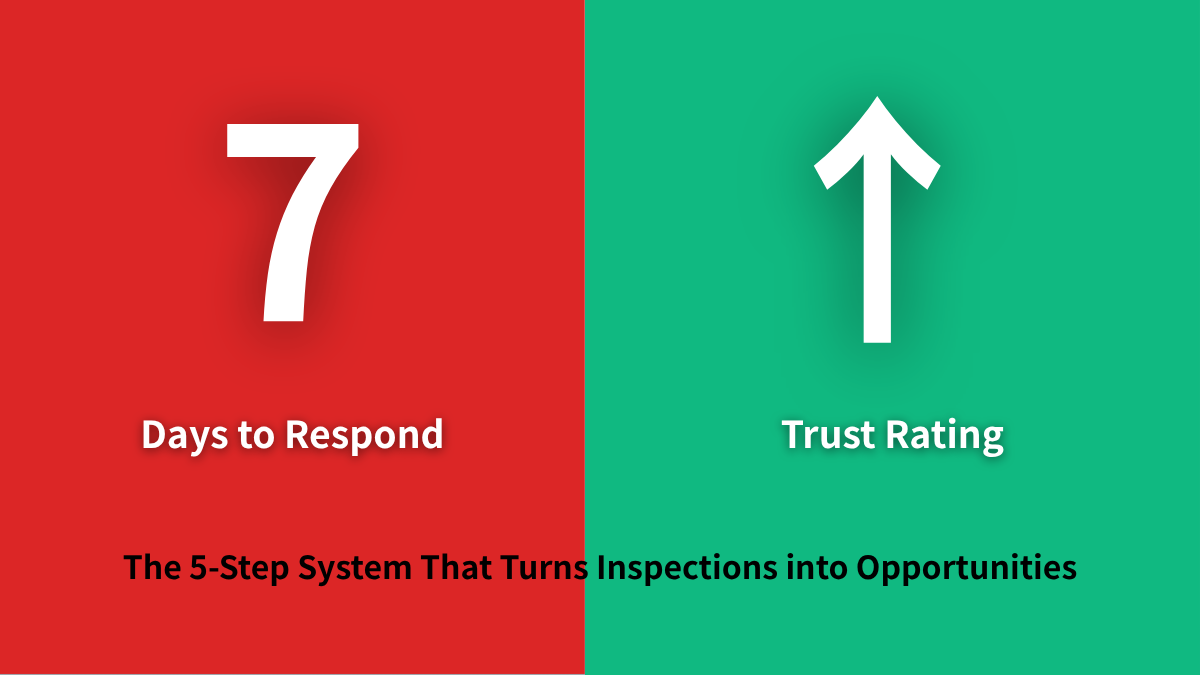
Day 7: Compiled evidence and submitted a voluntary report to the regulator
At the next formal audit, the inspector noted: “Your response was exceptionally fast and thorough.”
Despite having received guidance, my facility’s trust rating with regulators actually increased. The finding became an asset—not a liability.
Why? Because my response proved that management was competent, responsive, and genuinely committed to improvement.
The Bottom Line: Inspection Response Determines Facility Trajectory
Regulatory inspections are unavoidable. Every facility will face one eventually. The question is never whether you’ll receive guidance. The question is what you do next.
Facilities that panic, collapse. Facilities that respond systematically, emerge stronger.
A regulatory inspection is not a punishment. It’s a checkpoint. Only the facilities that clear it correctly survive long enough to build something lasting.
Ready to Turn Regulatory Inspections Into Trust Building?
Get the complete inspection response framework—showing exactly how to interpret findings, create corrective action plans, document corrections, and report proactively so inspections actually improve your relationship with regulators.
About the author
Koujirou Nagata
I’m a Japanese care facility operator based in Kobe, Japan. Over 17 years, I built three small-scale residential care homes in the U.S., sold two of them for $2.7M in a 2022 M&A exit, and currently operate a third. My staff turnover has held at roughly 3% — against a U.S. industry average of 34.53% — and the majority of my admissions have come through family referrals rather than paid marketing.
I now help U.S. and ASEAN operators of small-scale residential care homes — board and care homes, adult family homes, and similar facilities — apply the same operating methods to their own launches and expansions. The resources I’ve built reflect what I actually use, not what looks good on paper.
More at smallcarefacility.com
Two ways forward
Take what you need from here.
If you’re starting
The Care Facility Starter Kit
Six free guides I use myself in the operation of small-scale care facilities — financial planning, property evaluation, the first 90 seconds of family tours, and referral partner outreach. The materials I share with operators who reach out to me directly.
6 PDFs · Pay what you want · Instant download
If you’re past the basics
Complete USA + ASEAN Care Business Bundle
Six in-depth operator guides covering USA market entry, state selection across 9 states, the full financial model, staff hiring & retention, and ASEAN market entry — plus 16 working Excel templates I use myself: hiring scorecard, financial simulator, 1-on-1 tracker, retention analytics, and more.
View the Complete Bundle — $167
6 guides + 16 Excel templates · One-time purchase · Instant download
Koujirou Nagata · 17 years operating small-scale care facilities · 3 facilities built · $2.7M M&A exit · Currently operating
Join Care Operators Who View Inspections As Opportunities, Not Threats
Koujirou Nagata
17 years operating small-scale care facilities · 3 facilities built · $2.7M M&A exit · Currently operating