A Tour Is Not a Sales Pitch. It’s a Final Verdict.
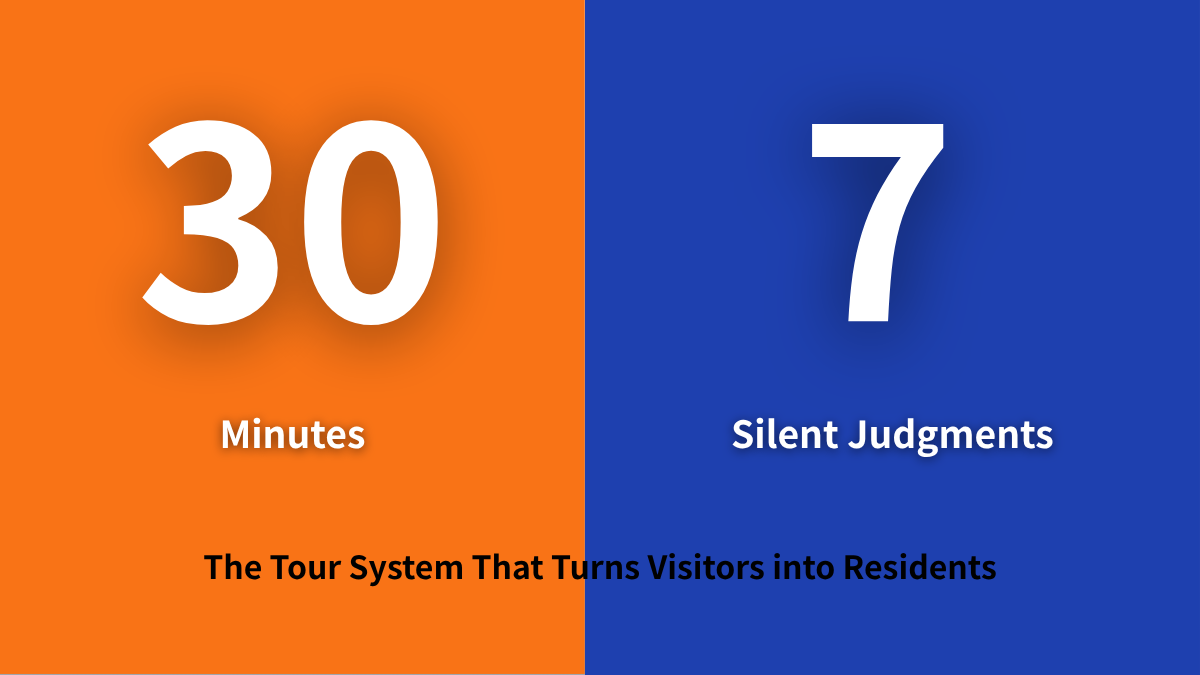
Families don’t choose care facilities from brochures or websites. They decide in 30 minutes—during the tour. And they’re not evaluating what you say. They’re reading signals you don’t even know you’re sending.
Most facility owners treat tours as an opportunity to explain their services. That’s the wrong framing entirely.
By the time a family schedules a visit, they’ve already narrowed their choices. They’re not shopping. They’re making a final decision. The tour is their last checkpoint: “Can I trust this place with my parent’s life?”
If you fail this 30-minute test, there is no second chance. They will never come back, and they will never tell you why.
They’ll simply place their parent elsewhere. Months later, you’ll notice the bed never filled. You’ll never know why.
The 7 Things Families Judge Without Realizing It
Signal 1: The Smell at the Entrance
Everything is decided in the first three seconds. The moment a family steps through your door, they inhale—and that single breath forms an impression that no amount of explanation can override.
If the entrance smells stale, clinical, or unclean, the visit is already over in their mind. They’re not consciously thinking: “This place smells bad.” They’re feeling: “This place is not being cared for properly.”
Smell cannot be faked. It’s the direct output of daily operations. A clean-smelling facility is proof of consistent management.
Signal 2: Staff Facial Expressions
Families pay more attention to your staff than to your building. Do staff members make eye contact? Do they greet visitors naturally? Are there genuine smiles?
Tense, distracted, or indifferent expressions tell the family one thing: “This team is under stress, and my parent will feel it.”
This is instinctive judgment, not conscious analysis. The family will later say: “Something felt off about the staff.” What they sensed was tension.
Signal 3: How Staff Interact with Current Residents
This is watched more closely than anything else. Does staff call residents by name? Do they make eye contact at the resident’s level? Is their tone warm and respectful?
The moment a staff member refers to a resident as “the person in Room 3,” trust collapses instantly. One impersonal phrase undoes everything.
The family is thinking: “If my parent is ‘Room 3’ to them, what happens when I’m not watching?”
Signal 4: The Dining Area and Common Spaces
Families notice every detail: floor cleanliness, table condition, kitchen hygiene, the organization of common areas, the comfort of furniture.
These small signals trigger a powerful inference in the family’s mind:
“If the visible areas are this careless, the parts we can’t see must be worse.”
They’re not evaluating the decor. They’re evaluating management quality.
Signal 5: The Expressions of Other Residents
This is the single most powerful factor in the family’s decision. Are residents calm and content? Are they engaged or abandoned? Do their faces show peace or distress?
The family is imagining one thing:
“Is this what my parent’s life will look like here?”
If there’s any doubt, the decision is already made. A resident sitting alone looking distressed says more than 100 brochures ever could.
Signal 6: Honesty During the Explanation
Facilities that only present positives are not trusted. Experienced families see through it immediately.
The facilities that win are the ones that openly state: “Here’s what we can do. Here’s what we can’t. And here are the risks you should be aware of.”
Transparency is the fastest path to trust. Overselling is the fastest path to suspicion.
When a facility owner admits limitations, families hear: “This person knows what they’re doing and isn’t pretending otherwise.”
Signal 7: How You Say Goodbye
The final 30 seconds of the visit determine the lasting impression. Does someone walk the family to the door? Is there a personal word of thanks? Is the farewell warm and unhurried?
A careless goodbye erases 29 minutes of good impressions. A thoughtful goodbye seals the decision. The last moment is the one they carry home.
The family will remember the goodbye more than the tour.
Never Leave Tour Quality to Individual Talent
The biggest trap in tour management is relying on individual personality.
“She’s great with families” works until she’s sick, on leave, or quits. If your conversion rate depends on who happens to be available that day, your occupancy will be permanently unstable.
Professional facilities systematize the tour experience. Every element is documented. Every staff member is trained. Results are predictable.
How I Systematized Tours to Guarantee Consistent Results
At my facility, every element of the tour is standardized:
Fixed walking route: Same order every time. No improvisation. This ensures nothing is missed and the pacing is consistent.
Standardized talking points: At each stop, specific information is shared. No rambling. No staff member deciding what to emphasize.
Shared checklist: Key moments to address. Family concerns to anticipate. Questions to answer proactively.
Documented farewell protocol: How to end the tour. What to say. How to follow up within 24 hours.
The result: any staff member can deliver the same quality tour. Conversion rates from visits to move-ins became stable and predictable.
Residents don’t arrive by luck. They arrive by system.
The Most Important Sales Process Your Facility Has
A facility tour lasts 30 minutes. But those 30 minutes determine years of revenue.
A well-executed tour converts one family into a resident who stays 3-5 years
That resident generates ¥900K – ¥1.5M in revenue over their tenure
That family refers other families, generating additional occupancy
One 30-minute tour can be worth ¥2M+ in lifetime value
Facilities that prepare for tours fill beds. Facilities that wing it watch families walk away.
A tour is not a task. It is the most important sales process your facility has. Invest everything in those 30 minutes.
About the author
Koujirou Nagata
I’m a Japanese care facility operator based in Kobe, Japan. Over 17 years, I built three small-scale residential care homes in the U.S., sold two of them for $2.7M in a 2022 M&A exit, and currently operate a third. My staff turnover has held at roughly 3% — against a U.S. industry average of 34.53% — and the majority of my admissions have come through family referrals rather than paid marketing.
I now help U.S. and ASEAN operators of small-scale residential care homes — board and care homes, adult family homes, and similar facilities — apply the same operating methods to their own launches and expansions. The resources I’ve built reflect what I actually use, not what looks good on paper.
More at smallcarefacility.com
Two ways forward
Take what you need from here.
If you’re starting
The Care Facility Starter Kit
Six free guides I use myself in the operation of small-scale care facilities — financial planning, property evaluation, the first 90 seconds of family tours, and referral partner outreach. The materials I share with operators who reach out to me directly.
6 PDFs · Pay what you want · Instant download
If you’re past the basics
Complete USA + ASEAN Care Business Bundle
Six in-depth operator guides covering USA market entry, state selection across 9 states, the full financial model, staff hiring & retention, and ASEAN market entry — plus 16 working Excel templates I use myself: hiring scorecard, financial simulator, 1-on-1 tracker, retention analytics, and more.
View the Complete Bundle — $167
6 guides + 16 Excel templates · One-time purchase · Instant download
Koujirou Nagata · 17 years operating small-scale care facilities · 3 facilities built · $2.7M M&A exit · Currently operating
Koujirou Nagata
17 years operating small-scale care facilities · 3 facilities built · $2.7M M&A exit · Currently operating