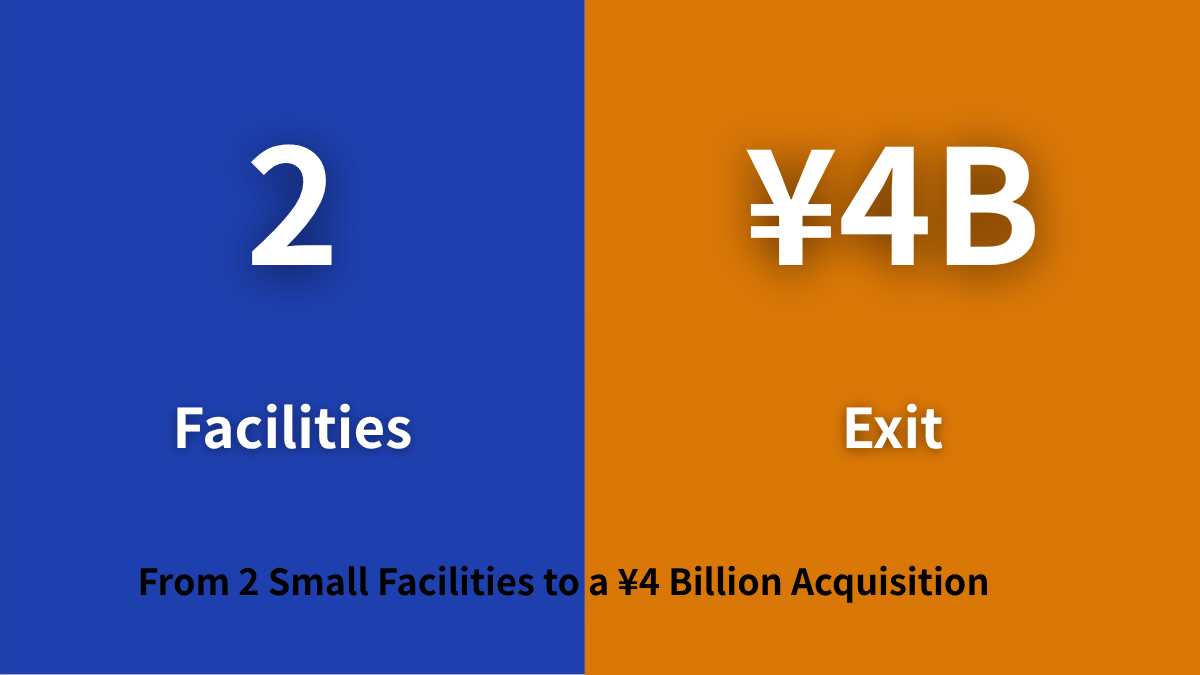
The False Choice That Traps Every Care Operator
Most care facility operators believe they face a binary decision:
Option 1: Stay Small — Operate a single facility, accept modest income, build a comfortable but limited business
Option 2: Go Big — Raise massive capital, attempt a regional or national chain, accept years of operating losses while scaling
Both options feel limiting. Option 1 caps your potential. Option 2 requires resources most entrepreneurs simply don’t have access to.
There’s a third path that almost nobody talks about.
I call it strategic scaling—growing methodically from one facility to multiple locations, making each one profitable before opening the next, until the combined operation becomes an irresistible acquisition target for institutional buyers.
This is exactly what I did. And the ¥4,000,000,000 exit price proved the model works.
Phase 1: Seven Years of Obsessive Optimization (Years 1–7)
The biggest mistake that scaling-minded entrepreneurs make is expanding before their first facility is truly optimized. They see profit and immediately think: “Now I can open a second location.”
This is how entrepreneurs double their losses instead of doubling their revenue.
I spent seven full years—not three, not five, seven—refining every aspect of my first facility before even considering a second location.
What “Fully Optimized” Actually Means in Practice
1. Consistent 95%+ Occupancy with a Waiting List
Your facility is not just full—it has more demand than supply. If you can’t consistently fill one facility, opening a second will not double your revenue. It will double your losses, because the problems that prevented full occupancy at facility one will replicate at facility two.
A waiting list is proof of product-market fit. You have a proven offering that exceeds local demand. Now you can expand that offering to a new location.
2. Every Process Documented and Teachable
From morning care routines to family communication protocols—everything written down. Every procedure documented. Every exception explained.
Why? Because if your operation depends on you being physically present, it’s not a business. It’s a job. And you can’t scale a job.
Documentation allows other people to execute your systems at the same quality level you would. This is the foundation of replication.
3. Staff Independence and Capability
Your team can run daily operations without you for two full weeks. They make decisions. They solve problems. They communicate with families and regulators. They do all of this without calling you for approval.
If your staff needs you to function, you don’t have a business. You have a dependency.
4. Active Referral Network
Care managers and local physicians are actively recommending your facility without you asking. They call you directly. They place residents without formal marketing.
If you still need to generate leads through advertising or sales calls, you’re not ready to scale. You don’t have product-market fit yet.
Phase 2: Clone the Playbook, Don’t Reinvent It (Years 7–12)
When I opened my second facility, I didn’t start from scratch. I didn’t “innovate” with a new approach. I cloned what worked.
Same operating procedures
Same staff training program
Same relationship-building approach with regulators and referral sources
Same care philosophy and daily practices
The absolute rules for facility number two:
Rule 1: Same Region
Close enough to physically visit both locations in a single day. You want regional depth, not national ambition at this stage.
Why? Because you need to personally oversee both facilities while the second one is establishing itself. You need to build relationships with the second region’s regulatory officials and referral sources. You need hands-on knowledge of both markets.
Attempting to scale nationally before you’ve successfully replicated locally almost always fails.
Rule 2: Gradual Expansion
Scale the bed count modestly. If your first facility operated 21 beds, the second might be 31 beds—not a jump to 50 or 100. Keep the model that’s already proven.
Small increases in scale keep the operational complexity manageable. You’re testing and refining the systems, not betting everything on a dramatically different size.
Rule 3: Promote From Within
The second facility’s manager should be a senior caregiver from facility one. Someone who already understands the culture. Someone who already knows your systems.
They don’t need to be trained in your philosophy because they’ve lived it for five years. No external hire can replicate that institutional knowledge, no matter how impressive their resume looks.
Phase 3: Build an Asset, Not Just a Business (Years 7–17)
This is where the strategic thinking diverges from typical care operator thinking.
Most operators think about monthly revenue. Smart operators think about asset value. There’s a massive difference.
Monthly revenue pays your bills. Asset value makes you wealthy.
When you’re thinking about scaling, you’re no longer optimizing for monthly profit. You’re optimizing for the value of the operation when you eventually sell it.
The Factors That Increase Your Operation’s Value to Potential Buyers
Value Factor Why Buyers Care How to Build It
Predictable Revenue Long-term residents with stable payment sources. High retention means predictable cash flow—exactly what institutional buyers want to see. Focus on resident satisfaction, family relationships, and care quality. High satisfaction = long tenure = predictable revenue.
Low Owner-Dependence If the business runs smoothly without you, it commands a premium. If it collapses when you leave, it’s worthless. Build systems. Document processes. Develop capable management teams. Prove the operation functions without your daily involvement.
Clean Compliance History Zero regulatory violations are a signal of operational excellence and risk mitigation. Maintain strong relationships with regulators. Conduct proactive compliance reviews. Resolve issues before they become violations.
Proven Scalability Multiple facilities running the same model prove to buyers that it can be replicated further—which is exactly what they’re paying for. Demonstrate that your model works across different locations, different populations, and different market conditions.
Relationship Networks Care manager relationships and physician referral networks are hard assets that don’t appear on balance sheets but generate real value. Invest heavily in building and maintaining professional relationships. They become the mechanism that fills your beds.
Why the Buyers Paid ¥4 Billion
When institutional buyers evaluated my operation, they weren’t primarily paying for buildings or equipment. Those physical assets were a small fraction of the purchase price.
What they were paying for:
A Proven System: The staff retention methodology that kept turnover at 3% (versus industry average of 40%+)
Regulatory Relationships: Built over 17 years with government officials who trusted our operations
Referral Networks: Care managers and physicians who maintained 95% occupancy without marketing spend
Documented Operating Procedures: Systems that could be replicated at new locations without the founder present
Track Record: Consistent profitability across multiple facilities proving the model’s sustainability
You’re not building a care facility. You’re building a business system that operates care facilities. That system is what commands premium M&A multiples.
The buyer wasn’t acquiring buildings. They were acquiring the intellectual property—the documented knowledge of how to run profitable, high-quality care facilities that consistently maintain high occupancy and staff retention.
Combined with the deep trust earned from 17 years in the local community, this system was worth ¥4,000,000,000.
The Three Phases at a Glance
Phase Years Focus Key Metric Exit Readiness
Phase 1: Optimize 1-7 Perfect one facility. Document everything. Build referral network. 95%+ occupancy with waiting list Facility is self-sustaining without founder
Phase 2: Replicate 7-12 Clone the proven model to a second facility in the same region. Promote from within for management. Both facilities at 90%+ occupancy Multiple facilities running the same system
Phase 3: Build Asset 7-17 Focus on value drivers: predictability, low owner-dependence, compliance, relationships. Institutional buyer interest emerges Operation valued at ¥4B+ premium multiple
Ready to Build a Scalable Care Facility System?
Get the complete strategic scaling framework—showing exactly how to optimize one facility, replicate the model, and build an operation valuable enough for institutional acquisition.
About the author
Koujirou Nagata
I’m a Japanese care facility operator based in Kobe, Japan. Over 17 years, I built three small-scale residential care homes in the U.S., sold two of them for $2.7M in a 2022 M&A exit, and currently operate a third. My staff turnover has held at roughly 3% — against a U.S. industry average of 34.53% — and the majority of my admissions have come through family referrals rather than paid marketing.
I now help U.S. and ASEAN operators of small-scale residential care homes — board and care homes, adult family homes, and similar facilities — apply the same operating methods to their own launches and expansions. The resources I’ve built reflect what I actually use, not what looks good on paper.
More at smallcarefacility.com
Two ways forward
Take what you need from here.
If you’re starting
The Care Facility Starter Kit
Six free guides I use myself in the operation of small-scale care facilities — financial planning, property evaluation, the first 90 seconds of family tours, and referral partner outreach. The materials I share with operators who reach out to me directly.
6 PDFs · Pay what you want · Instant download
If you’re past the basics
Complete USA + ASEAN Care Business Bundle
Six in-depth operator guides covering USA market entry, state selection across 9 states, the full financial model, staff hiring & retention, and ASEAN market entry — plus 16 working Excel templates I use myself: hiring scorecard, financial simulator, 1-on-1 tracker, retention analytics, and more.
View the Complete Bundle — $167
6 guides + 16 Excel templates · One-time purchase · Instant download
Koujirou Nagata · 17 years operating small-scale care facilities · 3 facilities built · $2.7M M&A exit · Currently operating
Join Entrepreneurs Building Systems, Not Just Facilities
Koujirou Nagata
17 years operating small-scale care facilities · 3 facilities built · $2.7M M&A exit · Currently operating