The Advertising Trap That Bleeds Care Facilities Dry
Senior care operators in the United States spend an average of $3,000–$8,000 per month on digital advertising. Google Ads. Facebook campaigns. Lead generation services. LinkedIn targeted outreach. They obsessively track cost-per-click, conversion rates, and return on ad spend.
And most of them still run below 80% occupancy.
The problem isn’t their advertising strategy. The problem is that advertising is the wrong tool entirely.
Elder care isn’t an impulse purchase. Families don’t choose a care facility because they saw a Google ad on a Tuesday morning. They choose based on trust—trust from people they already trust: their parent’s physician, the hospital discharge planner, the care manager who has personally visited your facility and observed how you treat residents.
Advertising generates leads. Referrals generate residents. The conversion rate difference is roughly 10:1.
The ¥400,000 Mistake That Taught Me Everything
I opened my first facility in 2005. At that time, residential care homes were still a new and unfamiliar concept in my region. I did what most entrepreneurs instinctively do—I spent money on advertising.
Newspaper inserts advertising my facility’s services
Brochure distribution through neighborhood mail campaigns
Door-to-door flyer drops in surrounding residential areas
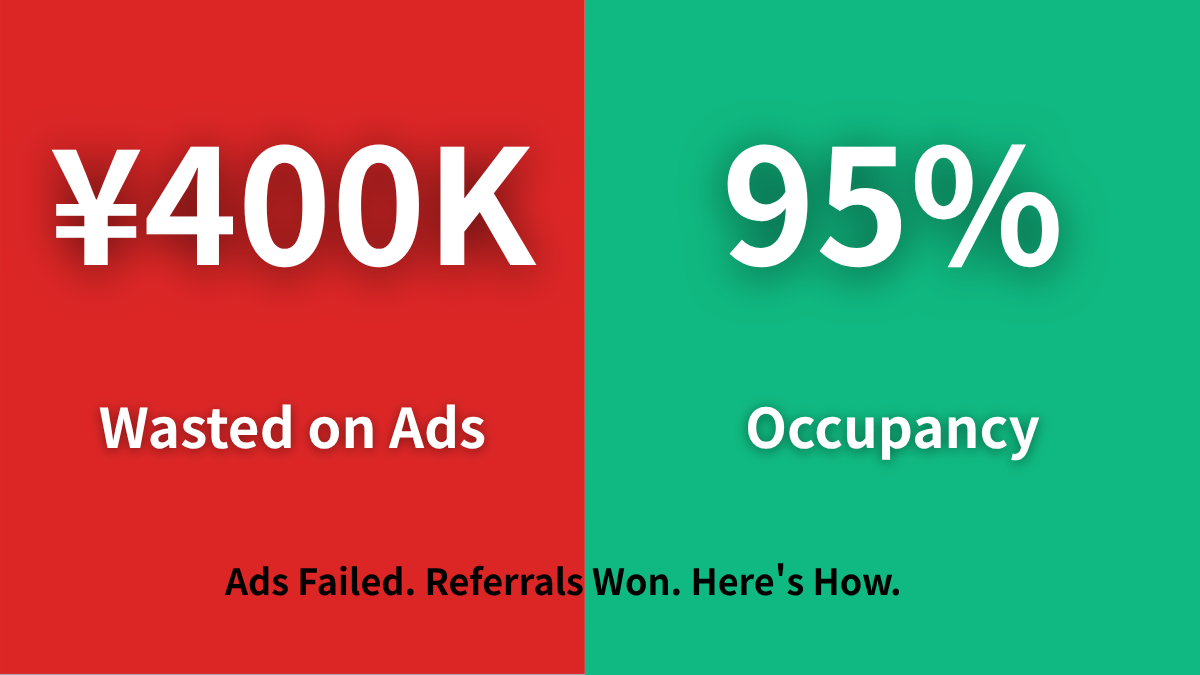
Total cost: approximately ¥400,000
The result? A handful of residents. The return on that investment was almost zero.
I was spending substantial capital on a marketing approach that generated minimal results. The disconnect between investment and outcome was undeniable.
Then I tried something completely different.
The Turning Point: One Speech That Changed Everything
I attended a local care manager association meeting—not to sell, but simply to observe and learn.
The organizers asked if I would give a brief presentation about my facility.
I agreed. My presentation wasn’t a sales pitch. It was an honest explanation of my care philosophy, my approach to elderly care, and what made our facility different from others in the region.
I talked about how we viewed residents not as cases to manage, but as human beings deserving of dignity and personal attention. I discussed our daily practices, how we engaged with families, and how we approached medical coordination. I answered questions directly and honestly.
That single presentation changed everything.
Care managers across the region learned about our facility from the person who actually ran it. They understood our philosophy. They could assess whether our approach aligned with the needs of the families they served.
Referrals started flowing in steadily. Within months, our beds were filling up—not from newspaper ads or flyer drops, but from professionals who trusted us enough to send families our way.
The Doctor I Met by Chance Who Became Our Medical Partner
Around the same time I was rebuilding the referral system, I began making introduction visits to nearby medical clinics—not to sell anything, but simply to introduce our facility and leave a brochure with accurate information.
During one of these routine visits, I met a physician who was considering opening his own practice in the area.
Years later, when he did open his practice, he became our cooperating medical institution. That one relationship—born from a simple, no-agenda visit—provided our facility with reliable medical oversight and a steady stream of patient referrals for years.
Serendipity is real. But it only happens when you show up.
The relationships that fill your beds aren’t built through advertising. They’re built through consistent, genuine presence in the professional networks that refer patients.
The Three Gatekeepers Who Fill Every Bed
Over 17 years, I’ve tracked where every single resident came from with meticulous detail. The pattern is unmistakable and consistent across all three of my facilities.
Three types of professionals are responsible for nearly 100% of admissions:
1. Care Manager Offices
Care managers (also called case managers or care coordinators) assess elderly clients’ needs and recommend appropriate facilities that match those needs. The care manager role is critical in ASEAN and USA markets.
A single care manager can refer 5-10 residents per year to facilities they trust
They visit your facility, talk to your staff, and observe your care quality firsthand
If they trust you, they’ll send families to you before recommending any competitor
They become advocates for your facility, not from marketing, but from genuine trust in your operations
2. Hospital Discharge Planners
When elderly patients are ready to leave the hospital but cannot live independently at home, hospital discharge planners find appropriate placement options. This is a critical referral source.
They need facilities that can accept residents quickly and reliably
They need facilities that deliver appropriate care aligned with patient medical needs
They need facilities that communicate professionally with the medical team and hospital
Speed, reliability, and professionalism matter more than price to discharge planners
3. Local Primary Care Physicians
Family doctors who treat elderly patients are constantly asked by families: “Doctor, do you know a good care facility?” A physician’s recommendation carries enormous weight.
One trusted doctor can fill multiple beds per year through referrals
Physicians refer based on trust in your facility’s care quality and medical coordination
Physician recommendations are the highest-trust referral source because families default to physician judgment
No amount of advertising can match the influence of a physician’s personal recommendation
How I Built Relationships with All Three—for Zero Cost
My method was simple, consistent, and cost nothing to implement.
Every month, I visited care managers, discharge planners, and physicians across my area. Not to sell—to introduce, to share information, and to become a familiar, trusted face.
The Three-Step Relationship Building Framework
Step 1: Initial Visit
Bring a facility brochure with accurate, detailed information
Introduce yourself personally and your facility philosophy
Ask about their needs and challenges in placing elderly clients
Listen more than you talk. Show genuine interest in their concerns
Leave your direct phone number and make yourself accessible
Step 2: Monthly Follow-Ups
Share facility updates and changes that might affect referral decisions
Ask proactively if they have clients who might benefit from your services
Report back on previously referred residents—how they’re doing, how their families feel about the care
Maintain consistent, light-touch contact that shows you value the relationship
Step 3: The Decisive Moment—Gratitude for Trust
When a referred resident achieves a positive outcome, send a brief thank-you note to the referring professional
Share specific details about the resident’s progress and family satisfaction
This simple gesture builds loyalty that no amount of advertising can buy
It signals that you value their trust and take their referrals seriously
The Numbers: Why Referrals Deliver 95% Occupancy
Referral-based admissions convert at dramatically higher rates because the trust barrier has already been cleared before the family ever contacts you.
Metric Advertising-Based Lead Professional Referral
Inquiry to admission conversion rate 3-5% 40-60%
Cost per resident acquired ¥500,000–¥1,500,000 ¥0 (only your time)
Admission quality (fit and stability) Often poor (wrong expectations) Usually excellent (pre-screened fit)
Resident satisfaction Variable (high expectation mismatch) High (realistic expectations set)
Referral source reliability Sporadic (platform algorithm changes) Consistent (relationship-based)
The financial difference is stark: Referral-based occupancy costs effectively zero per resident, while advertising-based occupancy costs ¥500K-¥1.5M per resident.
How to Build This System in USA and ASEAN Markets
The professional titles differ across countries, but the structure is identical.
Every senior care market has three categories of gatekeepers who control the flow of residents into facilities:
Needs assessors (care managers, social workers, case managers)
Hospital discharge coordinators and medical placement specialists
Primary care physicians and geriatric specialists
Your approach is the same in every market:
Find them
Visit them regularly (monthly is ideal)
Build trust through genuine engagement and excellent care outcomes
Report back on referred residents to show you value their trust
Become the facility they call first when a family needs help
Your waiting list is sitting in the offices of professionals who don’t know you exist yet. Go introduce yourself.
Stop spending money on advertising that generates low-conversion leads.
Start spending time on relationships that generate high-conversion residents.
The time investment is minimal. The return is exponential.
Ready to Build a Zero-Cost Referral System for Your Care Facility?
Get the complete relationship-building framework—showing exactly how to identify, approach, and build lasting trust with the three gatekeepers who fill every bed in your facility.
About the author
Koujirou Nagata
I’m a Japanese care facility operator based in Kobe, Japan. Over 17 years, I built three small-scale residential care homes in the U.S., sold two of them for $2.7M in a 2022 M&A exit, and currently operate a third. My staff turnover has held at roughly 3% — against a U.S. industry average of 34.53% — and the majority of my admissions have come through family referrals rather than paid marketing.
I now help U.S. and ASEAN operators of small-scale residential care homes — board and care homes, adult family homes, and similar facilities — apply the same operating methods to their own launches and expansions. The resources I’ve built reflect what I actually use, not what looks good on paper.
More at smallcarefacility.com
Two ways forward
Take what you need from here.
If you’re starting
The Care Facility Starter Kit
Six free guides I use myself in the operation of small-scale care facilities — financial planning, property evaluation, the first 90 seconds of family tours, and referral partner outreach. The materials I share with operators who reach out to me directly.
6 PDFs · Pay what you want · Instant download
If you’re past the basics
Complete USA + ASEAN Care Business Bundle
Six in-depth operator guides covering USA market entry, state selection across 9 states, the full financial model, staff hiring & retention, and ASEAN market entry — plus 16 working Excel templates I use myself: hiring scorecard, financial simulator, 1-on-1 tracker, retention analytics, and more.
View the Complete Bundle — $167
6 guides + 16 Excel templates · One-time purchase · Instant download
Koujirou Nagata · 17 years operating small-scale care facilities · 3 facilities built · $2.7M M&A exit · Currently operating
Join Entrepreneurs Building 95%+ Occupancy Without Marketing Budgets
Koujirou Nagata
17 years operating small-scale care facilities · 3 facilities built · $2.7M M&A exit · Currently operating