Why 80% of Care Facility Applications Get Sent Back
The licensing process is the first critical checkpoint where most care facility entrepreneurs stumble. The paperwork is massive, the requirements are highly technical, and a single mistake can delay your opening by months.
In both the USA and ASEAN markets, the majority of first-time applications get returned. Corrections requested. Additional documents demanded. Missing signatures discovered. A smooth first-pass approval is the exception, not the rule.
But complexity isn’t actually the real problem.
Most entrepreneurs treat licensing as a bureaucratic obstacle to push through as quickly as possible. What they completely miss is that it’s actually the starting point for building a relationship with the regulatory body—a relationship that will protect your business for years to come.
The “Submit and Pray” Method That Always Fails
Here’s how most entrepreneurs approach licensing—and why it consistently fails:
The Standard Approach
Step 1: Research requirements online or hire a consultant
Step 2: Prepare documents following published guidelines
Step 3: Submit the complete package
Step 4: Wait weeks or months for a response
Step 5: Receive a rejection or correction request. Start over.
On the surface, this looks like the logical, correct process. But there’s a critical flaw that undermines everything.
This approach treats the regulatory office as an impersonal processing machine. You’re throwing your application over a wall and hoping someone on the other side catches it correctly. That’s not a strategy—it’s a gamble. And most gamblers lose.
The Real Reason “Perfect” Applications Get Rejected
The most common licensing failure isn’t sloppy paperwork or missing signatures.
It’s submitting a technically correct application that misses what reviewers actually look for.
Entrepreneurs spend months preparing documents, only to have the entire application bounced back with a single correction request—sending them back to square one. This is the moment most people lose heart and consider abandoning the project entirely.
But the problem isn’t the quality of your documents.
The problem is that you don’t understand how the reviewer actually thinks about the application.
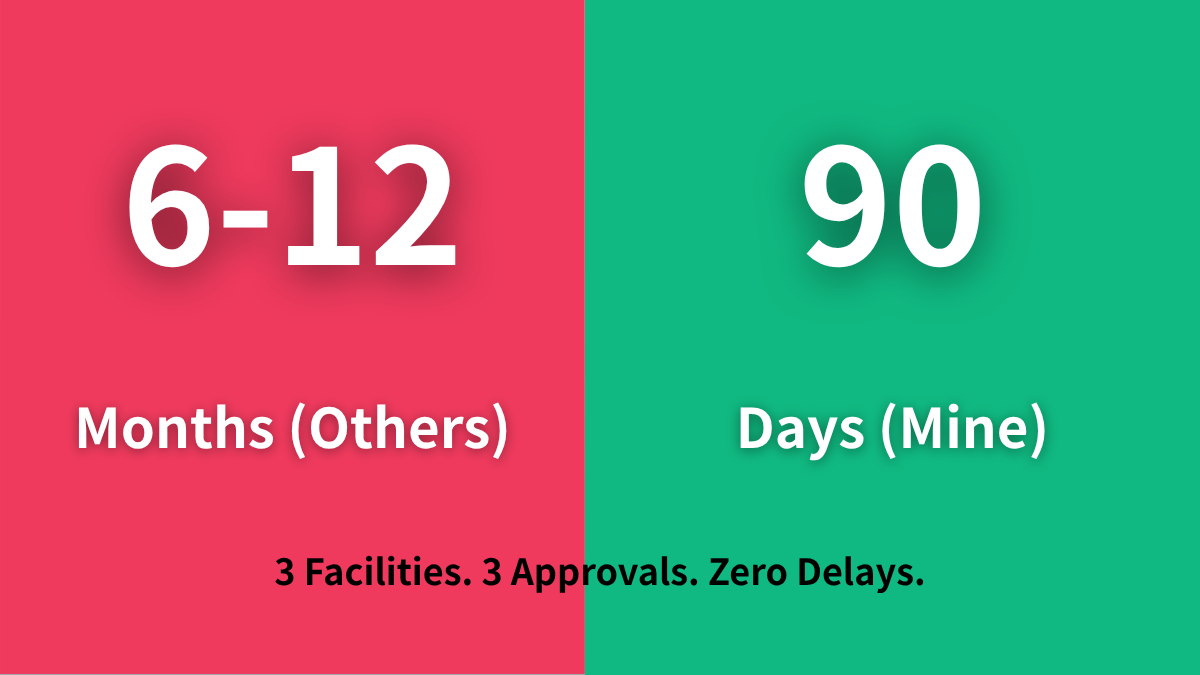
I’ve submitted licensing applications for three separate facilities across different regions. Not one was ever delayed or rejected. Not one required resubmission. The reason is simple and actionable: before I write a single document, I spend time learning how the licensing reviewers actually evaluate applications.
My 90-Day Licensing Timeline: Week by Week
Weeks 1–2: Visit the Welfare Office Counter Before Writing Anything
Before touching a single form, before drafting any documents, I visit the licensing office’s public consultation counter.
I bring a one-page concept summary of my planned facility and ask two direct questions:
“What are the most common reasons applications get delayed or rejected?”
“Do you have a published checklist or guideline that shows the exact requirements?”
This one visit eliminates 80% of potential problems before they ever exist. You’re getting the insider knowledge from the people who actually review applications. You’re understanding what keeps reviewers up at night. You’re learning the mistakes that trip up most applicants.
There is nothing improper about using the office’s public consultation service. That’s exactly what it exists for.
Weeks 3–4: Draft Using Official Guidelines and Counter Insights
Using the official checklists and requirements you obtained at the counter, prepare your application.
Because you already know the most common rejection reasons from your counter visit, you address every one of them proactively. The goal isn’t just a complete application—it’s an application that anticipates and answers the questions reviewers will have.
For example: If the counter staff mentioned that many applicants forget to include proof of physician availability, you don’t just include it—you emphasize it. You make it impossible for the reviewer to miss.
Weeks 5–6: Resolve Remaining Questions Through Public Consultation
For any questions that arise during your drafting, use the office’s public consultation service again.
“Is this the correct format for this section?” “Is this particular document required for my facility type?” “Can this requirement be satisfied with [specific approach]?”
These are straightforward questions that any applicant is entitled to ask. The office staff are there to answer them. There is nothing improper about using publicly available consultation services to ensure compliance—that’s exactly what they exist for.
This week-5-6 consultation also serves another purpose: it makes you a familiar face to the staff who will review your application. They’ve helped you prepare. They have some investment in seeing your application succeed.
Weeks 7–8: Submit a Clean, Thoroughly Prepared Application
An application built on official guidelines, informed by counter consultation, and refined through legitimate questions is far less likely to receive correction requests.
You’ve already addressed the problems that trip up 80% of first-time applicants.
Your application doesn’t just meet the letter of the law—it demonstrates that you understand what the law is trying to accomplish. You’ve thought through not just the form, but the intent behind the form.
Weeks 9–12: Approval
A thoroughly prepared application moves through the review process without delays. Clean in, clean out.
Three times, I’ve followed this process. Three times, I’ve had approval within 90 days. No revisions. No delays. No surprises.
The Hidden Payoff: An Early Warning System That Lasts 17 Years
Licensing isn’t a one-time event. The real, long-term value comes after your approval is granted.
By becoming a familiar face at the welfare office during the licensing process, you naturally stay connected to regulatory developments.
Updated guidelines arriving in the pipeline
Upcoming rule changes being discussed
Industry shifts that affect your operations
Regulatory focus areas changing
This information starts reaching you before it becomes a public announcement. Before it becomes a crisis.
My facilities operated for 17 years without a single regulatory surprise. Not once was I caught off guard by a rule change. Not once did I face an emergency modification or compliance crisis. Why? Because I received information about changes before the change happened, through the relationships I’d built during licensing and maintained through consistent engagement.
Most facilities scramble when regulations change. They face emergency modifications, costly corrections, and in the worst cases, the threat of suspension or closure. But when you have advance information, “reaction” turns into “preparation.”
Three Simple Habits That Change Everything
The entire system comes down to three practices:
1. Confirm Requirements at the Counter Before You Apply
Don’t guess. Don’t assume. Don’t rely on online research alone. Talk to the people who will review your application and ask them what success looks like.
2. Ask Questions Before You Assume
The office’s consultation service exists for applicants. Use it. Ask for clarification. Confirm your interpretation. Get the information in writing when possible.
3. Become a Familiar Face Before You Need to Be
Your counter visits, your questions, your engagement during the licensing process—these create familiarity with office staff. That familiarity becomes your early warning system for future regulatory changes.
That’s it. Your license arrives faster, your ongoing compliance stays smooth, and regulatory risks disappear—simply because you prepared thoroughly using every legitimate resource available and built relationships with the people who regulate your industry.
Ready to Navigate Licensing in 90 Days With Zero Delays?
Get the complete licensing framework—showing exactly how to use public consultation services, understand regulator thinking, and build relationships that protect your facility for 17+ years of operation.
About the author
Koujirou Nagata
I’m a Japanese care facility operator based in Kobe, Japan. Over 17 years, I built three small-scale residential care homes in the U.S., sold two of them for $2.7M in a 2022 M&A exit, and currently operate a third. My staff turnover has held at roughly 3% — against a U.S. industry average of 34.53% — and the majority of my admissions have come through family referrals rather than paid marketing.
I now help U.S. and ASEAN operators of small-scale residential care homes — board and care homes, adult family homes, and similar facilities — apply the same operating methods to their own launches and expansions. The resources I’ve built reflect what I actually use, not what looks good on paper.
More at smallcarefacility.com
Two ways forward
Take what you need from here.
If you’re starting
The Care Facility Starter Kit
Six free guides I use myself in the operation of small-scale care facilities — financial planning, property evaluation, the first 90 seconds of family tours, and referral partner outreach. The materials I share with operators who reach out to me directly.
6 PDFs · Pay what you want · Instant download
If you’re past the basics
Complete USA + ASEAN Care Business Bundle
Six in-depth operator guides covering USA market entry, state selection across 9 states, the full financial model, staff hiring & retention, and ASEAN market entry — plus 16 working Excel templates I use myself: hiring scorecard, financial simulator, 1-on-1 tracker, retention analytics, and more.
View the Complete Bundle — $167
6 guides + 16 Excel templates · One-time purchase · Instant download
Koujirou Nagata · 17 years operating small-scale care facilities · 3 facilities built · $2.7M M&A exit · Currently operating
Join Entrepreneurs Getting First-Pass Licensing Approval Without Delays
Koujirou Nagata
17 years operating small-scale care facilities · 3 facilities built · $2.7M M&A exit · Currently operating