Three Night-Shift Mistakes That Destroy Small Care Facilities
Mistake 1: Overstaffing
Placing two staff members on night duty at a 4–6 bed facility crushes your labor cost ratio instantly.
For small-scale operations, a two-person night shift is almost always a profit killer. Your fixed labor cost increases dramatically while your revenue remains unchanged. The unit economics collapse.
Many owners make this mistake out of fear: “What if something happens at night? We need backup.” The fear is understandable. But operationally, it’s unsustainable.
Mistake 2: No Staff at All
This is indefensible both legally and ethically.
Nighttime is when falls, choking incidents, and sudden health changes are most likely to occur. I’ve seen facilities where a single unmonitored nighttime fall led to a fracture, hospitalization, discharge, and permanent loss of the family’s trust—all from a single incident that proper staffing could have prevented.
The cost of one properly trained night worker is nothing compared to the cost of one preventable accident.
Mistake 3: Making Day Staff Pull Double Duty
Having day-shift workers cover nights seems efficient in the short term.
In reality, it guarantees burnout. Fatigue accumulates. Care quality drops. Mistakes multiply. Complaints escalate. Staff quit.
This cycle is predictable and irreversible once it starts. A caregiver working 16 hours straight is not providing good care at hour 15. They’re a liability.
The Night-Shift Model I’ve Used for 17 Years
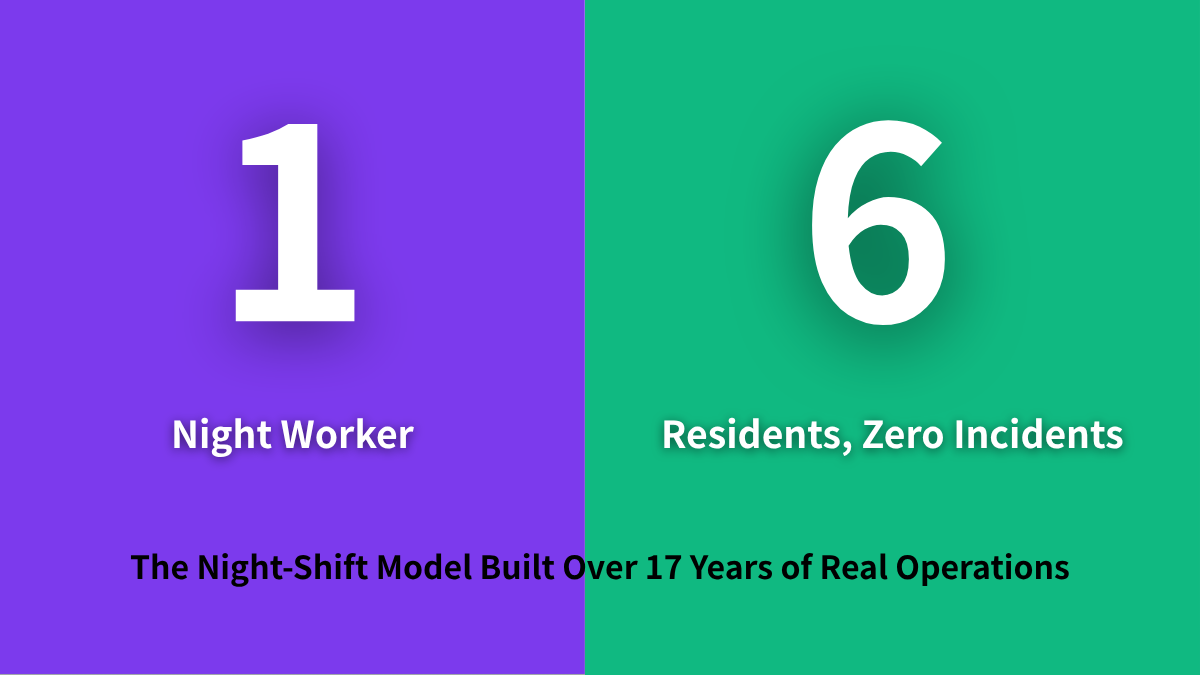
My facility uses one dedicated night-shift worker. The shift runs from 9:00 PM to 8:30 AM—a total of 11.5 hours.
The system is designed around a critical distinction: on-site hours versus active working hours.
The worker is present on-site for the full 11.5 hours (providing safety monitoring and immediate response capability). But active working time—the periods requiring constant attention and activity—is significantly less, with structured rest periods built strategically throughout the night.
The key principle: define exactly what must be done and protect the time when nothing needs to happen.
Most facilities fail at this distinction. They staff for constant activity all night. In reality, most of the night is quiet. Protect that quiet. Rest your staff. Then be ready to respond when activity is needed.
A Complete Night-Shift Schedule, Hour by Hour
9:00 PM: Bedtime assistance. Medication confirmation. Room safety check. This is active time.
10:00 PM – 5:00 AM: Scheduled rounds every 2 hours. Call bell response. Rest periods between rounds. This is a mix of structured monitoring and rest.
5:00 – 7:00 AM: Wake-up assistance. Toileting support. This is active time.
7:00 – 8:30 AM: Breakfast preparation support. Shift handover notes. This is active time.
8:30 AM: Handoff to day shift.
What this schedule accomplishes:
Active working periods (bedtime, rounds, wake-up, breakfast) total approximately 6–7 hours. Rest periods total approximately 4–5 hours. The night worker is present all night but not continuously active all night.
This is sustainable. A caregiver can maintain quality care through 6–7 hours of active work if they have built-in rest periods. They cannot maintain quality through 11.5 hours of constant activity.
When a Solo Night Shift Works—and When It Doesn’t
A single night-shift worker is not a universal solution. It works under specific conditions:
4 to 6 residents maximum
Few residents requiring constant supervision or frequent toileting
Low frequency of call bell activations
Simple building layout that allows quick rounds
Mostly independent residents (minimal dementia, mostly stable health)
The moment any of these conditions is violated, a solo night shift stops being cost optimization and becomes a liability.
If you have 8–10 residents, or residents with high supervision needs, or a complex building layout, you need two staff members. The additional cost is not optional—it’s a necessity.
How to Recruit Dedicated Night-Shift Staff (It’s Easier Than You Think)
“Nobody wants to work nights” is a myth that prevents good recruitment.
There is a reliable pool of people who specifically prefer night work:
People who hold daytime jobs and want supplemental income (their second job is your facility’s night shift)
Parents who need to be home during the day for childcare
People who naturally prefer nighttime schedules
Night students who want flexible work
The critical recruitment mistake: listing the position as “day and night shifts.”
The moment you do this, dedicated night-shift candidates stop reading. They’re looking for “night shift only,” and you’ve just signaled that you’ll move them around.
Advertise “Night shift only – dedicated position” and you’ll reach exactly the people who want exactly what you’re offering.
This changes everything about retention. You get people who chose nights, not people forced into nights.
The Emergency Backup System You Must Have in Place
Emergencies that exceed one person’s capacity will happen. This is not a possibility—it’s a certainty in a 17-year operation.
Sudden health changes requiring 911 calls
Falls that need immediate assistance
Multiple residents needing simultaneous attention
Equipment failures requiring immediate response
The solution is the owner’s personal backup commitment.
Throughout my 17 years, I maintained phone availability every night. If the night worker needed help, I was reachable within minutes. Not ideal. But reachable.
Simply communicating this to your night-shift staff transforms their confidence and retention.
Knowing that backup exists—even if rarely used—is the difference between a night worker who stays for years and one who quits after a month from anxiety and fear.
“You’re not truly alone. If something happens that’s bigger than one person, I’m available” changes everything about how a night worker experiences the job.
Night Staffing Is Not a Cost. It’s Insurance.
Many owners think cutting night staffing increases profit. In the short term, they’re technically correct—lower payroll means higher margins.
But a single nighttime incident can destroy years of accumulated profit in an instant:
Reputation damage: Takes years to rebuild if ever
Resident move-outs: Triggered by family distrust and fear
Referral networks: Go silent overnight when word spreads about an incident
Legal liability: Negligence accusations if proper staffing wasn’t in place
Staff morale: Remaining staff lose confidence in the facility’s management
The cost of one properly paid night worker is nothing compared to the cost of one preventable accident.
Think of it as insurance: you’re paying for peace of mind and protection against catastrophic risk.
The Bottom Line: Design for Risk Management, Not Cost Cutting
Night-shift design is not about minimizing cost. It’s about managing risk.
The goal is maximum resident safety with minimum sustainable staffing—and that balance requires deliberate engineering, not guesswork.
The facilities that get night staffing right protect their residents, their reputation, and their profit margin—all at the same time.
They don’t cut corners. They engineer the right solution.
Ready to Design a Night-Shift System That Protects Residents and Preserves Profit?
Get the complete night-shift framework—showing exactly how to staff nights efficiently, design a schedule that maintains quality while preventing burnout, and build a backup system that keeps staff confident and retained.
About the author
Koujirou Nagata
I’m a Japanese care facility operator based in Kobe, Japan. Over 17 years, I built three small-scale residential care homes in the U.S., sold two of them for $2.7M in a 2022 M&A exit, and currently operate a third. My staff turnover has held at roughly 3% — against a U.S. industry average of 34.53% — and the majority of my admissions have come through family referrals rather than paid marketing.
I now help U.S. and ASEAN operators of small-scale residential care homes — board and care homes, adult family homes, and similar facilities — apply the same operating methods to their own launches and expansions. The resources I’ve built reflect what I actually use, not what looks good on paper.
More at smallcarefacility.com
Two ways forward
Take what you need from here.
If you’re starting
The Care Facility Starter Kit
Six free guides I use myself in the operation of small-scale care facilities — financial planning, property evaluation, the first 90 seconds of family tours, and referral partner outreach. The materials I share with operators who reach out to me directly.
6 PDFs · Pay what you want · Instant download
If you’re past the basics
Complete USA + ASEAN Care Business Bundle
Six in-depth operator guides covering USA market entry, state selection across 9 states, the full financial model, staff hiring & retention, and ASEAN market entry — plus 16 working Excel templates I use myself: hiring scorecard, financial simulator, 1-on-1 tracker, retention analytics, and more.
View the Complete Bundle — $167
6 guides + 16 Excel templates · One-time purchase · Instant download
Koujirou Nagata · 17 years operating small-scale care facilities · 3 facilities built · $2.7M M&A exit · Currently operating
Join Care Operators Managing Nighttime Risk Without Destroying Margins
Koujirou Nagata
17 years operating small-scale care facilities · 3 facilities built · $2.7M M&A exit · Currently operating