“It’ll Work Out” Is the Most Expensive Sentence in Care Facility Business
The most common failure pattern in care facility startups is not bad location, bad staff, or even bad care quality. It’s launching with a vague assumption that “once residents come, we’ll be fine.”
The reality is brutally different.
No facility fills up immediately. Residents come one by one. Two residents the first month. Maybe three or four the second. Meanwhile, your fixed costs don’t wait for anything:
Rent is due on day one
Staff salaries are due on day one
Utilities, insurance, and lease payments are due on day one
Among all the facilities I’ve seen fail, the common thread is identical: the owner never calculated how many months of losses they would need to survive before reaching profitability.
They run out of cash and realize, “If we’d had just one more month, we would have made it.”
By then, it’s over.
How to Build a Financial Simulation in 30 Minutes
A complete financial model for a care facility doesn’t require advanced accounting knowledge or complex spreadsheet skills. Three simple calculations reveal everything you need to know.
Step 1: Calculate Your Monthly Fixed Costs
These are the expenses that hit your bank account every single month regardless of how many residents you have.
Rent or mortgage payment
Staff salaries (all positions)
Utilities (electricity, water, gas, internet)
Insurance (liability, property, workers’ compensation)
Equipment leases
Maintenance and cleaning supplies
At my facility, this number was approximately ¥1,500,000 per month.
This is your “burn rate”—the amount of money that disappears from your bank account every month no matter what happens. If you have zero residents, you’re still losing ¥1.5M. If you have six residents, you’re still losing the same ¥1.5M in fixed costs (though hopefully making enough profit from residents to cover it).
Know this number before you sign any lease. Before you hire any staff. Before you open any bank account.
Step 2: Calculate Your Gross Profit Per Resident
Not revenue. Profit. This distinction is absolutely critical.
In my case:
Monthly revenue per resident: ¥300,000–350,000
Variable costs per resident: ¥50,000 (food, supplies, resident-specific expenses)
Gross profit per resident: ¥250,000–300,000
Why this matters: Every new resident you admit adds approximately ¥250,000–300,000 to your bottom line. This is your fundamental building block. This is what pays your fixed costs. This is what generates profit.
If your gross profit per resident is lower than this, your economics don’t work. Period. No amount of operational excellence can fix fundamentally broken unit economics.
Step 3: Find Your Break-Even Point
Break-even is simple math:
Fixed costs (¥1,500,000) ÷ Gross profit per resident (¥250,000–300,000) = 5 to 6 residents
For a 6-bed facility, this means you need to be nearly full just to break even. The margin for error is razor thin.
The purpose of this calculation is not to feel confident. It’s to understand exactly how little room you have—so you plan accordingly.
If your break-even is 5.5 residents, you don’t get to celebrate when you reach 6. You understand that you’re just barely profitable and that losing one resident is a crisis.
Predicting Exactly Which Month You’ll Turn Profitable
Based on my actual experience across three facility openings, the typical admission fill rate looks like this:
Month Expected Residents Cumulative Residents Monthly Profit/Loss Cumulative Profit/Loss
Month 1 2 residents 2 -¥1,000,000 -¥1,000,000
Month 2 2–3 residents 4–5 -¥500,000 -¥1,500,000
Month 3 1–2 residents 5–6 -¥250,000 to +¥250,000 -¥1,750,000 to -¥1,250,000
This looks manageable. But here’s where most owners get blindsided:
If month 2 stays at 2 residents instead of reaching 3–4, your accumulated deficit nearly doubles.
One slow month doesn’t just delay profitability—it accelerates your cash drain exponentially. Suddenly you’re not running out of money in month 4. You’re running out in month 3.
This is why the financial simulation must include worst-case scenarios, not just the happy path.
Why Operating Reserves Are a Life-or-Death Decision
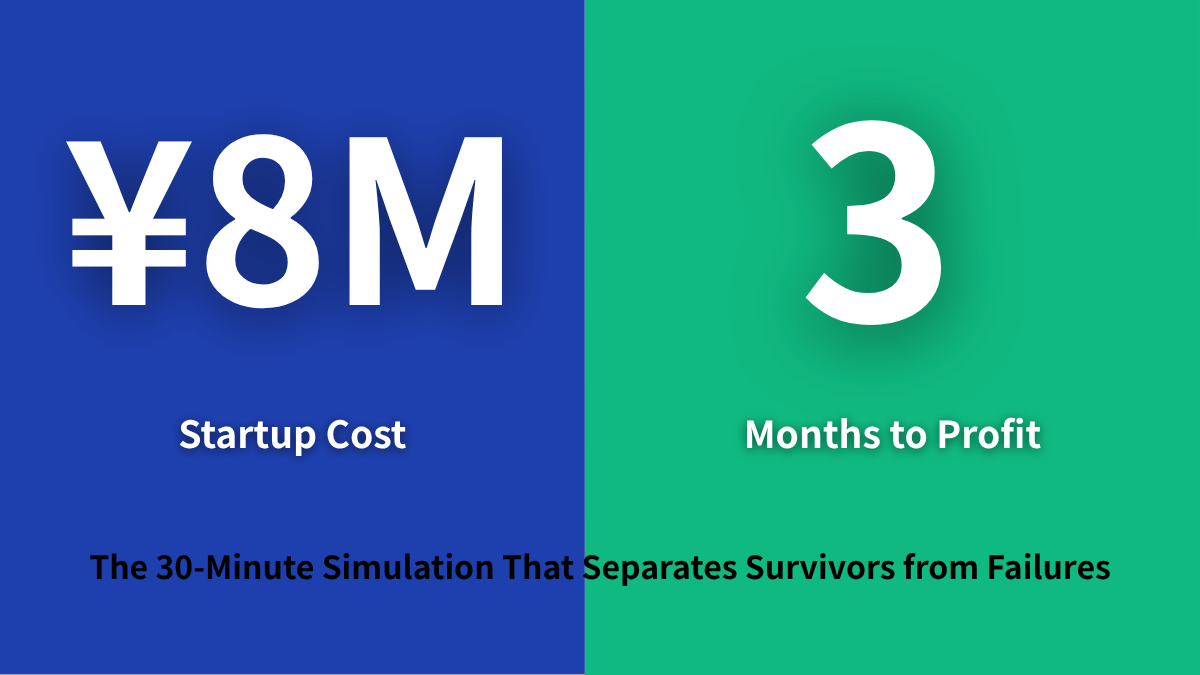
When I launched my facility with ¥8,000,000 in startup capital, I allocated ¥2,200,000 specifically as operating reserves. That was enough to survive three months of losses.
At ¥1.5M in monthly burn rate, three months of reserves covered:
Month 1 loss: ¥1.0M
Month 2 loss: ¥500K
Month 3 loss: approaching break-even
If I hadn’t set that money aside, there is a real chance I would have run out of cash before reaching profitability. Three months sounds like a long time. But in reality, it’s the difference between survival and closure.
The rule is simple: budget for three months of operating expenses as reserves. Not as a “nice to have.” As a non-negotiable requirement.
Without this buffer, you’re one slow month away from a desperate decision that destroys your business.
What Happens to Facilities That Skip the Simulation
The pattern is always the same and always predictable:
Residents come in slower than expected. Admissions that the owner projected for month 2 don’t arrive until month 3.
Cash drains faster than expected. The actual burn rate exceeds the projection because of unexpected costs.
Panic sets in. The owner realizes they’re running out of money faster than they calculated.
Fatal mistakes begin. To attract residents faster, the owner cuts prices—destroying margins. To cut costs, the owner reduces staff or quality—destroying service. Staff sense the desperation and start looking for other jobs. Turnover spikes. Care quality collapses. Remaining families lose trust and move their parents out.
The spiral becomes irreversible. By the time the owner realizes what’s happening, it’s too late. They’re in survival mode, making bad decisions daily.
And it all started because they never spent 30 minutes with a spreadsheet to predict the actual path to profitability.
The Bottom Line: Engineering Your Path to Profitability
A financial simulation takes 30 minutes to build. Skipping it can cost you millions of yen and your entire business.
Care facility management is not intuition. It’s engineering.
The facilities that reach profitability are the ones that designed their path to profitability before they ever opened their doors.
Profitable facilities don’t get lucky. They get built—on paper, before the first resident ever moves in.
Ready to Build a Financial Simulation That Predicts Your Profitability Path?
Get the complete financial modeling framework—showing exactly how to calculate fixed costs, gross profit per resident, break-even point, and the month-by-month path to profitability so you know exactly how long you can survive before turning profitable.
About the author
Koujirou Nagata
I’m a Japanese care facility operator based in Kobe, Japan. Over 17 years, I built three small-scale residential care homes in the U.S., sold two of them for $2.7M in a 2022 M&A exit, and currently operate a third. My staff turnover has held at roughly 3% — against a U.S. industry average of 34.53% — and the majority of my admissions have come through family referrals rather than paid marketing.
I now help U.S. and ASEAN operators of small-scale residential care homes — board and care homes, adult family homes, and similar facilities — apply the same operating methods to their own launches and expansions. The resources I’ve built reflect what I actually use, not what looks good on paper.
More at smallcarefacility.com
Two ways forward
Take what you need from here.
If you’re starting
The Care Facility Starter Kit
Six free guides I use myself in the operation of small-scale care facilities — financial planning, property evaluation, the first 90 seconds of family tours, and referral partner outreach. The materials I share with operators who reach out to me directly.
6 PDFs · Pay what you want · Instant download
If you’re past the basics
Complete USA + ASEAN Care Business Bundle
Six in-depth operator guides covering USA market entry, state selection across 9 states, the full financial model, staff hiring & retention, and ASEAN market entry — plus 16 working Excel templates I use myself: hiring scorecard, financial simulator, 1-on-1 tracker, retention analytics, and more.
View the Complete Bundle — $167
6 guides + 16 Excel templates · One-time purchase · Instant download
Koujirou Nagata · 17 years operating small-scale care facilities · 3 facilities built · $2.7M M&A exit · Currently operating
Join Entrepreneurs Engineering Their Path to Profitability Before Opening
Koujirou Nagata
17 years operating small-scale care facilities · 3 facilities built · $2.7M M&A exit · Currently operating