Why Silence Is the Most Dangerous Thing in Care Facility Operations
Most care facilities operate on a reactive communication model: you only contact families when something goes wrong.
The result is predictable and devastating:
Every time a family sees the facility’s number on their phone, their stomach drops. “A call from the facility” becomes synonymous with “bad news.” Families develop anxiety. They start assuming the worst. They begin considering moving their parent to another facility.
I learned this lesson the hard way years ago. A family once told me directly: “We haven’t heard anything from your facility in three months. We have no idea how our parent is doing. We’re considering moving them out.”
The resident was perfectly fine. Stable health. Happy. Well cared for. Content in daily activities. But the family didn’t know any of that, because we had never told them.
Families don’t make decisions based on facts. They make decisions based on perception. And perception is something you can control.
Silence doesn’t mean “everything is fine” to families. Silence means “nobody is paying attention. Nobody cares enough to update us. Something is probably wrong.”
The Monthly Report: A Trust-Building Machine
A monthly family report is not a clinical document. It’s not a medical update form. It’s a system for delivering reassurance on a predictable, consistent schedule.
When you consistently share good news and positive observations:
Families stop assuming the worst
Anxiety drops dramatically
Trust builds visibly
When difficult news eventually arrives—and it will—the family receives it calmly
Without regular positive updates: Every problem feels like evidence of neglect. Families assume you’ve been hiding issues. They lose confidence. They move their parent.
With regular positive updates: Problems feel like honest communication from a trusted partner. Families understand that you care. They’re prepared to handle difficulties because you’ve demonstrated consistent engagement.
The difference between move-out and loyalty is often nothing more than consistent communication.
The 5 Items Every Monthly Report Must Include
1. Health Summary (1-2 sentences)
“Your mother’s appetite has been stable, and she’s finishing every meal. She’s been sleeping well and has good energy during the day.”
Key principle: No medical jargon. No clinical language. One or two sentences that a family member can read and instantly understand. The goal is clarity and reassurance, not clinical precision.
The family’s deepest anxiety is: “Is my parent being properly cared for?” Answer that question simply and directly.
2. Daily Life Snapshot (1 sentence)
“She’s been enjoying conversations with other residents during afternoon tea time. She laughed quite a bit yesterday when they were telling stories.”
Key principle: Paint a picture. Families want to visualize their parent’s day. What does their loved one do? What makes them smile? What brings them joy?
Give families something to see. Something to imagine. This is what makes the report feel real rather than formulaic.
3. Meals (1 sentence)
“His favorite this month was the beef stew. He asked for seconds twice.”
Key principle: This may seem trivial, but “Is my parent eating properly?” is the number one concern families carry silently. They worry about appetite, nutrition, whether their parent enjoys their meals.
Proactively answer this question before they have to ask. And include something specific and personal—a meal they loved, something they requested, a time they laughed at mealtime.
4. One Photo (visual confirmation)
A single photo of the resident smiling, engaged in activity, or enjoying a meal.
Key principle: One photo multiplies the value of the entire report by ten. No amount of written description can match the reassurance of seeing their parent happy, healthy, and engaged.
A photo says: “Your parent is here. They’re real. They’re smiling. They’re okay.”
Get permission from families first, of course. But virtually every family will welcome a monthly photo of their parent.
5. Next Month’s Plans (1-2 sentences)
“We’re planning a garden outing next month if the weather cooperates. We’re also going to have a birthday celebration for another resident, and your mother will be invited to participate.”
Key principle: Forward-looking information tells the family: “This facility is thinking ahead. They have plans for my parent. They’re engaged in their wellbeing.”
This creates a sense of security and continuity that no amount of reactive communication can match. Families feel like their parent is part of a community, not just a resident in a facility.
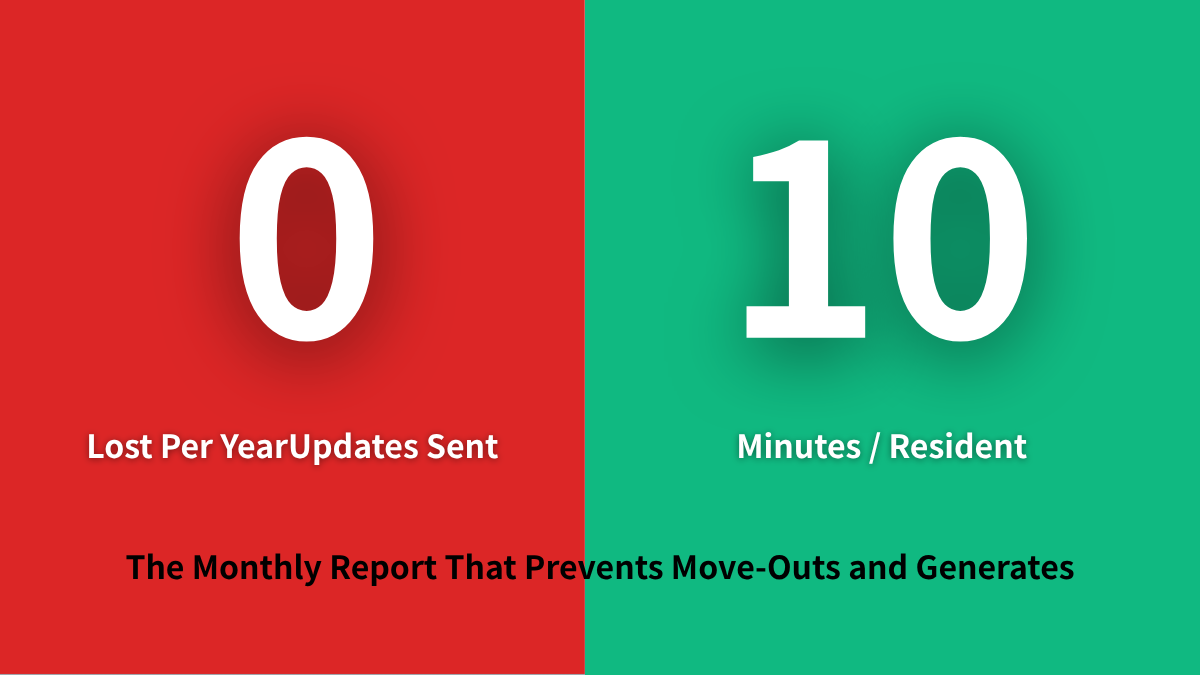
Total Time Investment: 10 Minutes Per Resident Per Month
With a simple template, each monthly report takes approximately 10 minutes to prepare.
For a small facility with 4 to 6 residents, the entire monthly process is completed in under one hour.
For a facility with 10 residents, two hours monthly.
That single hour—or two hours—is not administrative overhead. It’s a system that prevents move-outs, generates referrals, and builds the kind of trust that no marketing campaign can replicate.
There is no other activity in care facility management that delivers this much return on this little time investment.
What Changed After I Introduced Monthly Reports
After implementing monthly family reports across my facilities, the changes were immediate and dramatic:
Complaints dropped significantly. The reason was straightforward: families moved from a state of “not knowing” to a state of “knowing.” Anxiety is caused by missing information. Provide the information, and the anxiety disappears.
Move-out rate decreased. Families who receive consistent positive information don’t think about leaving. They feel connected to the facility. They trust the operation.
Referrals increased noticeably. Families who receive monthly reports don’t just stay. They refer. They tell their friends and other families: “Our parent is in a great place. The facility sends us updates every month. We know exactly how they’re doing.”
Why does this work?
Families don’t just want their parent to be cared for. They want to feel included. They want to feel respected. They want proof that their parent is thriving.
A monthly report delivers all three of these simultaneously.
The Highest-ROI Activity in Care Facility Management
One hour per month. In return, you:
Prevent move-outs (saves tens of thousands in occupancy loss)
Reduce complaints and stress (frees your time and mental energy)
Generate referrals (brings new residents without marketing cost)
Build genuine trust (creates stability for the long term)
There is no other activity in care facility operations that delivers this much return on this little investment.
Not renovations. Not equipment upgrades. Not marketing campaigns. One hour per month, and your entire occupancy and reputation improve.
The Bottom Line: Communication Determines Reputation
The value of a care facility is not determined by care quality alone. Many facilities provide excellent care but fail because families don’t know about it.
The value of a care facility is determined by how well you communicate that quality to families.
A monthly report is the simplest, most effective way to close the gap between what you actually do and what families believe you do. Start this month.
Ready to Build Family Trust and Prevent Move-Outs With Monthly Reports?
Get the complete monthly family report framework—showing exactly which five elements to include, how to write them in 10 minutes per resident, and how this single system generates referrals and eliminates anxiety.
About the author
Koujirou Nagata
I’m a Japanese care facility operator based in Kobe, Japan. Over 17 years, I built three small-scale residential care homes in the U.S., sold two of them for $2.7M in a 2022 M&A exit, and currently operate a third. My staff turnover has held at roughly 3% — against a U.S. industry average of 34.53% — and the majority of my admissions have come through family referrals rather than paid marketing.
I now help U.S. and ASEAN operators of small-scale residential care homes — board and care homes, adult family homes, and similar facilities — apply the same operating methods to their own launches and expansions. The resources I’ve built reflect what I actually use, not what looks good on paper.
More at smallcarefacility.com
Two ways forward
Take what you need from here.
If you’re starting
The Care Facility Starter Kit
Six free guides I use myself in the operation of small-scale care facilities — financial planning, property evaluation, the first 90 seconds of family tours, and referral partner outreach. The materials I share with operators who reach out to me directly.
6 PDFs · Pay what you want · Instant download
If you’re past the basics
Complete USA + ASEAN Care Business Bundle
Six in-depth operator guides covering USA market entry, state selection across 9 states, the full financial model, staff hiring & retention, and ASEAN market entry — plus 16 working Excel templates I use myself: hiring scorecard, financial simulator, 1-on-1 tracker, retention analytics, and more.
View the Complete Bundle — $167
6 guides + 16 Excel templates · One-time purchase · Instant download
Koujirou Nagata · 17 years operating small-scale care facilities · 3 facilities built · $2.7M M&A exit · Currently operating
Join Care Operators Building Trust Through Consistent Family Communication
Koujirou Nagata
17 years operating small-scale care facilities · 3 facilities built · $2.7M M&A exit · Currently operating