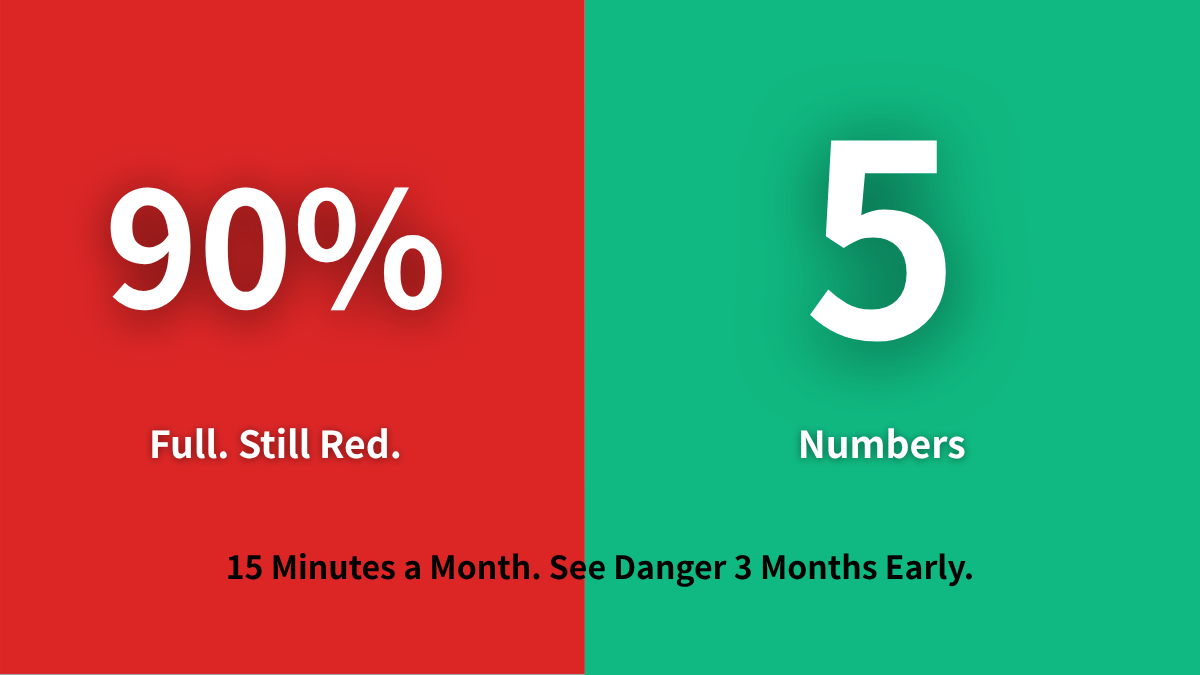
How a Facility Can Be 90% Full and Still Hemorrhaging Cash
Care facilities at 90% occupancy that are losing money actually exist. I’ve seen them. And it happens more often than most operators realize.
The reason is always the same: the operator watches revenue but ignores profit. They see “all beds full” and assume the business is healthy. They never look deeper.
What makes it worse is how late most operators realize the problem. The bank balance is shrinking. Payments are getting tight. Payroll is becoming difficult to meet. And by the time they notice, it’s already a crisis.
Management isn’t about reacting to results. It’s about reading the signals before the results arrive. That’s what these five numbers give you.
Fifteen minutes at month-end. Five numbers. And you’ll see danger three months before it hits.
The Five Metrics That Matter
Metric 1: Labor Cost Ratio
What it is: (Total monthly payroll) ÷ (Total monthly revenue) × 100
Target: Under 60% of revenue. My facilities consistently run at 55–58%.
Why it matters: Labor is typically your largest expense. When this ratio creeps above 65%, your entire profit margin collapses. The difference between 55% and 70% is bankruptcy.
What causes it to spike: Reactive hiring is the most common mistake. “We’re short-staffed, so let’s add someone.” “Shifts are tough, so let’s add hours.” Repeat this cycle a few times and your payroll has quietly ballooned out of control. You wake up one day realizing you have too many people for your revenue level.
How to fix it: The key isn’t headcount—it’s deployment efficiency. Whether you can design a four-person team that runs the entire operation smoothly is the dividing line between profitable and unprofitable facilities. Don’t hire your way out of operational problems. Reorganize your way out.
Metric 2: Occupancy Rate
What it is: (Current residents) ÷ (Total capacity) × 100
Target: Above 90%. If it drops below 85%, take immediate action.
Why it matters: This isn’t just a revenue metric—it’s a diagnostic alarm. When occupancy drops, only two things can be causing it: referrals are declining, or move-outs are increasing. One is a sales problem. The other is a service problem.
The critical insight: If you don’t diagnose which one is causing the drop, you’ll drift in a vague sense of “things aren’t going well” without ever fixing the root cause. You’ll make random changes hoping something sticks.
How to respond: When occupancy drops below 85%, immediately investigate: Are referral sources still sending families? Or are residents staying shorter durations before moving out? This distinction determines your response entirely.
Metric 3: Food Cost Ratio
What it is: (Total monthly food costs) ÷ (Total monthly revenue) × 100
Target: 10–15% of revenue.
Why it matters: This is where profit silently disappears without anyone noticing. Over-ordering, food waste, inefficient purchasing, lack of menu planning—these can drain tens of thousands of yen every month.
The danger: Unlike labor costs, which show up obviously in payroll, food waste is invisible. You buy too much. Some goes bad. You throw it out. No one notices. Until your monthly financials show you’re bleeding money and you can’t figure out why.
How to control it: Plan menus one week in advance and bulk-purchase accordingly. This single habit nearly eliminates food waste. No random purchasing. No over-ordering. Just predictable, planned, efficient purchasing.
Metric 4: Fixed Cost Total
What it is: Rent + insurance + utilities + lease payments + all recurring monthly expenses
Target: Monthly variation under 5%.
Why it matters: Fixed costs should be stable month to month. If they fluctuate more than 5%, something is wrong.
What causes variation: Unnecessary contracts you’re not reviewing. Expenses that are creeping in without being noticed. Utility overages from inefficiency. Unexpected maintenance costs that should have been preventable.
How to fix it: Fixed costs aren’t about cutting—they’re about keeping them from moving. Review every fixed cost line item quarterly. Are we still using that subscription? Can we renegotiate that contract? Is the insurance policy still optimal? Small changes in fixed costs compound significantly over time.
Metric 5: Cash Flow — The Most Important Number of All
What it is: Actual cash in your bank account, not accounting profit
Target: Always maintain three months of operating expenses in cash reserve.
Why it matters: This is the metric that determines whether your facility survives a crisis.
What can happen: Sudden resident move-outs happen. Equipment breaks unexpectedly. Staff emergencies arise. A family withholds payment during a dispute. These aren’t possibilities—they’re certainties in a 17-year operational timeline.
With three months of cash reserves: You respond to crises calmly. You make sound decisions. You can handle setbacks without panic.
Without them: Every decision becomes defensive, desperate, and usually wrong. You’re forced into bad choices. You cut corners. You accept lower-quality residents just to fill beds. You make mistakes you’ll regret.
The Critical Distinction: Accounting Profit vs Actual Cash
This is the distinction that kills most care facilities.
Your accounting statement can show strong profit. Your spreadsheet shows you made ¥2 million this month. And yet your bank balance is shrinking.
This happens because accounting profit and actual cash in your bank account are two different things.
You might have outstanding receivables (families who owe you money but haven’t paid yet). You might have timing issues where expenses came due but revenue hasn’t arrived. You might have invested in equipment or renovations that show as expense but are actually long-term assets.
Operators who don’t understand this distinction will hit a wall eventually—guaranteed.
This is why cash flow is your most important metric. Not profit. Not revenue. Cash. Actual money in your bank account that you can use to pay bills and meet payroll.
The 15-Minute Monthly Management Ritual
On the last day of every month, spend fifteen minutes reviewing these five numbers:
Metric Target Action if Outside Target Time to Calculate
Labor Cost Ratio Under 60% Review staffing deployment. Reassign duties. Never hire first. 3 minutes
Occupancy Rate Above 90% If below 85%, diagnose: referral problem or service problem? Respond accordingly. 2 minutes
Food Cost Ratio 10–15% If above 15%, review menu planning and purchasing procedures. 3 minutes
Fixed Cost Total Under 5% monthly variation If varying more, audit contracts and subscriptions. What’s moving? 4 minutes
Cash Flow 3 months of operating expenses If below target, reduce discretionary spending immediately. 3 minutes
Fifteen minutes. Once a month. And you’ll see danger three months before it arrives.
Operators who only watch revenue discover problems when it’s too late. By the time they realize something is wrong, the crisis is already acute.
Operators who watch these five numbers are always one step ahead. They see the warning signs early. They adjust before it becomes critical.
The Bottom Line: Prevention vs Reaction
Management is not about responding to problems after they happen. It’s about preventing them before they start.
These five metrics are your early warning system. They show you the direction you’re moving—toward health or toward crisis—before the destination is obvious.
Review them monthly. Take action immediately when they drift out of target. And you’ll never be surprised by a financial crisis.
Ready to Master Financial Management in 15 Minutes a Month?
Get the complete five-metric framework—showing exactly which financial indicators predict success or bankruptcy three months in advance, and how to use them for early warning detection.
About the author
Koujirou Nagata
I’m a Japanese care facility operator based in Kobe, Japan. Over 17 years, I built three small-scale residential care homes in the U.S., sold two of them for $2.7M in a 2022 M&A exit, and currently operate a third. My staff turnover has held at roughly 3% — against a U.S. industry average of 34.53% — and the majority of my admissions have come through family referrals rather than paid marketing.
I now help U.S. and ASEAN operators of small-scale residential care homes — board and care homes, adult family homes, and similar facilities — apply the same operating methods to their own launches and expansions. The resources I’ve built reflect what I actually use, not what looks good on paper.
More at smallcarefacility.com
Two ways forward
Take what you need from here.
If you’re starting
The Care Facility Starter Kit
Six free guides I use myself in the operation of small-scale care facilities — financial planning, property evaluation, the first 90 seconds of family tours, and referral partner outreach. The materials I share with operators who reach out to me directly.
6 PDFs · Pay what you want · Instant download
If you’re past the basics
Complete USA + ASEAN Care Business Bundle
Six in-depth operator guides covering USA market entry, state selection across 9 states, the full financial model, staff hiring & retention, and ASEAN market entry — plus 16 working Excel templates I use myself: hiring scorecard, financial simulator, 1-on-1 tracker, retention analytics, and more.
View the Complete Bundle — $167
6 guides + 16 Excel templates · One-time purchase · Instant download
Koujirou Nagata · 17 years operating small-scale care facilities · 3 facilities built · $2.7M M&A exit · Currently operating
Join Entrepreneurs Managing Care Facilities With Financial Precision
Koujirou Nagata
17 years operating small-scale care facilities · 3 facilities built · $2.7M M&A exit · Currently operating